Home › FAQ Hub › Why is data quality a persistent weakness in financial institutions?
AI, Data & AnalyticsWhy is data quality a persistent weakness in financial institutions?
Data quality is a persistent weakness in financial institutions because their data has been shaped by decades of mergers, fragmented core systems, manual workarounds and inconsistent definitions.
Financial institutions are, in a sense, data businesses: they hold information about money, risk and customers, and they are regulated largely on the basis of the data they report. Yet many still struggle to produce a single, reliable figure for something as basic as total exposure to a client.
Data quality is a persistent weakness in financial institutions because their data has been shaped by decades of mergers, fragmented core systems, manual workarounds and inconsistent definitions. Historical acquisitions leave multiple platforms holding overlapping customer and product records; legacy architectures make standardisation difficult; spreadsheet-based processes fill gaps between systems; and different departments define the same term in different ways. The result is inconsistent and duplicated data that undermines risk reporting, analytics, AI and customer experience. Fintechs, without this historical debt, often deploy cleaner architectures and integrate AI faster. For incumbents, improving data quality is less a technology project than a long-term governance discipline.
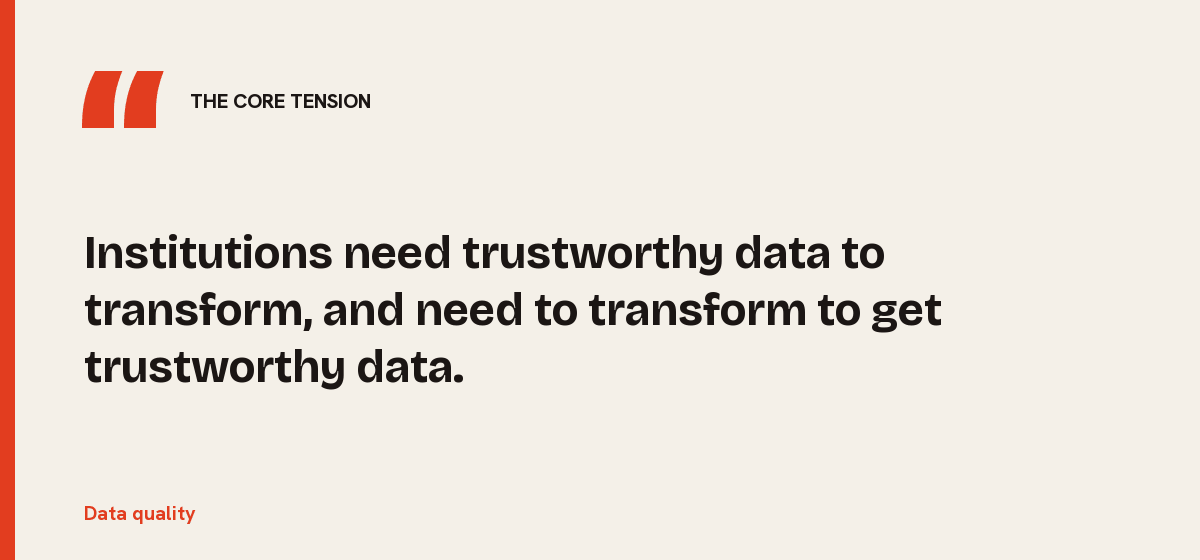
The core tension, in one line:
Institutions need trustworthy data to transform, and need to transform to get trustworthy data.
a bank wants to launch personalised offers in its app. It discovers that a significant share of customers appear more than once across its systems, with different addresses and product holdings. Before personalisation can work, it must match and clean records, agree a single customer definition and fix the processes that created the duplicates.
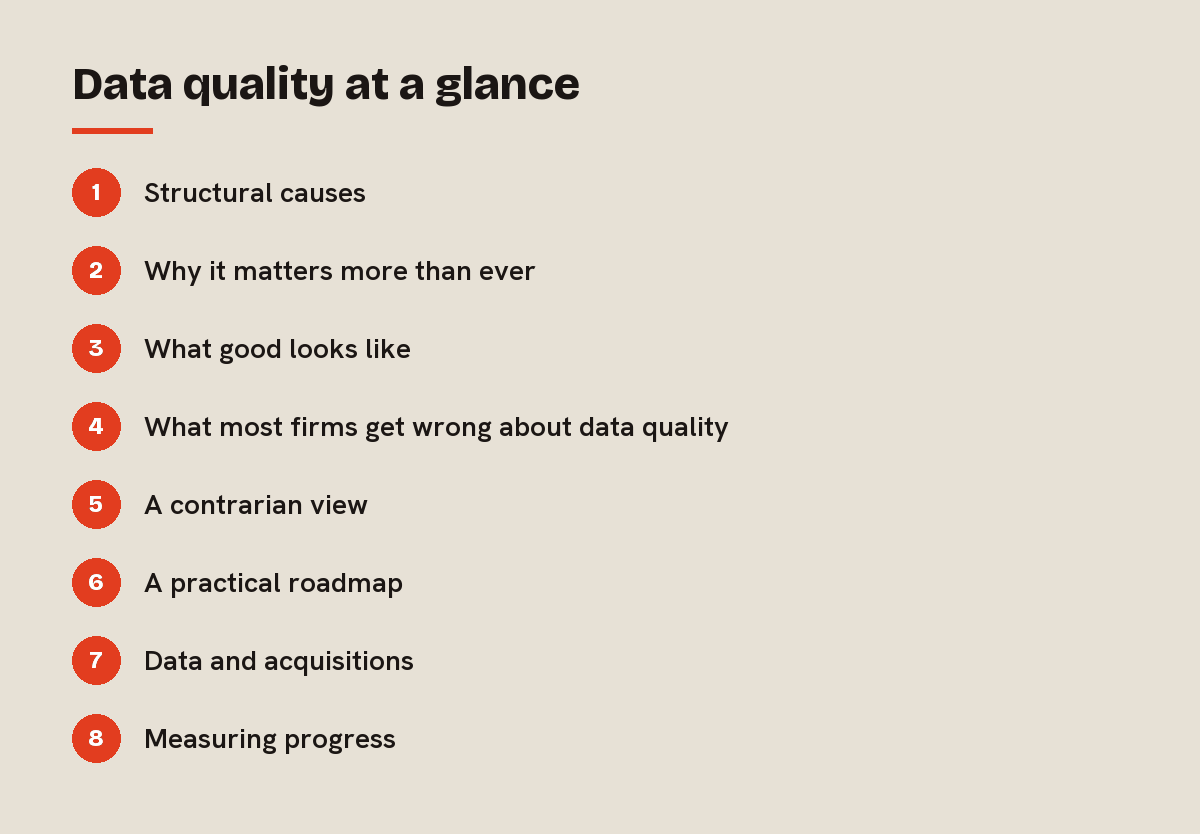
1. Structural causes
| Cause | What it looks like on the ground | Why it persists |
|---|---|---|
| Multiple core platforms | Separate systems for products, regions or legacy brands | Replacing them is costly and risky |
| Mergers and acquisitions | Acquired businesses keep their own systems and definitions | Integration is often left incomplete |
| Spreadsheet workarounds | Manual files bridging gaps between systems | They are quick to create and hard to remove |
| Inconsistent definitions | “Customer”, “exposure” or “default” defined differently by function | No single owner of definitions |
| Unclear ownership | Data treated as an IT asset rather than a business responsibility | Problems are fixed downstream, not at source |
2. Why it matters more than ever
- Risk and regulatory reporting: supervisors expect accurate, complete and timely risk data.
- AI and analytics: models trained on poor data produce poor decisions.
- Customer experience: duplicate or inconsistent records lead to errors customers notice.
- Cost: manual reconciliation and correction consume large amounts of time.
The supervisory message is clear. The ECB reported in 2025 that the number of institutions without fully adequate risk data aggregation and reporting capabilities is still too high, with significant gaps against its May 2024 guide, which uses the Basel Committee’s principles for effective risk data aggregation and risk reporting as its benchmark.
3. What good looks like
| Practice | What it looks like on the ground |
|---|---|
| Clear ownership | Named business owners for key data domains, accountable for data quality |
| Common definitions | A shared glossary for critical terms, used across functions |
| Quality at source | Validation when data is captured, not only when reported |
| Automated checks | Continuous monitoring of completeness, accuracy and timeliness |
| Single data platform | A governed platform for analytics and reporting, fed by core systems |
The ECB’s 2024 review of digitalisation practices highlights a unified governance structure, a single data lake and automated data quality checks as sound practices.
4. What most firms get wrong about data quality
- Treating it as a one-off clean-up: data degrades again unless the processes that create it change.
- Starting with technology: a new data platform does not fix poor definitions or ownership.
- Fixing downstream: correcting data in reports rather than at source hides problems instead of solving them.
- Lacking business accountability: when data belongs to IT, business teams do not prioritise fixing it.
Example: an insurer struggled to report consistent policy counts because three systems defined “active policy” differently. It appointed a business owner for policy data, agreed one definition, added validation rules at the point of entry and set up automated monitoring. Within a year, reconciliation effort fell sharply and reporting disputes largely disappeared.
5. A contrarian view
The topic is often treated as a hygiene issue for back-office teams. In reality, it is a strategic constraint: it decides how quickly an institution can launch personalised services, adopt AI, meet regulatory demands and integrate acquisitions. Treating it as strategic changes who owns it and how it is funded.
6. A practical roadmap
- Prioritise critical data for risk, regulatory reporting and key customer journeys.
- Assign business owners with clear accountability.
- Agree definitions for the most important terms.
- Fix at source, with validation in capture processes.
- Automate monitoring and report quality metrics to senior management.
- Retire spreadsheets progressively as systems improve.
7. Data and acquisitions
Mergers are one of the most common sources of lasting data quality problems. Integration plans tend to prioritise customer-facing continuity and cost savings, leaving data harmonisation for later, and later often never comes. Institutions that make data integration an explicit, funded workstream in every acquisition, with agreed definitions and a timetable for retiring duplicate systems, avoid adding another layer of inconsistency each time they grow.
8. Measuring progress
Simple measures make the problem visible: the share of critical data elements with an owner and definition, error rates found by automated checks, time spent on manual reconciliation, and the number of reporting adjustments needed each period. Reported regularly to the executive committee, these indicators turn an abstract problem into a managed one.
Key takeaways on data quality
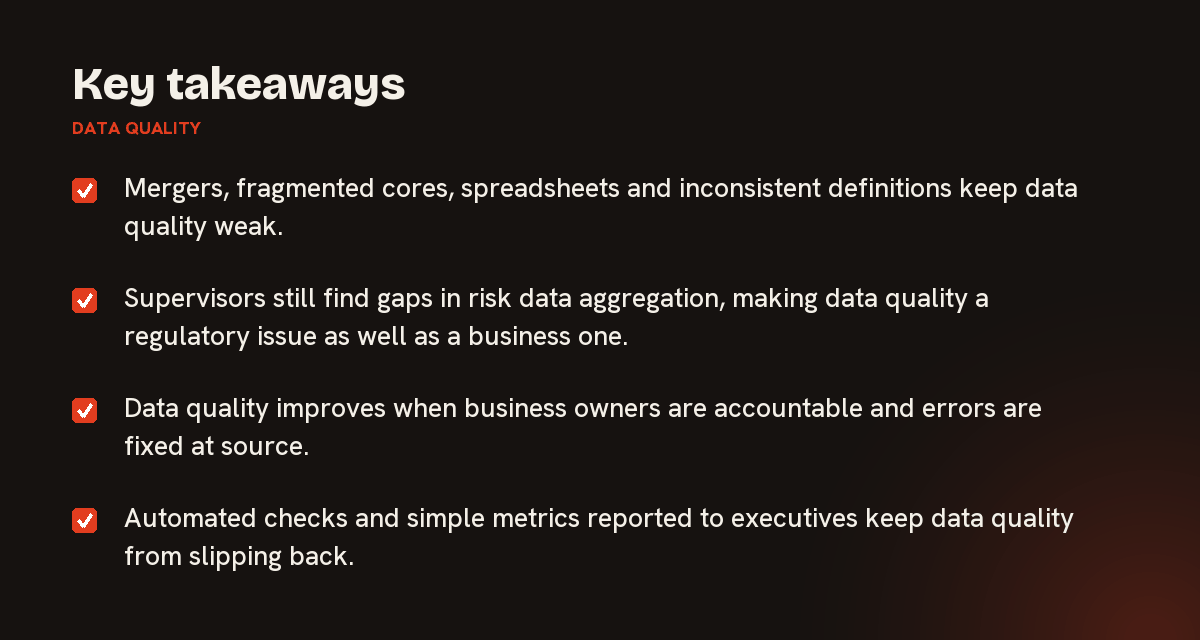
- Mergers, fragmented cores, spreadsheets and inconsistent definitions keep data quality weak.
- Supervisors still find gaps in risk data aggregation, making data quality a regulatory issue as well as a business one.
- Data quality improves when business owners are accountable and errors are fixed at source.
- Automated checks and simple metrics reported to executives keep data quality from slipping back.
For leadership teams, improving data quality is a prerequisite for almost every transformation goal, from AI to personalisation to regulatory confidence. It rarely produces headlines, but it determines whether the initiatives that do will succeed.
Optimizium helps banks, insurers and wealth managers build data governance that lasts. We respect the institutional knowledge embedded in existing systems and reports, because it explains why data looks the way it does. And we bring risk, finance and compliance colleagues into the design as co-authors, so better data serves both the business and its supervisors.
Explore how we approach this across Banking, Insurance, Wealth Management and Beyond Banking, browse the FAQ Hub, or read the related question: What distinguishes rules-based from algorithmic personalization?
Related questions
Partner with the experts.
Let's discuss how Optimizium can accelerate your roadmap and navigate complex digital transformation.
Schedule a consultation →