Home › FAQ Hub › How does digital affect customer retention dynamics?
Tech & Core ModernisationHow does digital affect customer retention dynamics?
Digital affects customer retention in two directions. It improves retention by reducing friction, enabling proactive communication, personalising service, predicting risk of leaving and creating ecosystem stickiness through connected products and services.
For decades, financial institutions kept customers partly because leaving was hard: paperwork, branch visits, waiting periods. Digital channels are removing much of that friction, which changes why customers stay and why they go.
Digital affects customer retention in two directions. It improves retention by reducing friction, enabling proactive communication, personalising service, predicting risk of leaving and creating ecosystem stickiness through connected products and services. At the same time, it lowers switching barriers, so customers who are dissatisfied can leave far more easily than before.
The dynamics differ by sector. In banking, switching barriers are high but declining as data-sharing initiatives grow. In insurance, renewals drive recurring economics, so each renewal moment matters. In wealth, trust and advisory relationships dominate churn. Fintechs combine low switching costs with high product velocity. In every case, digital customer retention depends more on value and experience than on inertia.
The core tension, in one line:
Digital makes it easier for customers to stay happy and easier for unhappy customers to leave.
a bank’s analytics flag customers whose salary has stopped arriving in their account, an early sign that they may be moving their main banking elsewhere. A timely, helpful contact about their needs, rather than a generic offer, keeps a meaningful share of them as primary customers.
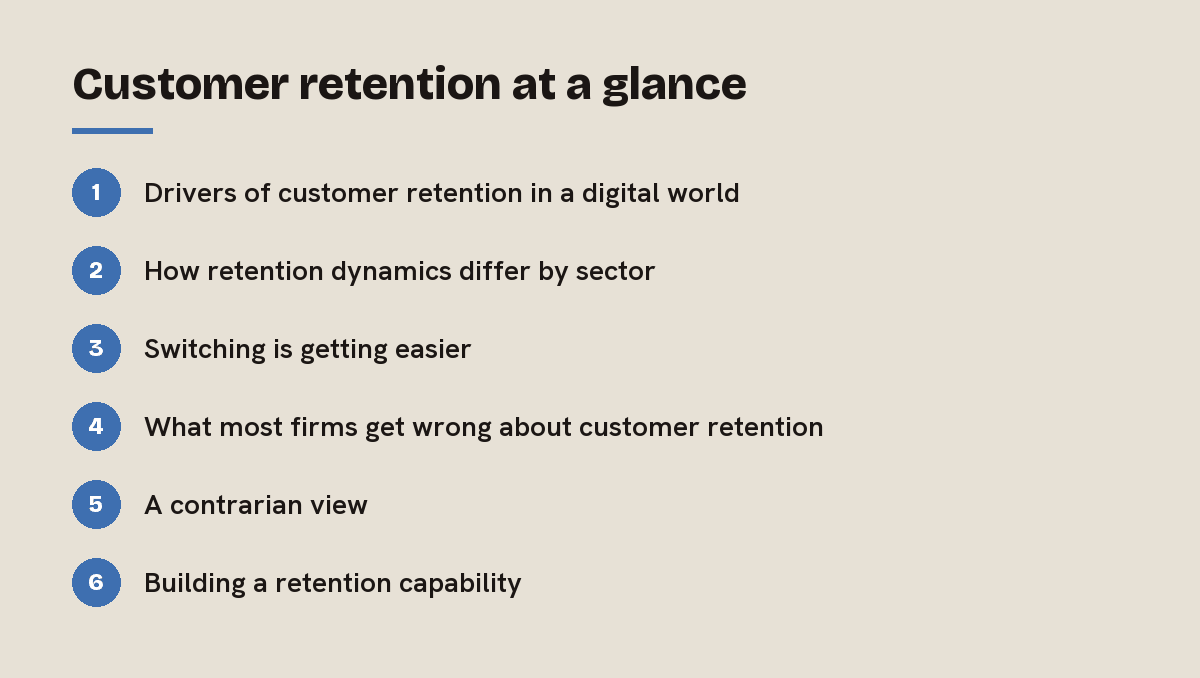
1. Drivers of customer retention in a digital world
| Driver | What it looks like on the ground | Effect |
|---|---|---|
| Friction reduction | Simple servicing, instant changes | Fewer reasons to leave |
| Proactive communication | Reminders, alerts, renewal explanations | Fewer surprises |
| Personalisation | Relevant offers and insights | Higher perceived value |
| Predictive risk modelling | Early signals of leaving | Time to act |
| Ecosystem integration | Connected products and partners | Higher cost of leaving |
2. How retention dynamics differ by sector
- Banking: the primary relationship, where salary arrives, drives value. Data sharing makes it easier for competitors to win parts of the relationship.
- Insurance: renewal is the key moment. Clear explanations of price changes and a good claims history matter most.
- Wealth: trust in advice and performance communication dominate; adviser changes are a common trigger for leaving.
- Fintech: low switching costs mean products must keep earning their place.
| Sector | Main retention moment | Main risk |
|---|---|---|
| Banking | Salary and everyday use | Becoming a secondary account |
| Insurance | Renewal and claim | Price shock or poor claim |
| Wealth | Reviews and market falls | Loss of trust or adviser departure |
| Fintech | Early use | Low engagement after onboarding |
3. Switching is getting easier
Regulation is lowering barriers. The European Commission’s Financial Data Access proposal would let customers share a much wider range of financial data with authorised providers, making comparison and switching simpler. In the UK, the FCA’s Consumer Duty expects firms to enable customers to switch or exit products without unreasonable barriers. Retention strategies that rely on friction are therefore becoming both less effective and riskier.
Digital use is the norm: Eurostat reports that 67 per cent of people aged 16 to 74 in the EU used internet banking in 2024, so the digital experience is now central to customer retention.
4. What most firms get wrong about customer retention
- Relying on inertia: friction-based retention erodes as switching gets easier and draws regulatory attention.
- Rewarding new customers over loyal ones: better prices only for newcomers damage trust and fairness.
- Acting too late: retention offers made after a customer has decided to leave rarely work.
- Ignoring service failures: many departures follow a bad experience, not a better offer elsewhere.
Example: an insurer analysed customers who left at renewal and found that many had experienced a slow or confusing claim in the previous year. Improving claims communication and following up after each claim reduced departures among those customers more than any renewal discount had.
5. A contrarian view
Digital is often seen as a threat to customer retention because it makes leaving easier. It is also the best tool institutions have ever had to understand why customers leave and to act early. Firms that use digital signals to fix problems and add value will retain more customers than those that tried to keep them through friction.
6. Building a retention capability
- Map retention moments for each product and segment.
- Use data to spot early signals of leaving.
- Act with service, not only offers.
- Treat loyal customers fairly on price and benefits.
- Measure retention by cause, not just by rate.
Key takeaways on customer retention
- Digital improves customer retention through lower friction, proactive service, personalisation and ecosystems.
- Easier switching means customer retention now depends on value and experience rather than inertia.
- Each sector has its own customer retention moments: salary, renewal, review or early use.
- Fair treatment of loyal customers protects customer retention and meets rising regulatory expectations.
For leadership teams, customer retention is shifting from a defensive discipline to a test of value. Digital makes it possible to understand and serve customers better than ever, and institutions that use that capability well will keep the customers worth keeping.
Optimizium helps banks, insurers and wealth managers build retention strategies grounded in customer value and fair treatment. We respect the relationship knowledge held by frontline teams, because they hear first why customers leave. And we bring data, risk and compliance colleagues into the design as co-authors, so retention efforts are effective and fair.
Explore how we approach this across Banking, Insurance, Wealth Management and Beyond Banking, browse the FAQ Hub, or read the related question: How does wealth management differ from retail banking in digital strategy?
Partner with the experts.
Let's discuss how Optimizium can accelerate your roadmap and navigate complex digital transformation.
Schedule a consultation →