Home › FAQ Hub › How does digital change risk management?
Tech & Core ModernisationHow does digital change risk management?
Digital changes risk management by making it real-time, data-rich and model-driven. Behavioural analytics improve fraud detection; alternative data improves underwriting and credit scoring; digital onboarding reduces errors in customer due diligence; and in wealth, suitability assessments integrate scenario analysis.
For decades, much of the risk function in financial institutions worked on a monthly or quarterly rhythm: reports compiled from several systems, reviewed by committees, acted upon weeks later. Digital is compressing that rhythm to days, hours and sometimes milliseconds.
Digital changes risk management by making it real-time, data-rich and model-driven. Behavioural analytics improve fraud detection; alternative data improves underwriting and credit scoring; digital onboarding reduces errors in customer due diligence; and in wealth, suitability assessments integrate scenario analysis. At the same time, digital creates new risks and new scrutiny. Supervisors look closely at the explainability of risk models, at the quality of the data behind them and at the operational resilience of cloud infrastructures and third-party providers. The risk categories affected span credit, operational, fraud, market and conduct risk. In short, digital gives the risk function better tools and a larger, faster-moving set of risks to manage.
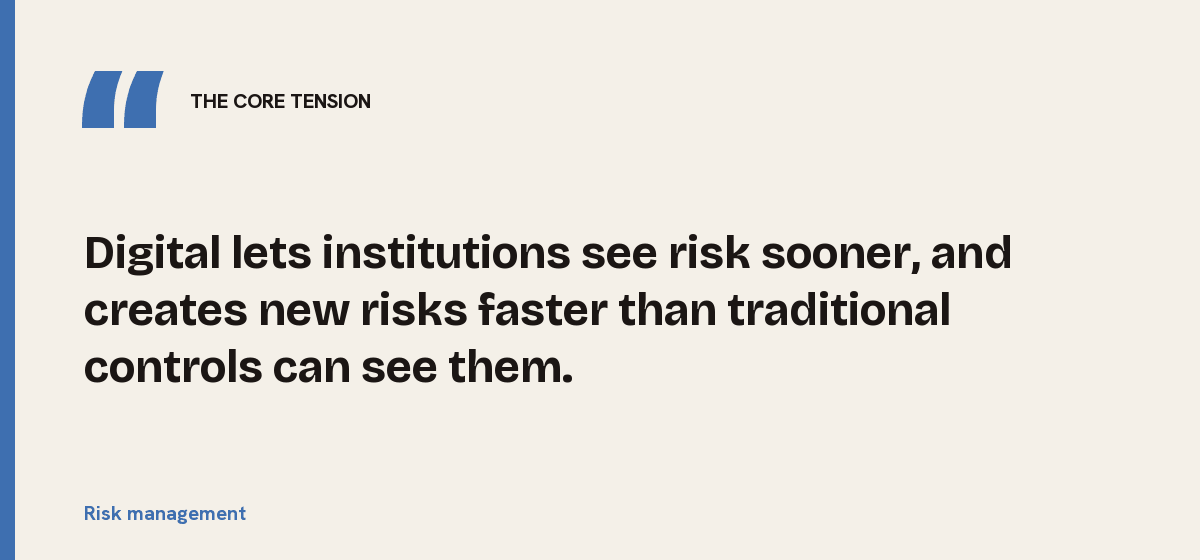
The core tension, in one line:
Digital lets institutions see risk sooner, and creates new risks faster than traditional controls can see them.
a bank moves its credit monitoring from monthly reports to daily signals drawn from transaction data. It spots early signs of financial stress among some small business customers weeks earlier than before and contacts them with restructuring options, reducing losses and helping customers through a difficult period.
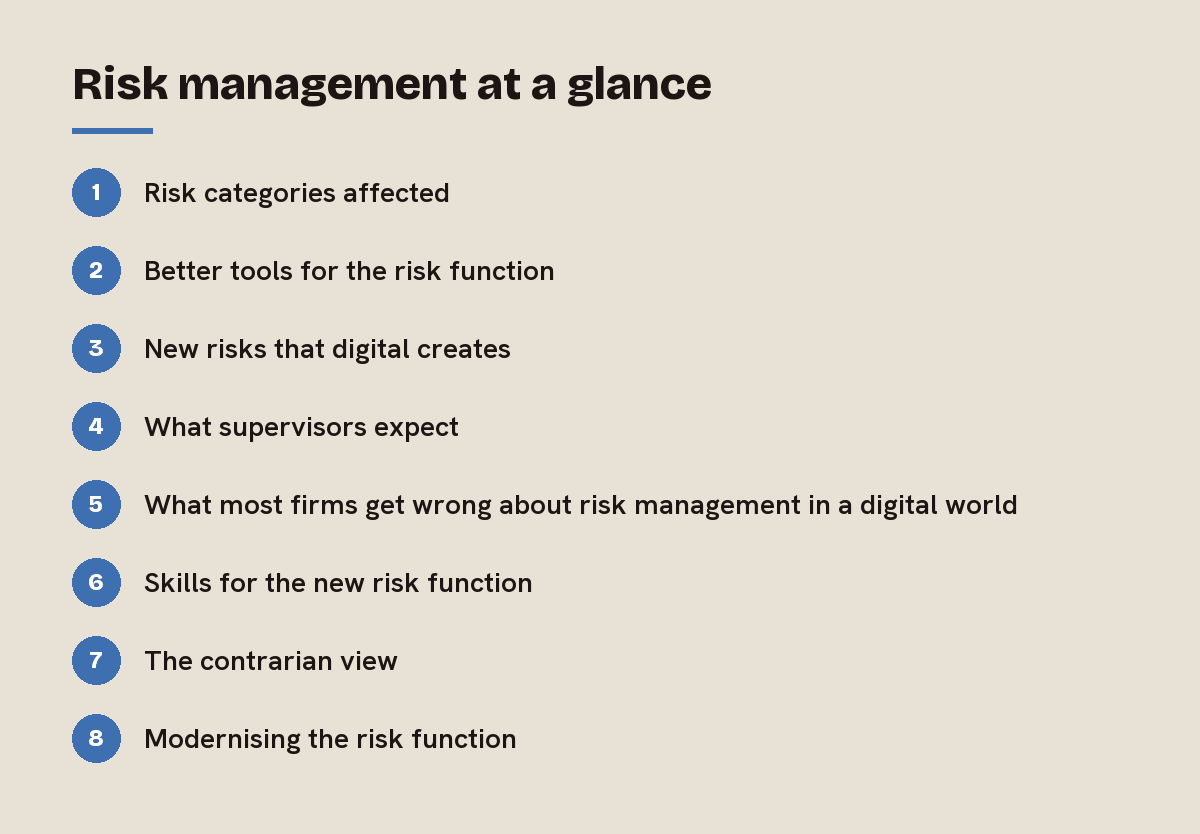
1. Risk categories affected
| Risk category | How digital changes it |
|---|---|
| Credit risk | Real-time data and new models for origination and monitoring |
| Operational risk | Automation reduces manual errors; cloud and third parties add dependency risk |
| Fraud risk | Behavioural analytics and real-time scoring at onboarding and payment |
| Market risk | Faster data and scenario analysis for portfolios |
| Conduct and regulatory risk | Digital journeys must be fair, clear and evidenced at scale |
2. Better tools for the risk function
- Real-time monitoring: dashboards and alerts replace periodic reports for key risks.
- Richer data: transaction, behavioural and external data improve risk assessment.
- Advanced models: machine learning supports credit, fraud and anomaly detection.
- Automated controls: checks embedded in digital journeys apply consistently.
- Scenario analysis: faster simulation of market and credit scenarios, including in wealth suitability.
3. New risks that digital creates
- Model risk: more models, changing more often, with less transparency.
- Data risk: decisions depend on data quality across many systems.
- ICT and cyber risk: greater dependence on technology and connectivity.
- Third-party risk: cloud providers and partners become critical.
- Conduct risk at scale: a flawed digital journey affects thousands of customers at once.
4. What supervisors expect
| Area | Expectation |
|---|---|
| Operational resilience | Under the Digital Operational Resilience Act, applicable since 17 January 2025, firms must manage ICT risk, report incidents, test resilience and oversee critical ICT providers |
| AI and models | The EU AI Act treats AI for creditworthiness and for life and health insurance pricing as high-risk, with oversight and documentation duties |
| Risk data | Banks are expected to meet the Basel principles on risk data aggregation and reporting |
Data remains a weak point. The ECB reported in 2025 that the number of institutions without fully adequate risk data aggregation and reporting capabilities is still too high, with significant gaps against its May 2024 guide. Digital risk management depends on fixing those foundations.
5. What most firms get wrong about risk management in a digital world
- Adding risk reviews at the end: reviewing digital products just before launch slows delivery and catches problems too late.
- Deploying models without monitoring: models drift as behaviour changes; without monitoring, risk grows unseen.
- Underestimating third parties: outsourced technology does not outsource accountability.
- Treating data quality as an IT issue: poor data is a risk management problem with business owners.
Example: an insurer embedded risk specialists in its digital product teams. Instead of reviewing each new journey at the end, they helped design controls from the first sprint, defining which checks should be automated and which needed human review. Launch times shortened and the number of control issues found after launch fell.
6. Skills for the new risk function
The risk function itself needs new capabilities. Data engineers and scientists help build monitoring and models; specialists in cloud, cyber and third-party risk assess new dependencies; and product-minded risk partners work inside delivery teams. Many institutions build these skills by combining experienced risk professionals with digital specialists, so deep knowledge of credit, insurance and markets is paired with modern tools.
7. The contrarian view
Digital is often seen as making risk management harder. It can also make it far better: real-time data, automated controls and continuous monitoring give the risk function a clearer view than it has ever had. The institutions that benefit are those that see the risk function as a co-designer of digital change rather than a gatekeeper at the end.
8. Modernising the risk function
- Invest in risk data foundations aligned with supervisory principles.
- Move to real-time monitoring for key risks.
- Strengthen model risk management for AI and machine learning.
- Embed risk partners in digital product teams.
- Govern third parties as part of operational resilience.
Key takeaways on risk management
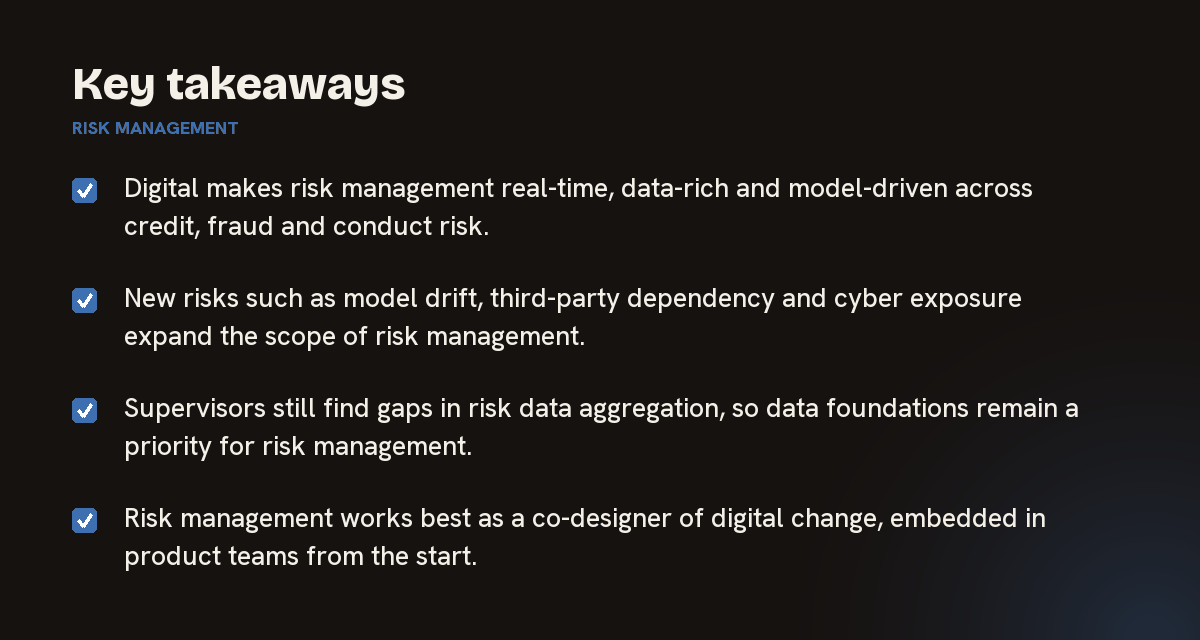
- Digital makes risk management real-time, data-rich and model-driven across credit, fraud and conduct risk.
- New risks such as model drift, third-party dependency and cyber exposure expand the scope of risk management.
- Supervisors still find gaps in risk data aggregation, so data foundations remain a priority for risk management.
- Risk management works best as a co-designer of digital change, embedded in product teams from the start.
For leadership teams, modernising risk management is as important as modernising customer journeys. The two depend on each other: institutions can only move as fast as they can see and control the risks of moving.
Optimizium helps banks, insurers and wealth managers modernise risk management alongside their digital transformation. We respect the depth of expertise in risk functions, because it protects customers and the institution. And we bring risk, compliance and technology teams together as co-authors, so controls are designed into digital change from the start.
Explore how we approach this across Banking, Insurance, Wealth Management and Beyond Banking, browse the FAQ Hub, or read the related question: How does wealth management differ from retail banking in digital strategy?
On this page
Partner with the experts.
Let's discuss how Optimizium can accelerate your roadmap and navigate complex digital transformation.
Schedule a consultation →