Home › FAQ Hub › How does digital enhance fraud management?
Tech & Core ModernisationHow does digital enhance fraud management?
Digital technology enhances fraud management by combining behavioural analytics, device fingerprinting, biometrics and machine learning models to detect fraud more accurately and to reduce false positives that frustrate genuine customers.
Digital channels made financial services faster and more convenient for customers. They did the same for fraudsters. The institutions that keep losses down are the ones that use digital tools to fight back at the same speed.
Digital technology enhances fraud management by combining behavioural analytics, device fingerprinting, biometrics and machine learning models to detect fraud more accurately and to reduce false positives that frustrate genuine customers. Real-time scoring allows payments and onboarding to be assessed in milliseconds, so suspicious activity is stopped before money leaves. The focus differs by sector: wealth platforms concentrate on account takeover and money movement, insurers on claims fraud, banks on payments fraud and synthetic identities, and fintechs on onboarding fraud. Effective digital fraud management balances protection with customer experience, because blocking legitimate customers is costly too.
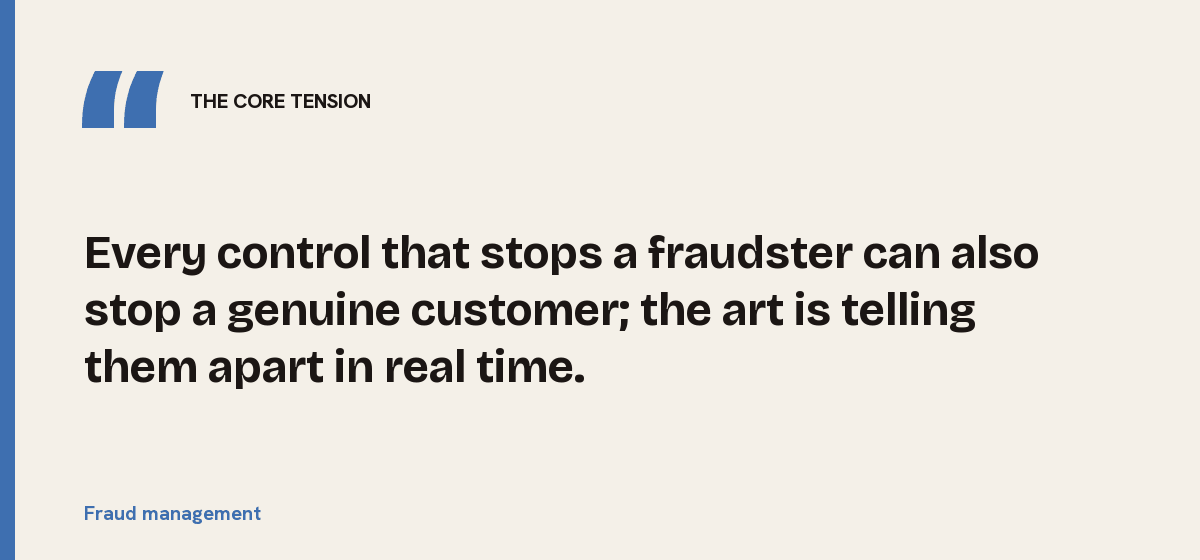
The core tension, in one line:
Every control that stops a fraudster can also stop a genuine customer; the art is telling them apart in real time.
a customer logs into her banking app from a new phone and tries to send a large payment to a new payee. The bank’s models notice the new device, an unusual typing pattern and a payee linked to previous scams. The payment is paused, the customer receives a clear warning and a call, and the scam is stopped before any money is lost.
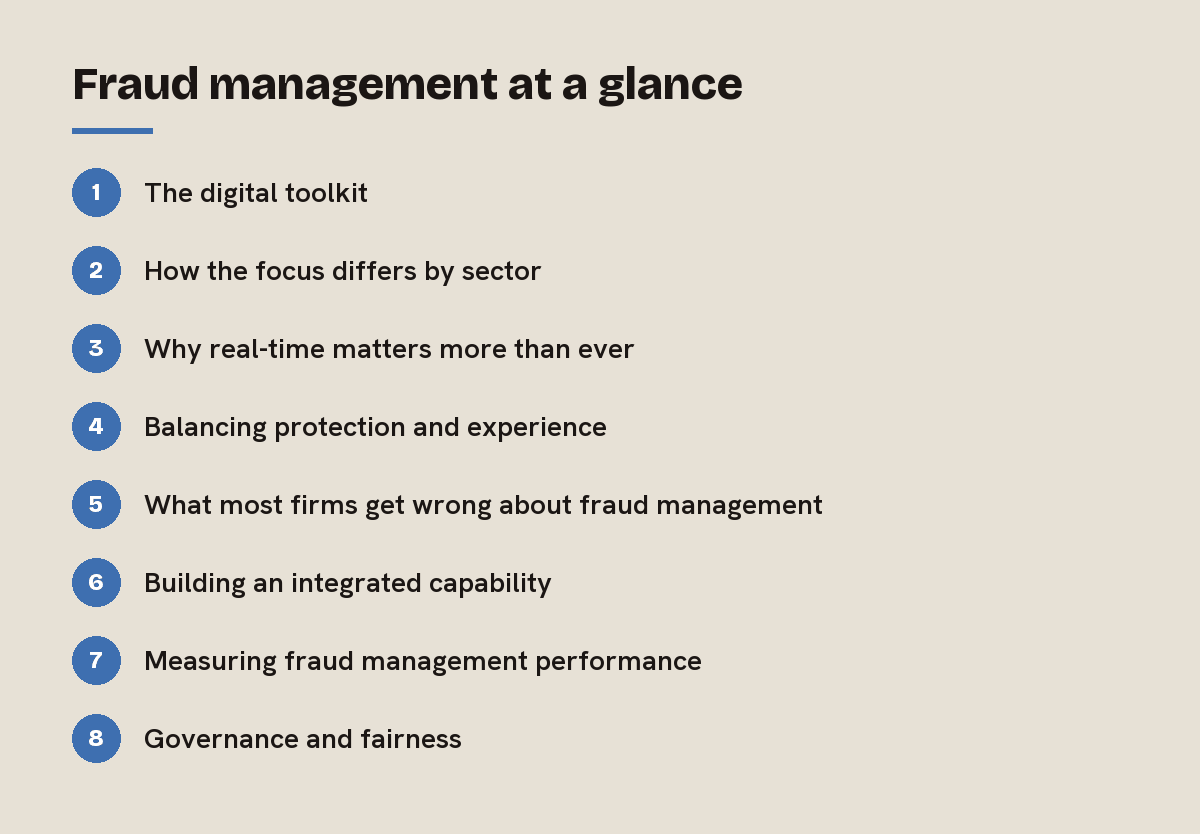
1. The digital toolkit
| Tool | What it does | Where it helps most |
|---|---|---|
| Behavioural analytics | Learns how each customer usually behaves and flags anomalies | Account takeover, scams |
| Device fingerprinting | Recognises devices and their risk signals | Login and payment fraud |
| Biometrics | Verifies identity through face, fingerprint or voice | Onboarding, high-risk transactions |
| Machine learning models | Scores transactions and applications using many signals | Payments, applications, claims |
| Network analysis | Finds links between accounts, devices and people | Organised fraud rings, mule accounts |
2. How the focus differs by sector
- Banking: payments and synthetic identity. Instant payments leave little time to intervene, and synthetic identities combine real and fake data to open accounts.
- Insurance: claims fraud. Exaggerated or staged claims, false documents and organised fraud networks.
- Wealth: account takeover and money movement. Fraudsters target high-value accounts and attempt withdrawals or transfers.
- Fintech: onboarding fraud. Fast, fully digital onboarding attracts fraudsters testing weak controls.
3. Why real-time matters more than ever
Payments are speeding up. Under the EU’s Instant Payments Regulation, providers must offer instant euro transfers at any time of day and a service that checks the payee’s name against the account before the payment is authorised. Instant, irrevocable payments mean fraud management must also work in real time, and payee checks help customers spot scams before they pay.
AI is now central to this. According to the ECB, 64 per cent of the banks it supervises use AI for fraud and cybercrime prevention, the leading use of AI in the sector. The ECB also notes that among the banks it examined, neural networks are mainly used for fraud detection, reflecting the complexity of the patterns involved.
4. Balancing protection and experience
| Approach | Customer experience | Fraud outcome |
|---|---|---|
| Blunt rules | Many genuine transactions blocked | Fraudsters adapt around fixed rules |
| Real-time, model-based scoring | Most customers unaffected | Better detection of new patterns |
| Step-up checks only when risk is high | Friction only where needed | Strong protection at key moments |
| Clear, timely warnings | Customers understand and cooperate | Fewer successful scams |
5. What most firms get wrong about fraud management
- Siloed teams and data: separate fraud teams for cards, payments, onboarding and claims miss patterns that span products.
- Optimising for detection only: high false-positive rates cost revenue and damage trust.
- Ignoring scams: customers tricked into authorising payments themselves require different controls and communication.
- Slow model updates: fraud patterns change quickly; models that are updated quarterly fall behind.
Example: an insurer’s claims fraud team relied on rules and handler intuition. It introduced network analysis linking claims, repairers, addresses and phone numbers, and found several organised rings that individual handlers could never have seen. Losses fell, and genuine claims were settled faster because fewer were held for manual checks.
6. Building an integrated capability
- Unify data across channels and products for a single view of risk.
- Score in real time at onboarding, login, payment and claim.
- Apply step-up checks proportionate to risk.
- Communicate clearly with customers at moments of risk.
- Monitor models continuously and retrain as patterns shift.
- Share intelligence with industry partners where permitted.
7. Measuring fraud management performance
A balanced scorecard prevents teams from optimising one number at the expense of others. Useful measures include fraud losses as a share of volume, detection rate, false-positive rate, the share of genuine customers who experience a block, time to resolve false alarms, and scam reimbursement costs. Reviewing these together shows whether fraud management is protecting customers without driving them away.
8. Governance and fairness
Fraud models make consequential decisions, such as blocking payments or delaying claims. They need the same discipline as other high-impact models: clear documentation, testing for unfair outcomes across customer groups, human review of difficult cases, and fast routes for customers to resolve false alarms.
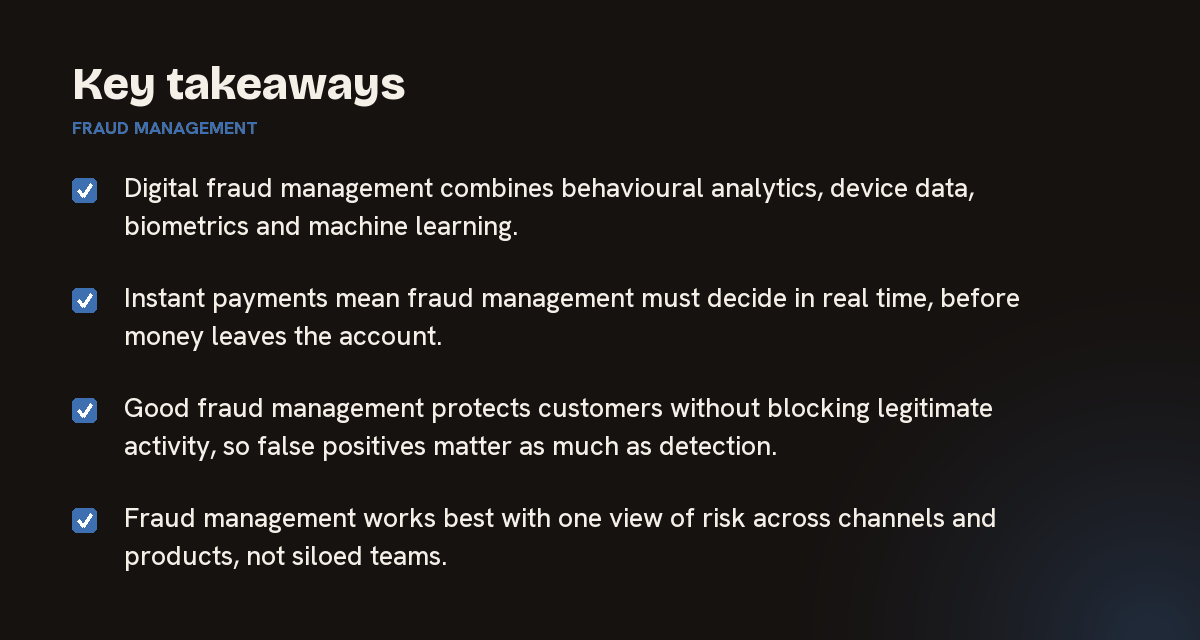
Key takeaways on fraud management
- Digital fraud management combines behavioural analytics, device data, biometrics and machine learning.
- Instant payments mean fraud management must decide in real time, before money leaves the account.
- Good fraud management protects customers without blocking legitimate activity, so false positives matter as much as detection.
- Fraud management works best with one view of risk across channels and products, not siloed teams.
For leadership teams, fraud management is both a cost line and a trust signal. Losses, false alarms and scam reimbursements all affect the bottom line; the way an institution protects customers in difficult moments shapes how they feel about it for years.
Optimizium helps banks, insurers and wealth managers modernise fraud management across channels. We respect the expertise of fraud and financial crime teams, because they understand how criminals really operate. And we bring risk, data protection and compliance colleagues into the design as co-authors, so stronger controls are also fair and explainable.
Explore how we approach this across Banking, Insurance, Wealth Management and Beyond Banking, browse the FAQ Hub, or read the related question: How does wealth management differ from retail banking in digital strategy?
On this page
Partner with the experts.
Let's discuss how Optimizium can accelerate your roadmap and navigate complex digital transformation.
Schedule a consultation →