Home › FAQ Hub › How does leadership maturity influence transformation outcomes?
Leadership, Change & Operating ModelsHow does leadership maturity influence transformation outcomes?
Leadership maturity determines whether transformation is symbolic or structural. Mature digital leadership shows strategic clarity about why the institution is changing, long-term capital commitment beyond a single budget year, technical literacy at board level and visible behavioural role-modelling by senior executives.
Two institutions can launch similar transformation programmes with similar budgets and similar advisers. One changes how it competes within three years; the other produces a new app and a set of slides. The difference usually starts at the top.
Leadership maturity determines whether transformation is symbolic or structural. Mature digital leadership shows strategic clarity about why the institution is changing, long-term capital commitment beyond a single budget year, technical literacy at board level and visible behavioural role-modelling by senior executives. Immature leadership treats transformation as a programme to be delegated, funded annually and reported on in activity rather than results.
The signals are practical: a board that can challenge technology choices, capital allocated on a multi-year horizon, clear articulation of the economics of change, protection of transformation teams from short-term cuts, and leaders who change their own ways of working. Where leadership maturity is high, transformation programmes are far more likely to deliver lasting outcomes.
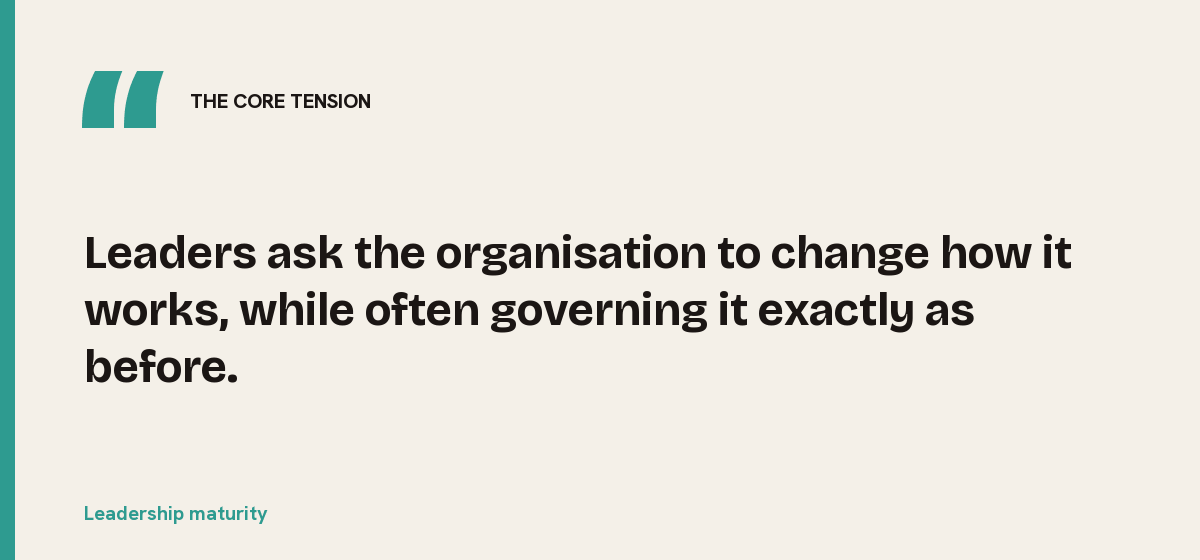
The core tension, in one line:
Leaders ask the organisation to change how it works, while often governing it exactly as before.
a bank’s executive committee approved a transformation plan but continued to review every change in monthly committees and to cut budgets mid-year. After a reset, the committee delegated decisions to journey owners within clear limits, committed three-year funding and reviewed outcomes quarterly. Delivery speed and results improved visibly within a year.
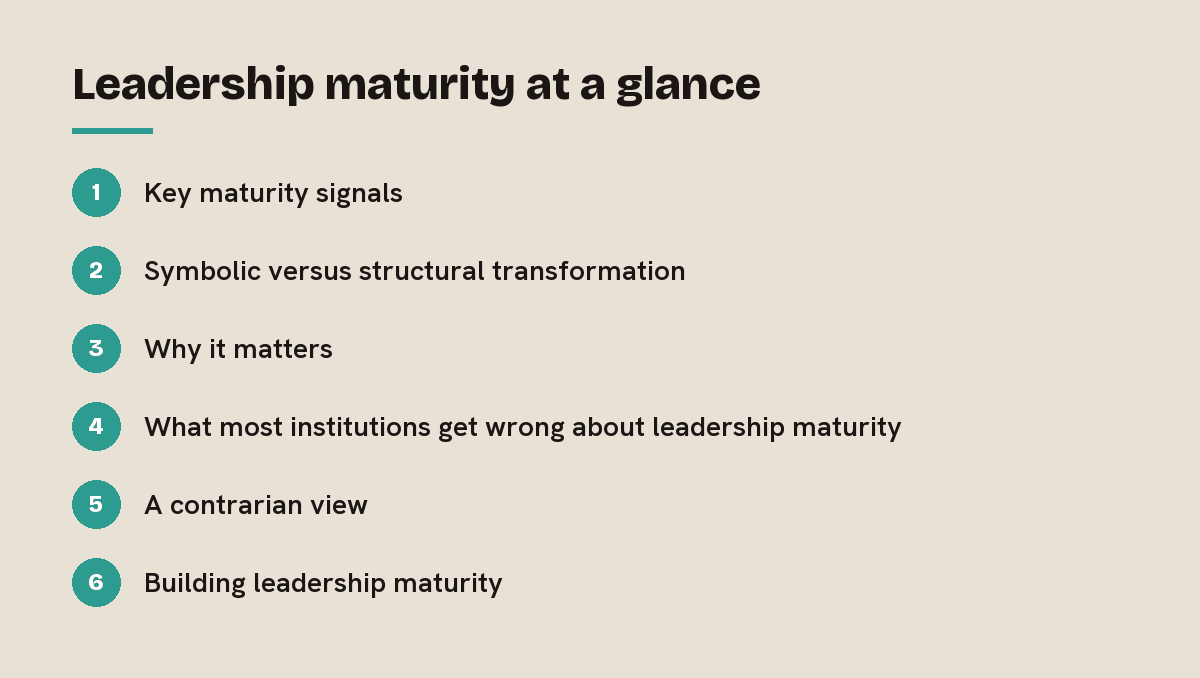
1. Key maturity signals
| Signal | What it looks like on the ground | Why it matters |
|---|---|---|
| Board digital fluency | Directors who understand technology and data risks | Better challenge and sponsorship |
| Multi-year capital | Funding committed beyond the budget year | Teams can plan and finish work |
| Clear economics | A shared view of how change creates value | Priorities and trade-offs are explicit |
| Protected teams | Transformation capacity not cut first | Momentum survives pressure |
| Role-modelling | Leaders change their own behaviour | Credibility with the organisation |
2. Symbolic versus structural transformation
| Symbolic | Structural |
|---|---|
| New logos, labs and announcements | New decision rights and funding models |
| Activity reported to the board | Outcomes reported to the board |
| Delegated to a programme office | Owned by business leaders |
| Annual budgets | Multi-year commitments |
3. Why it matters
Large transformations often fail to deliver. McKinsey found that only 16 per cent of respondents said their digital transformations had improved performance and been sustained. Supervisors also look at leadership: the ECB’s 2024 review of digitalisation practices includes clear allocation of digital responsibility within the management body and non-executive challenge of digital strategy among its assessment criteria. Skills are shifting too: the World Economic Forum expects 39 per cent of workers’ core skills to change by 2030, and leaders are not exempt.
4. What most institutions get wrong about leadership maturity
- Delegating transformation: a programme office cannot substitute for executive ownership.
- Funding year by year: stop-start budgets break teams and momentum.
- Measuring activity: boards that review project status rather than outcomes reward the wrong things.
- Asking others to change first: organisations watch what leaders do, not what they say.
Example: an insurer’s board added two directors with digital and data experience and introduced a quarterly review of transformation outcomes, alongside financial results. Questions shifted from “is the project on track?” to “are claims faster and cheaper?”, and executive priorities followed.
5. A contrarian view
Leadership maturity is often equated with charismatic sponsorship. In practice, the most effective digital leaders are often quiet about it: they fund consistently, delegate clearly, measure outcomes and remove obstacles. Consistency matters more than enthusiasm.
6. Building leadership maturity
- Develop board digital fluency through recruitment and education.
- Commit multi-year funding for core transformation work.
- Agree the economics of change and review them regularly.
- Delegate decisions to journey owners within clear limits.
- Model new ways of working in leadership forums.
Key takeaways on leadership maturity
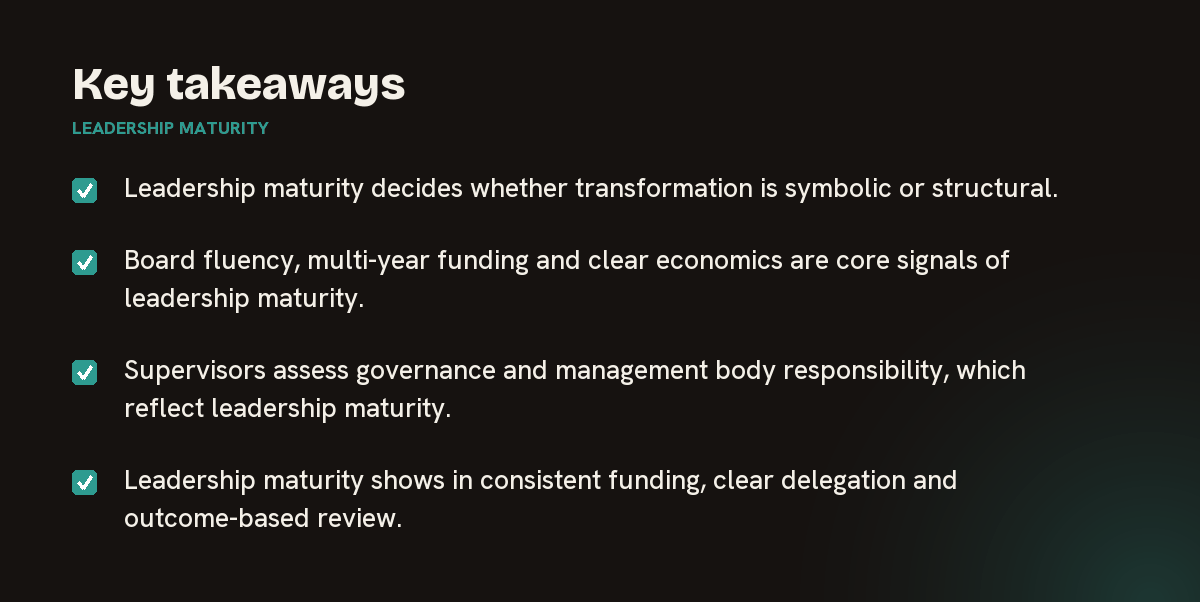
- Leadership maturity decides whether transformation is symbolic or structural.
- Board fluency, multi-year funding and clear economics are core signals of leadership maturity.
- Supervisors assess governance and management body responsibility, which reflect leadership maturity.
- Leadership maturity shows in consistent funding, clear delegation and outcome-based review.
For boards and executive teams, leadership maturity is the most powerful and least discussed factor in transformation outcomes. Investing in it, through skills, governance and behaviour, raises the return on every other transformation investment.
Optimizium works with boards and executive teams in banks, insurers and wealth managers to strengthen digital leadership and governance. We respect the experience leaders bring, because it is essential to steering change wisely. And we bring risk, finance and HR into the design as co-authors, so leadership practices support both ambition and control.
Explore how we approach this across Banking, Insurance, Wealth Management and Beyond Banking, browse the FAQ Hub, or read the related question: How does transformation affect labor models and workforce composition?
Related questions
Partner with the experts.
Let's discuss how Optimizium can accelerate your roadmap and navigate complex digital transformation.
Schedule a consultation →