Home › FAQ Hub › How does personalization differ by industry?
Digital Ops & Customer ExperienceHow does personalization differ by industry?
Personalization in financial services differs by industry because each sector has different product complexity, different data and different regulatory limits. Banks personalise mainly from transactional and credit data, producing tailored offers and pre-approvals.
Every financial institution says it wants to treat customers as individuals. What that means in practice depends heavily on what the institution sells, what data it holds and what the rules allow it to do with that data.
Personalization in financial services differs by industry because each sector has different product complexity, different data and different regulatory limits. Banks personalise mainly from transactional and credit data, producing tailored offers and pre-approvals. Insurers personalise from risk and lifestyle data, adjusting premiums and coverage. Wealth managers personalise from goals and risk appetite, shaping portfolios and advice. Fintechs personalise from behavioural and engagement data, optimising upsell and conversion. In each case, the levers are set by what the product needs and what the data can support. The best personalization is not the most data-intensive; it is the one that gives customers something more useful while staying explainable and fair.
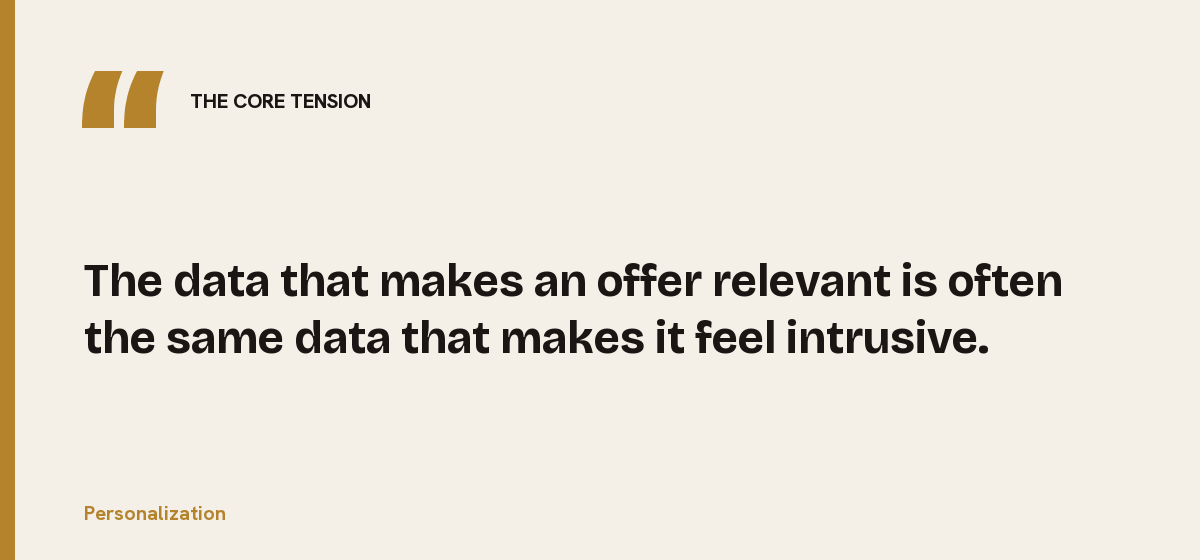
The core tension, in one line:
The data that makes an offer relevant is often the same data that makes it feel intrusive.
a bank sees that a customer’s salary has risen and her rent payments have stopped. It offers a pre-approved mortgage illustration in the app, with a clear explanation of what data was used and an option to switch off such offers. The customer uses it, and trusts it, because it is relevant and transparent.
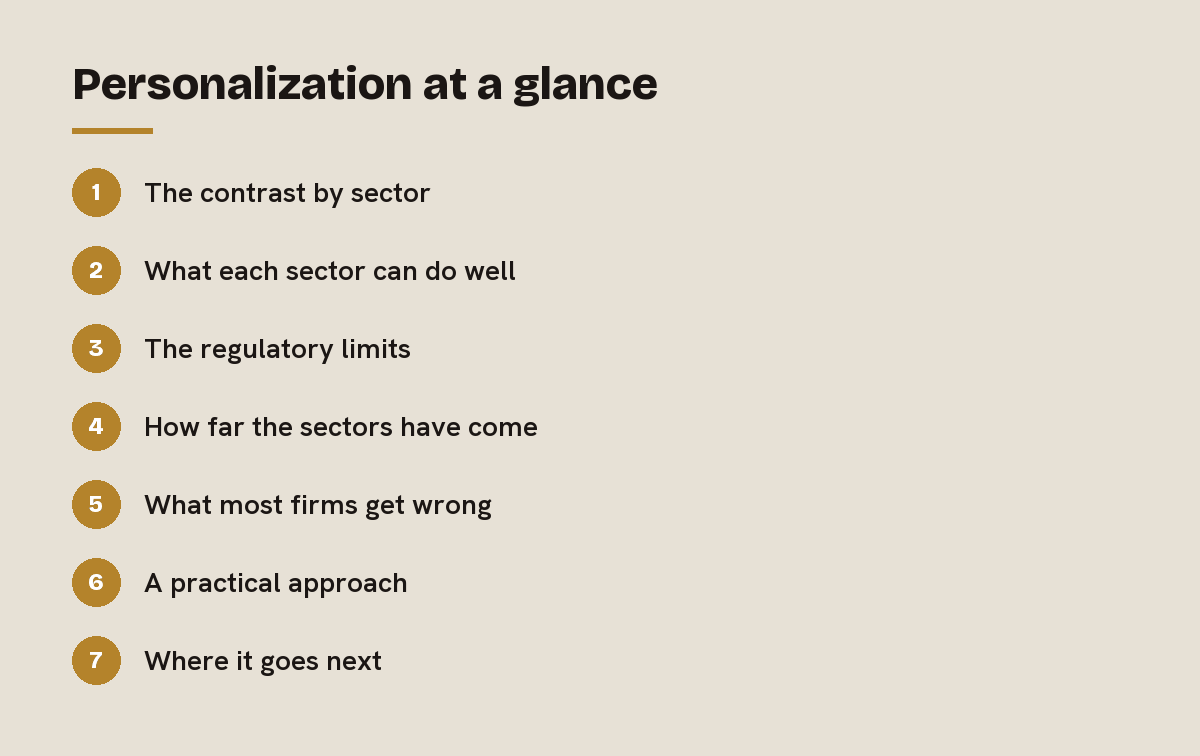
1. The contrast by sector
| Sector | Dominant driver | Example | Main constraint |
|---|---|---|---|
| Banking | Transactional and credit data | Tailored offers, pre-approvals, spending insights | Affordability and responsible lending |
| Insurance | Risk and lifestyle data | Premiums, coverage options, prevention advice | Fair pricing, discrimination rules |
| Wealth | Goals and risk appetite | Portfolios, planning scenarios, content | Suitability and best interest |
| Fintech | Behavioural and engagement data | Upsells, feature prompts, conversion | Consumer protection, transparency |
2. What each sector can do well
- Banking: frequent transactions give banks a rich, current picture of financial life. In banking, relevance comes mostly from timing: offering the right product when a need appears.
- Insurance: risk data allows more accurate pricing and cover, and increasingly prevention, such as alerts about weather or driving behaviour.
- Wealth: goals-based personalization helps clients see how decisions affect outcomes, which supports better advice and better behaviour.
- Fintech: fast experiments and behavioural data let fintechs refine journeys and features quickly.
3. The regulatory limits
Tailoring in finance operates within firm legal boundaries, and they are tightening.
- Automated decisions: under Article 22 of the GDPR, individuals have the right not to be subject to decisions based solely on automated processing that significantly affect them. The Court of Justice confirmed in its SCHUFA judgment of December 2023 that a credit score can itself fall within that rule when it plays a decisive role in a lender’s decision.
- High-risk AI: the EU’s Artificial Intelligence Act classifies AI systems used to assess creditworthiness, and those used for risk assessment and pricing in life and health insurance, as high-risk, with requirements on data, documentation and human oversight.
- Fair treatment: pricing and offer rules in many markets restrict practices that lead to unfair outcomes for loyal or vulnerable customers.
| Sector | Where the strictest limits apply |
|---|---|
| Banking | Credit scoring and pricing |
| Insurance | Life and health pricing; use of sensitive data |
| Wealth | Recommendations that must be suitable |
| Fintech | Offers of credit and investment products |
4. How far the sectors have come
AI is accelerating the shift. EIOPA’s 2023 digitalisation survey of European insurers found that artificial intelligence is already used by 50 per cent of respondents in non-life insurance and 24 per cent in life. Banks are further along in many areas, especially fraud detection and customer analytics, while wealth managers are earlier in using AI for client-facing personalization.
5. What most firms get wrong
- Starting from data instead of need: collecting more data rarely helps if the institution has not decided what it wants to do better for customers.
- Optimising for conversion only: personalised offers that lift sales but increase complaints or cancellations destroy value.
- Black-box models in regulated decisions: models that cannot be explained are hard to defend in credit, insurance pricing or advice.
- Ignoring the customer’s view: customers accept tailored offers when they understand them and can control them.
Example: an insurer introduced personalised renewal offers based on claims history and risk data. Early results showed higher retention, but a review found that some long-standing customers were paying more than new customers with similar risk. The insurer adjusted its pricing rules and added a fairness check to every model release, protecting both customers and its reputation.
6. A practical approach
- Define the customer outcome each use case should improve.
- Map data and legal basis, including any high-risk or automated decision rules.
- Start with explainable models in regulated decisions.
- Give customers control over offers and data use.
- Monitor outcomes for fairness, complaints and value over time.
7. Where it goes next
Over the next few years, tailoring in finance will be shaped as much by governance as by technology. Institutions that can show regulators and customers why each recommendation was made, and that it served the customer, will be able to use richer data and models with confidence. Those that cannot will find their room for manoeuvre narrowing.
Key takeaways on personalization
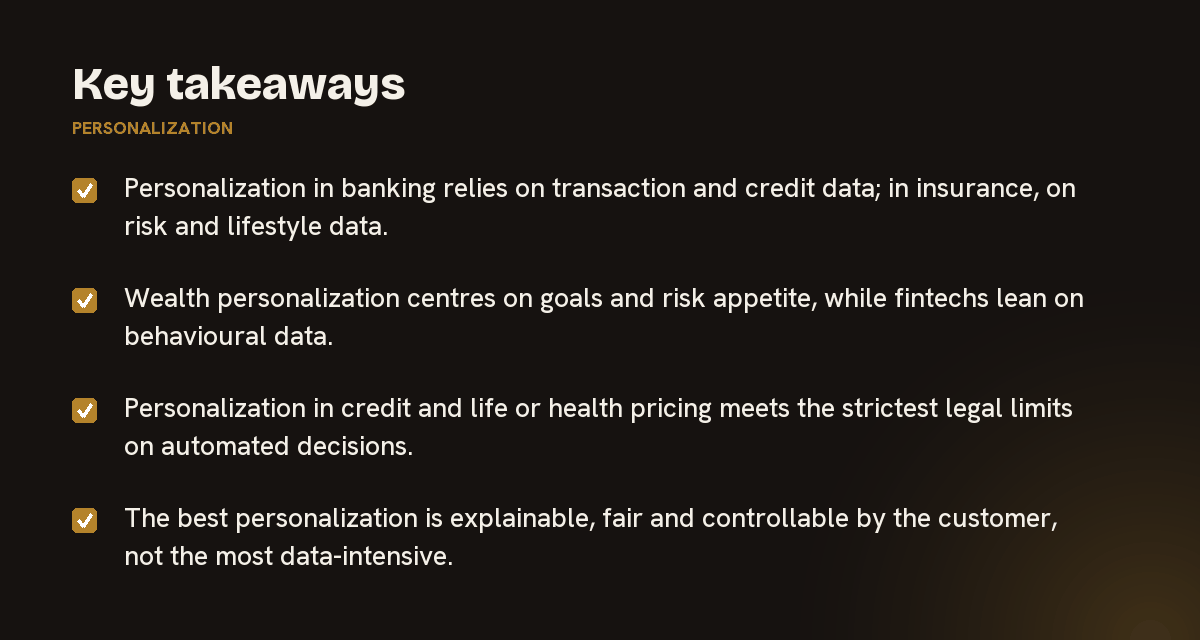
- Personalization in banking relies on transaction and credit data; in insurance, on risk and lifestyle data.
- Wealth personalization centres on goals and risk appetite, while fintechs lean on behavioural data.
- Personalization in credit and life or health pricing meets the strictest legal limits on automated decisions.
- The best personalization is explainable, fair and controllable by the customer, not the most data-intensive.
For leaders, the lesson is that personalization is not a single capability to copy from another industry. It must be designed around each sector’s products, data and rules, with explainability and fairness built in from the start.
Optimizium helps banks, insurers and wealth managers build personalization that is useful, fair and defensible. We respect the customer knowledge and risk expertise institutions already hold, because they define what responsible personalization looks like. And we bring data protection, risk and compliance colleagues into the design as co-authors, so every model and offer can be explained and trusted.
Explore how we approach this across Banking, Insurance, Wealth Management and Beyond Banking, browse the FAQ Hub, or read the related question: What distinguishes rules-based from algorithmic personalization?
Related questions
Partner with the experts.
Let's discuss how Optimizium can accelerate your roadmap and navigate complex digital transformation.
Schedule a consultation →