Home › FAQ Hub › How does self-service adoption evolve over time?
Leadership, Change & Operating ModelsHow does self-service adoption evolve over time?
Self-service adoption in financial services typically follows an S-curve: initial resistance, then accelerated adoption, and finally saturation. Early stages are slowed by trust concerns, usability gaps and regulatory friction, such as extra checks or documents.
When a bank or insurer launches a new self-service journey, early numbers often disappoint. Months later, usage suddenly climbs, then levels off well short of everyone. That pattern is predictable, and understanding it helps institutions invest at the right moment.
Self-service adoption in financial services typically follows an S-curve: initial resistance, then accelerated adoption, and finally saturation. Early stages are slowed by trust concerns, usability gaps and regulatory friction, such as extra checks or documents. Adoption accelerates as processes are simplified, interfaces improve and incentives align, for example when staff encourage customers to try the digital route.
Saturation is reached when all suitable segments have migrated or when a stable hybrid pattern emerges, with some customers and needs remaining with people. Continuous optimisation and feedback loops are needed to keep self-service adoption high, because expectations and products keep changing.
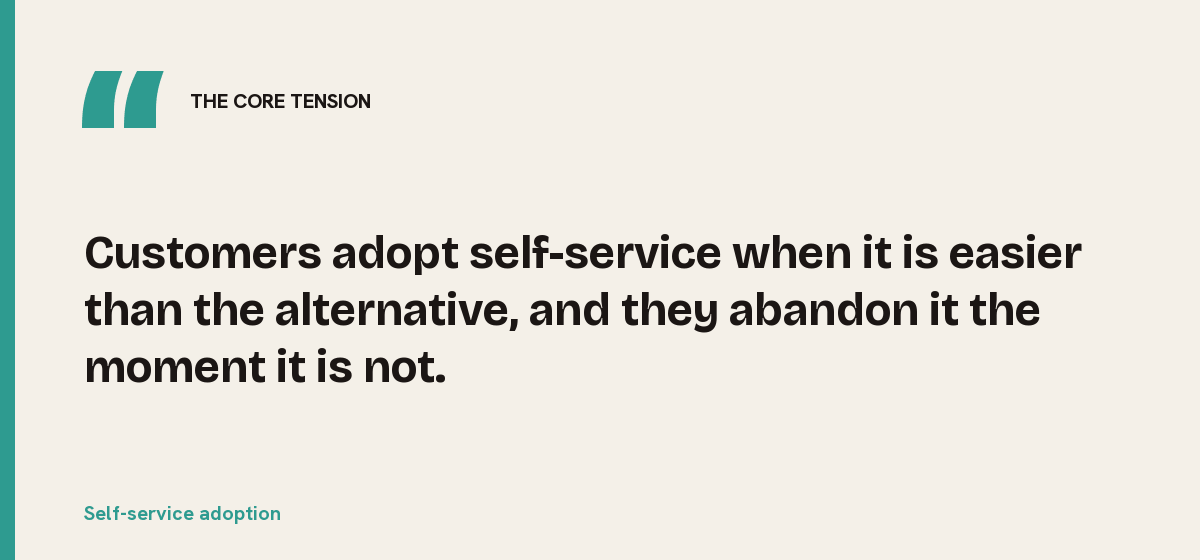
The core tension, in one line:
Customers adopt self-service when it is easier than the alternative, and they abandon it the moment it is not.
an insurer launched online claims notification and saw low usage in the first year. After simplifying the form, adding photo upload and status tracking, and asking call-centre staff to offer a guided first use, adoption accelerated sharply. It then levelled off as complex claims continued to be reported by phone.
1. The three stages of self-service adoption
| Stage | What it looks like on the ground | What slows or speeds it |
|---|---|---|
| Initial resistance | Low usage, many abandoned attempts | Trust, usability, extra checks |
| Acceleration | Rapid growth as journeys improve | Simplification, staff support, word of mouth |
| Saturation | Usage stabilises | Remaining needs better served by people |
2. What drives each stage
- Trust: customers need confidence that a digital action has worked and is secure.
- Usability: clear, short journeys with helpful error messages.
- Regulatory friction: checks that can be made digital, such as identity verification, remove a major barrier.
- Incentives: staff who are credited for digital adoption help customers make the switch.
- Habit: once customers succeed a few times, they tend to stay with self-service.
The broader trend supports adoption. Eurostat reports that in 2024, 93 per cent of people aged 16 to 74 in the EU used the internet and 67 per cent used internet banking. The gap between those figures is the room still available for self-service adoption in banking.
3. Why saturation is not the end
| Reason adoption plateaus | Response |
|---|---|
| Complex needs | Keep human support, with smooth hand-overs |
| Vulnerable customers | Accessible design and assisted options |
| Poor journeys | Fix the steps where customers drop out |
| Low awareness | Prompt customers at the right moment |
Accessibility matters here. Under the European Accessibility Act, consumer banking services provided after 28 June 2025 must meet accessibility requirements, which can lift adoption among customers who previously struggled with digital channels. Abandonment also limits the curve: Signicat found that 68 per cent of European consumers had abandoned a financial services application in the previous year.
4. What most firms get wrong about self-service adoption
- Judging too early: low first-year usage often reflects the resistance stage, not failure.
- Pushing too hard: forcing customers online before journeys work damages trust.
- Ignoring staff: frontline teams can accelerate or quietly block adoption.
- Stopping improvement after launch: adoption stalls when journeys stop getting better.
Example: a bank’s app-based address change had modest use. Analysis showed customers were unsure whether the change applied to all their products. A clear confirmation listing every affected account, and a follow-up message, increased self-service adoption and cut related calls.
5. A contrarian view
The goal is often framed as maximum self-service adoption. A better goal is the right adoption: high for simple, frequent tasks, lower where advice or reassurance adds value. Pushing every interaction to self-service can raise complaints and costs elsewhere.
6. Keeping the curve moving
- Measure adoption by task and segment, not just overall.
- Fix the biggest drop-off points continuously.
- Support first use with staff guidance and prompts.
- Keep human options for complex and vulnerable cases.
Key takeaways on self-service adoption
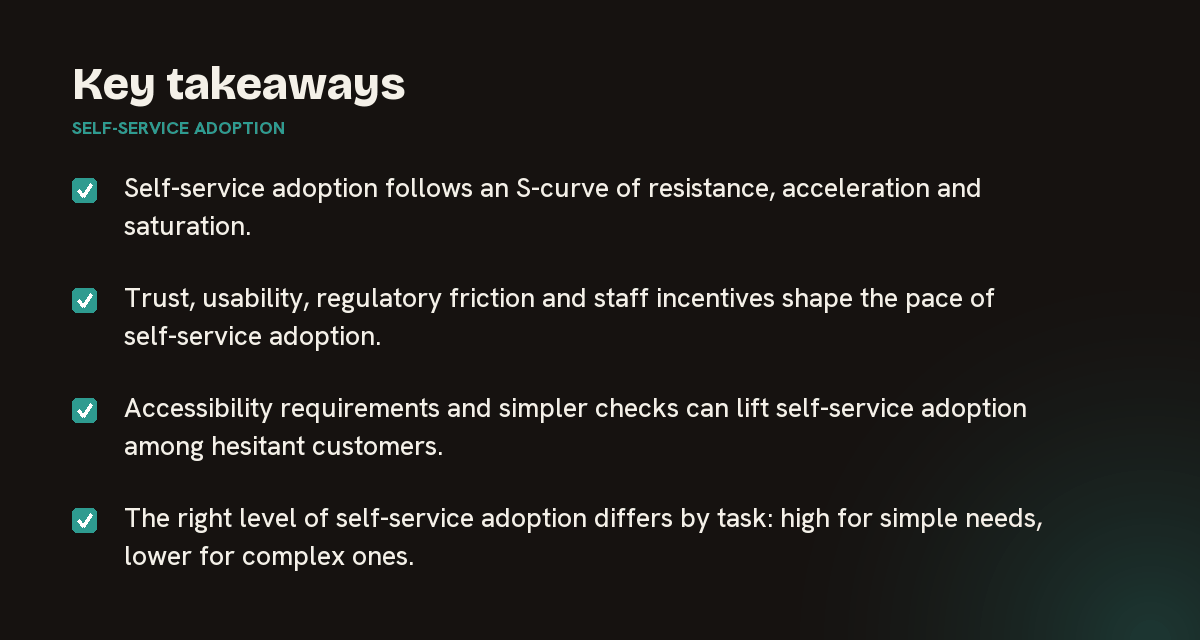
- Self-service adoption follows an S-curve of resistance, acceleration and saturation.
- Trust, usability, regulatory friction and staff incentives shape the pace of self-service adoption.
- Accessibility requirements and simpler checks can lift self-service adoption among hesitant customers.
- The right level of self-service adoption differs by task: high for simple needs, lower for complex ones.
For leadership teams, understanding the self-service adoption curve helps set realistic expectations and investment plans. Early patience, continuous improvement and the right balance with human service produce better results than aggressive migration targets.
Optimizium helps banks, insurers and wealth managers design self-service that customers choose. We respect the knowledge of service teams, because they see where customers struggle. And we bring risk, compliance and accessibility specialists into the design as co-authors, so self-service is easy, safe and inclusive.
Explore how we approach this across Banking, Insurance and Wealth Management, browse the FAQ Hub, or read the related question: What makes “design maturity” strategically relevant?
Related questions
Partner with the experts.
Let's discuss how Optimizium can accelerate your roadmap and navigate complex digital transformation.
Schedule a consultation →