Home › FAQ Hub › What makes “design maturity” strategically relevant?
Leadership, Change & Operating ModelsWhat makes “design maturity” strategically relevant?
Design maturity is the degree to which an institution uses design, meaning research with real customers, rapid prototyping and evidence about behaviour, to shape products, journeys and policies rather than to decorate them.
Most financial institutions treat design as the last coat of paint on a product that has already been decided. The firms that win digital customers treat it as the way decisions get made in the first place.
Design maturity is the degree to which an institution uses design, meaning research with real customers, rapid prototyping and evidence about behaviour, to shape products, journeys and policies rather than to decorate them. It matters strategically because it drives four things boards care about: how quickly customers can be onboarded, how clearly risks and costs are disclosed, how much customers trust the digital channel, and how much rework a programme needs before launch. Fintechs tend to operate at a higher design maturity than incumbents, not because they have better designers, but because design sits closer to the decision. Raising design maturity is therefore an operating model change, not a hiring exercise.
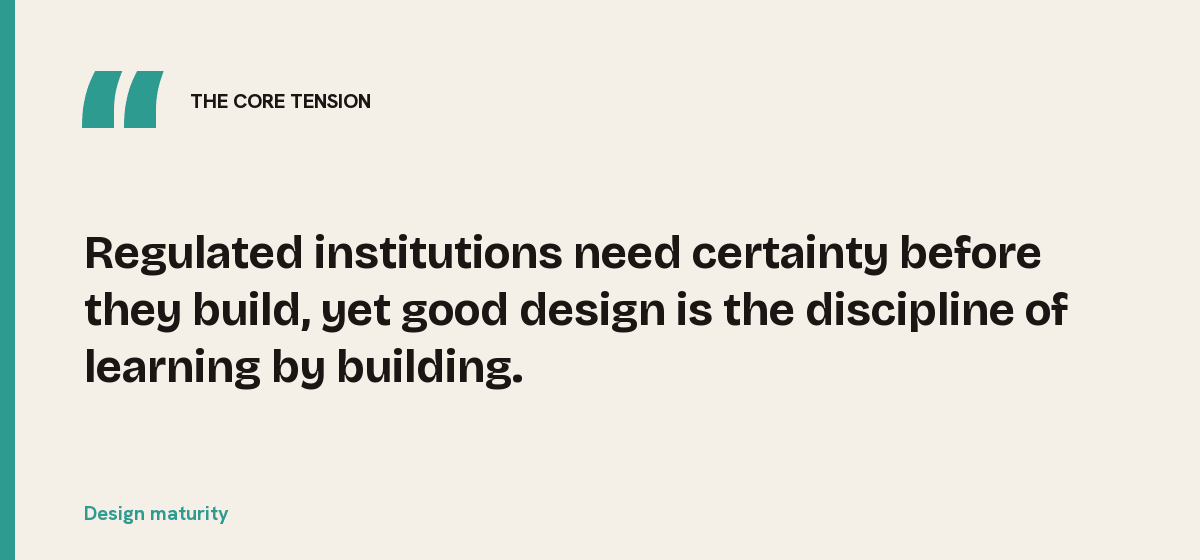
The core tension, in one line:
Regulated institutions need certainty before they build, yet good design is the discipline of learning by building.
a bank redesigns its mortgage application with a two-person design team embedded in the product squad. They test the income declaration step with twelve real applicants before a line of production code is written, discover that most people stall on one ambiguous question, and rewrite it. Completion rises, and the fix costs a day of work rather than a quarter of rework after launch.
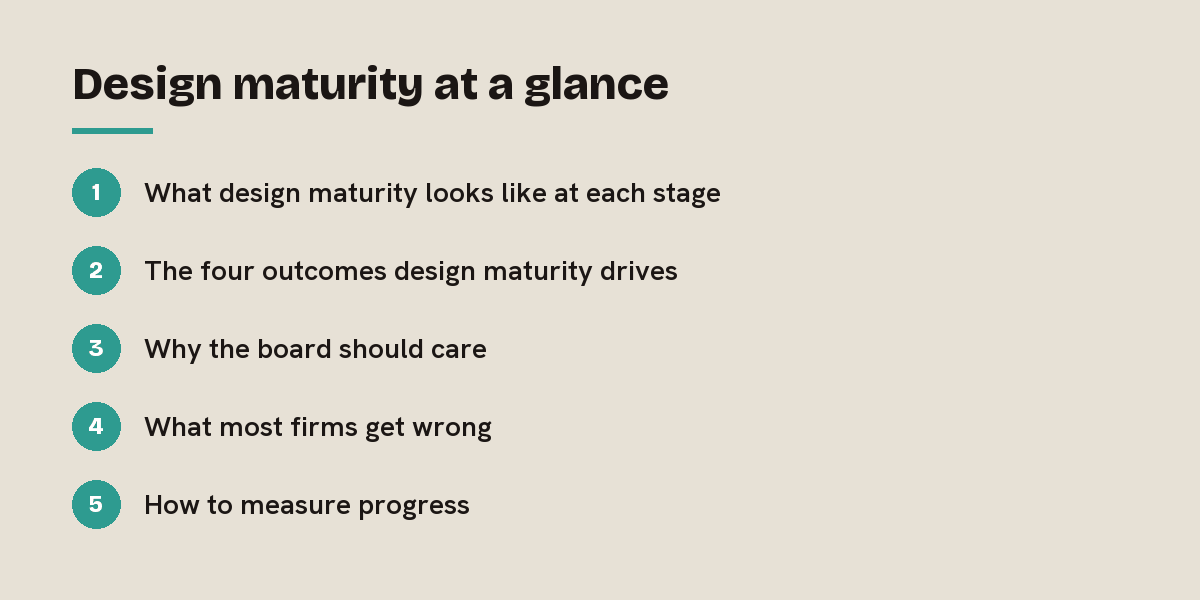
1. What design maturity looks like at each stage
It is easiest to understand as a ladder. Most incumbents sit on the second or third rung; most scaled fintechs sit on the fourth.
| Stage | What it looks like on the ground | Why it matters |
|---|---|---|
| 1. Cosmetic | Design is asked to “make the screens look good” after requirements are signed off | Problems are discovered by customers, after launch |
| 2. Usability | Usability tests happen, but late, and findings compete with delivery dates | Obvious friction is removed; structural friction stays |
| 3. Embedded | Designers sit in product teams and research shapes the backlog | Journeys improve steadily; decisions rest on evidence |
| 4. Strategic | Research informs product strategy, pricing presentation and policy wording | Design becomes a source of advantage, not a service |
The jump from stage two to stage three is where most value is released, and it is mainly about where designers sit and who listens to them.
2. The four outcomes design maturity drives
Four outcomes show where design earns its place in the numbers.
- Customer journeys: mature teams map the whole journey, including the paper, phone and branch steps, so the digital part does not simply move friction somewhere else.
- Disclosure reduction: mature design teams turn dense terms into layered information, the key facts first and the detail on demand, which helps customers understand without removing anything the regulator requires.
- Onboarding speed: every unnecessary field or unclear instruction costs completions. Signicat’s survey of 7,600 European consumers found that 68 per cent had abandoned a financial services application, up from 63 per cent two years earlier.
- Digital trust: customers judge safety by how a service behaves: clear confirmations, honest error messages, no surprises. Good design is how an institution makes that behaviour consistent.
3. Why the board should care
Design has moved from a craft concern to a commercial and regulatory one.
On the commercial side, McKinsey’s study of 300 listed companies over five years found that firms in the top quartile of its design index achieved 32 percentage points higher revenue growth and 56 percentage points higher shareholder returns than their industry peers, and retail banking was one of the three sectors studied.
On the regulatory side, the FCA’s Consumer Duty requires UK firms to give customers the information they need, at the right time, presented in a way they can understand. That is a design requirement written in regulatory language. Firms with low design maturity struggle to evidence it, because they have never tested whether customers understand what they were shown.
| Lens | Low design maturity | High design maturity |
|---|---|---|
| Revenue | Drop-off accepted as normal | Drop-off treated as a defect to be fixed |
| Cost | Rework after launch, high contact-centre volumes | Problems found in prototypes, fewer calls |
| Conduct risk | Understanding assumed | Understanding tested and evidenced |
| Speed | Long debates about opinions | Short tests that settle the question |
4. What most firms get wrong
The usual response to a design gap is to hire more designers. That rarely moves an institution up the ladder on its own.
- Design without decision rights: if a researcher’s findings can be overruled by a delivery date every time, the organisation stays at stage two however many people are hired.
- Testing too late: usability testing a finished product only tells you what is wrong when it is most expensive to change.
- Separating design from compliance: the best disclosure work happens when designers, lawyers and compliance officers write the wording together, rather than passing documents back and forth.
- Measuring output, not outcome: counting screens designed says nothing; completion rates, comprehension scores and complaint volumes say a great deal.
5. How to measure progress
Because the subject sounds soft, it is often left unmeasured. It need not be. A small set of indicators, reviewed quarterly by the executive team, is enough to show whether the organisation is moving up the ladder.
- Research cadence: how many product decisions in the quarter were informed by research with real customers, and how many were made on opinion alone.
- Time to first test: the number of days between an idea being approved and its first test with customers. Mature teams measure this in days, not months.
- Journey completion: the share of customers who finish key journeys such as onboarding, a claim or a top-up, tracked step by step.
- Comprehension: the share of customers who can correctly explain the key terms of a product after reading the disclosure, tested on a sample.
- Avoidable contact: calls and messages caused by unclear screens or letters, which are a direct cost of weak design.
These measures also give the board a common language with product and compliance teams, which is often the first real step towards change.
Example: an insurer’s claims team believed customers abandoned online claims because of a technical fault. Five recorded sessions showed the real cause: the form asked for a policy number most customers did not have to hand. Allowing a search by name and postcode removed the drop-off. No new technology was needed, only the habit of watching customers before deciding.
Key takeaways on design maturity
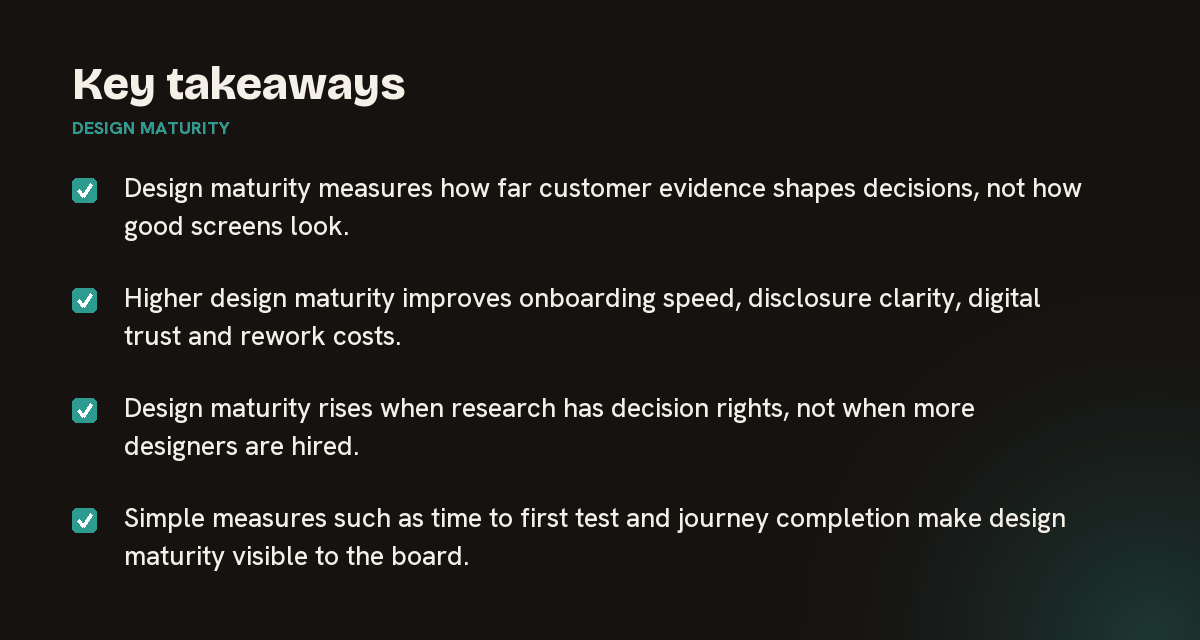
- Design maturity measures how far customer evidence shapes decisions, not how good screens look.
- Higher design maturity improves onboarding speed, disclosure clarity, digital trust and rework costs.
- Design maturity rises when research has decision rights, not when more designers are hired.
- Simple measures such as time to first test and journey completion make design maturity visible to the board.
Raising design maturity is a leadership choice before it is a capability choice. It means giving evidence from customers a formal place in decisions, funding small experiments, and accepting that the first version of a journey will be wrong in ways nobody in the room can predict. Institutions that make that shift find their programmes get faster, not slower, because they spend less time arguing and less money fixing.
Optimizium helps banks, insurers and wealth managers build design maturity into their operating model. We respect the product and risk knowledge already inside the institution, because it is what turns a pleasant prototype into a compliant, profitable product. And we bring compliance and legal colleagues into research and design as co-authors, so that clear disclosure and good conduct are designed in rather than inspected afterwards.
Explore how we approach this across Banking, Insurance and Wealth Management, browse the FAQ Hub, or read the related question: How does leadership maturity influence transformation outcomes?
What is “operational digitization” vs. “customer digitization”?
Related questions
Partner with the experts.
Let's discuss how Optimizium can accelerate your roadmap and navigate complex digital transformation.
Schedule a consultation →