Home › FAQ Hub › How important is talent reskilling?
Leadership, Change & Operating ModelsHow important is talent reskilling?
Talent reskilling is critically important for financial institutions because the capabilities that transformation needs, in data, user experience, engineering, cybersecurity, risk technology and digital product management, are in short supply, and the existing workforce holds the product, risk and customer knowledge that new hires lack.
Every transformation plan in financial services eventually meets the same constraint: the people needed to deliver it are scarce, expensive and in demand everywhere else. Hiring alone will not close the gap.
Talent reskilling is critically important for financial institutions because the capabilities that transformation needs, in data, user experience, engineering, cybersecurity, risk technology and digital product management, are in short supply, and the existing workforce holds the product, risk and customer knowledge that new hires lack. Reskilling turns experienced employees into the product managers, data specialists and digital compliance experts the organisation needs, often faster and with lower risk than external recruitment. That is why banks, insurers and wealth managers increasingly build internal academies and certification pathways. Talent reskilling is not a training programme on the side of transformation; it is one of the conditions for transformation to succeed.
The core tension, in one line:
Institutions cannot hire enough digital talent, yet they already employ people who understand the business better than any new hire.
an insurer needs product owners for its new digital squads. Instead of recruiting externally, it selects experienced underwriters and claims specialists, puts them through a twelve-week product management academy, and pairs each with an experienced coach. Within a year, most squads are led by people who know both the product and the customer.
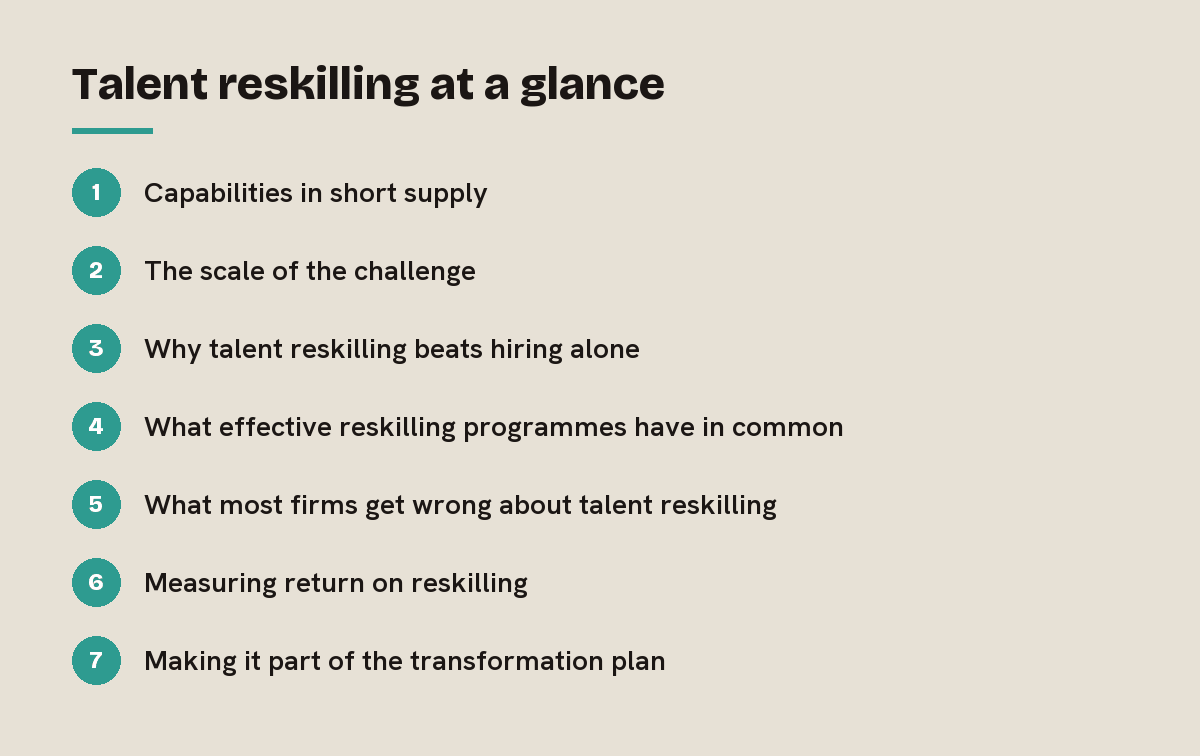
1. Capabilities in short supply
| Capability | What it looks like on the ground | Why reskilling helps |
|---|---|---|
| Product management | Owning a digital product end to end, from customer need to results | Business experts already understand customers and economics |
| Cloud engineering | Building and running services on cloud platforms | Existing engineers know the systems being migrated |
| Data science and model risk | Building, validating and monitoring models | Actuaries, risk analysts and quants have strong foundations |
| Digital compliance and regtech | Embedding controls in digital journeys and automation | Compliance staff know the rules; they need the digital toolkit |
2. The scale of the challenge
The World Economic Forum’s Future of Jobs Report 2025 found that employers expect 39 per cent of workers’ core skills to change by 2030, and that 50 per cent of the workforce has now completed training as part of long-term learning strategies, up from 41 per cent in 2023. Financial services sit near the front of that shift because so much of their work is information-based.
The constraint shows up in supervisory data too. ECB Supervisory Board Chair Claudia Buch noted that around 5 per cent of bank staff are allocated to digital transformation initiatives, and that institutions report difficulty recruiting technology talent. When the external market is tight, talent reskilling becomes the main lever.
3. Why talent reskilling beats hiring alone
| Factor | External hiring | Talent reskilling |
|---|---|---|
| Speed to productivity | Months to learn the business | Weeks to learn new tools on top of business knowledge |
| Cost | High salaries and recruitment fees | Training investment, retained salaries |
| Retention | Competitive market, higher turnover | Stronger loyalty; visible career paths |
| Culture | Risk of a two-tier workforce | Change led by familiar faces |
| Risk knowledge | Often limited | Deep understanding of products and controls |
The point is not to stop hiring. Some specialist skills must come from outside. But the strongest digital teams combine a smaller number of external experts with a larger group of reskilled colleagues.
4. What effective reskilling programmes have in common
- Internal academies: structured programmes with clear curricula, cohorts and practical projects.
- Certification pathways: recognised qualifications that lead to defined roles and pay grades.
- Learning by doing: participants work on live transformation projects with coaching, not just classroom content.
- Selection on aptitude: candidates chosen for curiosity and problem-solving as well as current role.
- Leadership sponsorship: senior leaders visibly support the programme and protect learning time.
5. What most firms get wrong about talent reskilling
- Treating it as an HR initiative: if the business does not create roles for reskilled people, they leave or return to old jobs.
- Teaching tools, not ways of working: a course on a cloud platform does little if teams still work in sequential hand-offs.
- Ignoring middle managers: managers who were never reskilled themselves often struggle to lead reskilled teams.
- Measuring attendance, not outcomes: the measure that matters is how many people now perform new roles well.
Example: a retail bank planned to hire fifty data analysts over two years. It instead launched a data academy for existing staff from operations, finance and risk. A first cohort of twenty completed the programme in six months and joined analytics teams; the bank then hired a smaller number of senior specialists to lead them. Delivery started earlier and turnover was lower than in the bank’s previous external hiring drives.
6. Measuring return on reskilling
Boards rightly ask what reskilling delivers. Useful measures include the share of new digital roles filled internally, time to productivity in those roles compared with external hires, retention of reskilled employees after one and two years, and the delivery performance of teams they join. Over time, the cost avoided in recruitment fees and contractor spend usually makes a clear financial case on its own.
7. Making it part of the transformation plan
Talent reskilling works best when it is planned alongside the target operating model. If an institution knows how many product owners, engineers and data specialists its future structure needs, it can set reskilling targets, choose cohorts and time programmes to match delivery. Without that link, training becomes generic and its impact hard to see.
Key takeaways on talent reskilling
- Talent reskilling fills digital roles faster than external hiring because people already know the business.
- Effective talent reskilling combines academies, certification and learning on live projects.
- Talent reskilling only sticks when new roles exist for people to move into.
- Measuring internal fill rates, time to productivity and retention shows the return on talent reskilling.
For leadership teams, talent reskilling deserves the same attention as technology investment. Systems can be bought; the people who understand both the business and the new tools have to be developed, and the earlier that starts, the sooner transformation stops depending on scarce external hires.
Optimizium helps banks, insurers and wealth managers design reskilling programmes tied to their operating model and delivery plans. We respect the experience and institutional knowledge of existing teams, because it is the foundation new skills are built on. And we bring HR, risk and compliance into the design as co-authors, so new roles come with clear accountabilities and controls.
Explore how we approach this across Banking, Insurance and Wealth Management, browse the FAQ Hub, or read the related question: Why do frontline and middle management often resist digital?
Related questions
On this page
Partner with the experts.
Let's discuss how Optimizium can accelerate your roadmap and navigate complex digital transformation.
Schedule a consultation →