Home › FAQ Hub › How should digital maturity be assessed in financial institutions?
Leadership, Change & Operating ModelsHow should digital maturity be assessed in financial institutions?
A useful digital maturity assessment looks at structural, behavioural and commercial dimensions together. Structurally, it covers technology and data: cloud adoption, modularity, APIs, AI deployment and data governance.
Most financial institutions have been through at least one digital maturity survey: a questionnaire, a radar chart and a score compared with peers. Few of those exercises changed what the institution did next. The problem is usually not the idea of measuring maturity but the way it is measured.
A useful digital maturity assessment looks at structural, behavioural and commercial dimensions together. Structurally, it covers technology and data: cloud adoption, modularity, APIs, AI deployment and data governance. Behaviourally, it covers the operating model: product-led structures, cross-functional teams, agile governance and compliance built into delivery. Commercially, it covers customer and financial outcomes: digital completion, cost to serve, retention and growth.
The best assessments also include risk and resilience, measure each customer journey separately rather than averaging, and compare against the right peers. Above all, a digital maturity assessment should end with a short list of priorities and owners, not a single score.
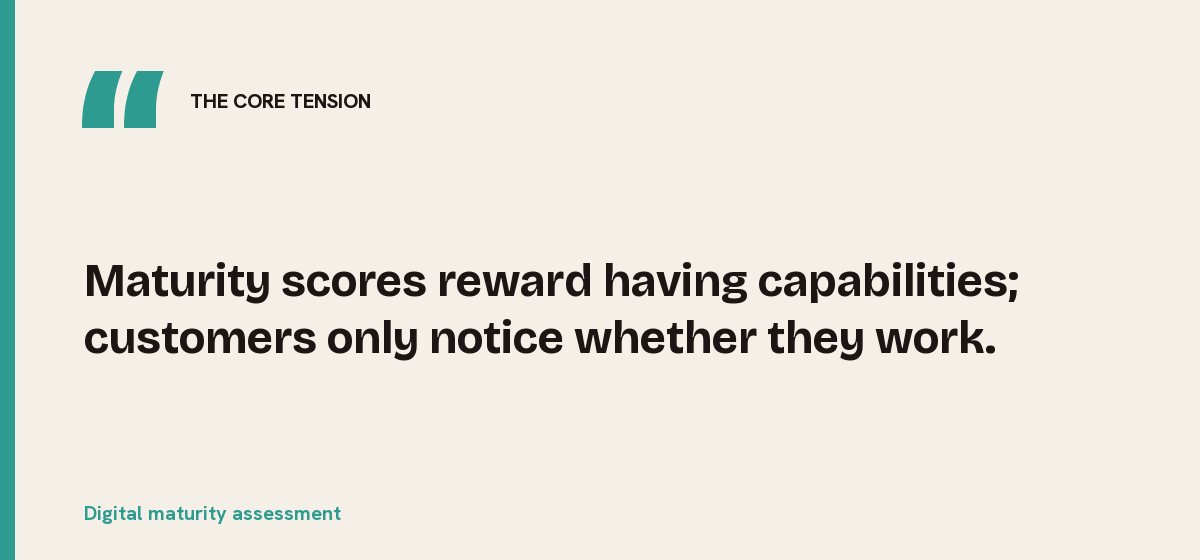
The core tension, in one line:
Maturity scores reward having capabilities; customers only notice whether they work.
a bank scored highly on a generic maturity survey because it had cloud platforms, an app and agile teams. A journey-based digital maturity assessment found that business lending still relied on paper forms and took weeks. That finding, not the overall score, set the next year’s priorities.
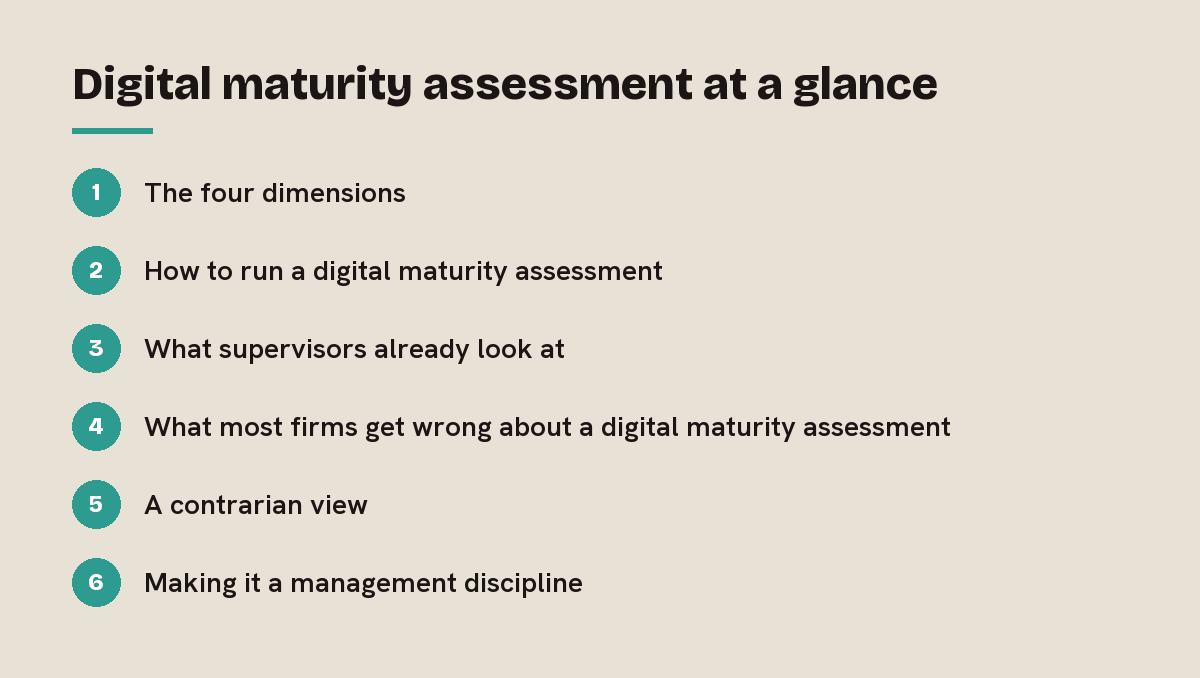
1. The four dimensions
| Dimension | What to assess | Example indicators |
|---|---|---|
| Technology and data | Cloud, modularity, APIs, AI, data governance | Share of journeys on modern platforms, data quality issues |
| Operating model | Product teams, governance, compliance by design | Lead time from idea to customer, journeys with owners |
| Customer and commercial | Digital completion, cost, retention, growth | Completion rates, cost per case, digital sales |
| Risk and resilience | Controls, resilience, third parties | Incidents, recovery times, audit findings |
2. How to run a digital maturity assessment
- Assess by journey: onboarding, servicing, claims, lending, advice.
- Use outcome evidence, not only self-reported capability.
- Compare with relevant peers for each journey.
- Include control functions in the assessment team.
- End with priorities, owners and measures for the next year.
| Common approach | Better approach |
|---|---|
| One score for the whole institution | Scores by journey and dimension |
| Questionnaires and opinions | Data on completion, cost and lead time |
| Benchmark against any bank | Benchmark against relevant peers |
| Report presented, then filed | Priorities with owners and targets |
3. What supervisors already look at
Supervisors have their own view of maturity. The ECB’s 2024 review of digitalisation practices sets out fourteen assessment criteria across business model and strategy, governance, and risk management, including KPI frameworks, data governance and internal control involvement. When the ECB surveyed 105 large banks, it found many lacked adequate indicators to steer their digital strategy. In insurance, EIOPA found that the level of digitalisation is varied and in most cases still at an early stage. A good digital maturity assessment aligns with these supervisory lenses.
4. What most firms get wrong about a digital maturity assessment
- Averaging everything: a strong line of business hides weak ones.
- Rewarding capabilities over results: owning a platform is not the same as using it well.
- Leaving out risk: maturity without control is not maturity in a regulated industry.
- No follow-through: assessments that do not change priorities waste time.
Example: an insurer’s annual digital maturity assessment had produced similar scores for three years. It switched to journey-based measures, such as share of claims notified digitally, cycle time and cost per claim, with owners for each. The next assessment showed clear movement in two journeys and highlighted a third that needed investment.
5. A contrarian view
Many institutions want a single maturity score to report to the board. The more useful report is a map: where the institution is strong, where it is weak, and what will change in the next twelve months. A single score invites comparison; a map invites action.
6. Making it a management discipline
- Repeat the assessment annually, using the same journey measures.
- Link findings to budgets and team objectives.
- Report progress to the board alongside financial results.
- Retire measures that no longer drive decisions.
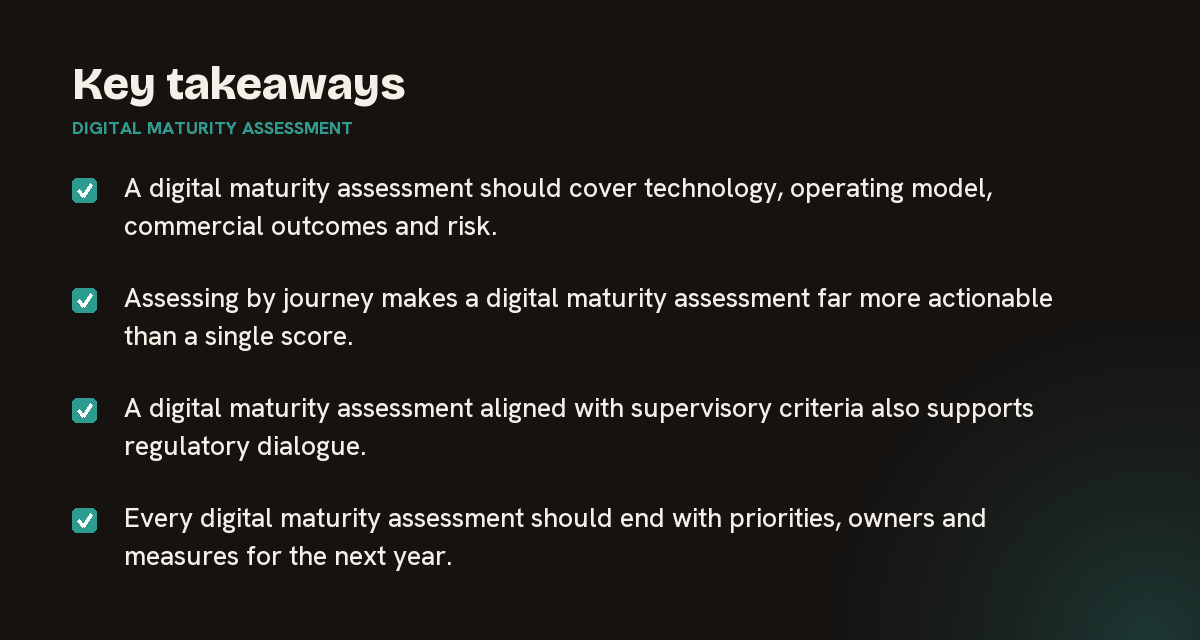
Key takeaways on digital maturity assessment
- A digital maturity assessment should cover technology, operating model, commercial outcomes and risk.
- Assessing by journey makes a digital maturity assessment far more actionable than a single score.
- A digital maturity assessment aligned with supervisory criteria also supports regulatory dialogue.
- Every digital maturity assessment should end with priorities, owners and measures for the next year.
For leadership teams, a well-designed digital maturity assessment is a management tool, not a report card. It shows where to invest, what to stop and how to measure progress in terms customers and supervisors recognise.
Optimizium helps banks, insurers and wealth managers design and run journey-based maturity assessments. We respect the knowledge of business and control teams, because they see where journeys succeed and fail. And we bring risk and compliance into the assessment as co-authors, so maturity includes control as well as capability.
Explore how we approach this across Banking, Insurance, Wealth Management and Beyond Banking, browse the FAQ Hub, or read the related question: Why do digital transformations require cultural change, not only technology change?
Partner with the experts.
Let's discuss how Optimizium can accelerate your roadmap and navigate complex digital transformation.
Schedule a consultation →