Home › FAQ Hub › What defines “advisor enablement” in wealth management?
Leadership, Change & Operating ModelsWhat defines “advisor enablement” in wealth management?
Advisor enablement is the set of platforms, tools and processes that help wealth advisers serve clients better and more efficiently: analytics, planning tools, portfolio simulations, automated reporting and integrated suitability workflows.
Wealth management has always depended on the quality of its advisers. What has changed is how much of an adviser’s week is consumed by tasks clients never see: gathering data, preparing reports, documenting suitability and chasing paperwork.
Advisor enablement is the set of platforms, tools and processes that help wealth advisers serve clients better and more efficiently: analytics, planning tools, portfolio simulations, automated reporting and integrated suitability workflows. Its purpose is to raise adviser productivity, reduce manual errors and strengthen compliance, so that advisers can focus on high-value conversations with clients.
Good advisor enablement also supports hybrid models, where clients handle simple tasks digitally and advisers concentrate on planning, complex decisions and life events. It balances human expertise with algorithmic recommendations, allowing firms to scale without losing the trust that personal advice creates.
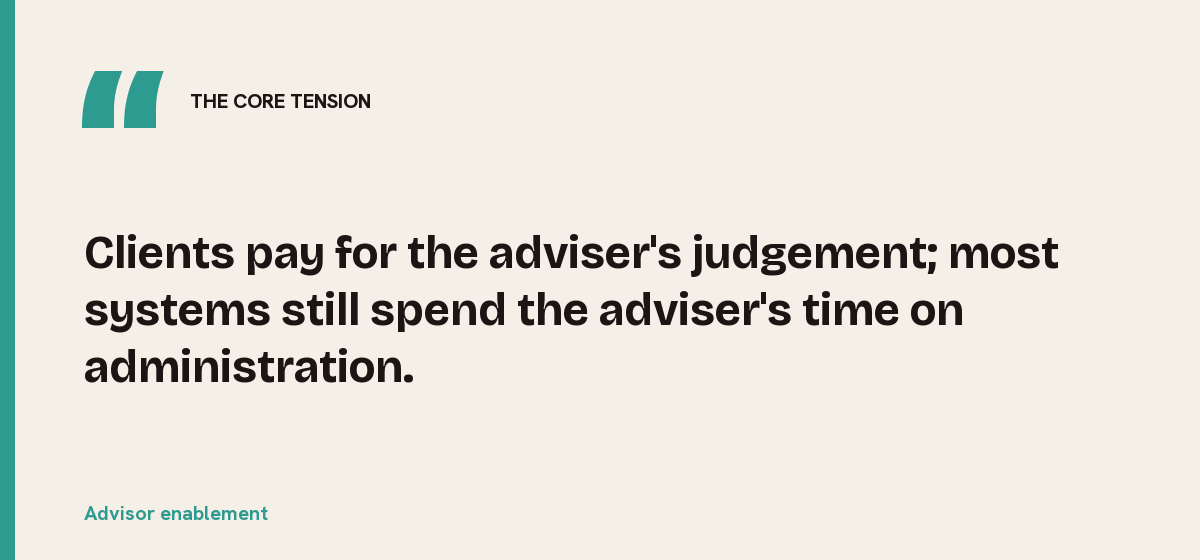
The core tension, in one line:
Clients pay for the adviser’s judgement; most systems still spend the adviser’s time on administration.
an advisory firm gives its advisers a single workstation that pulls client data, holdings, research and suitability records into one view, pre-fills review packs and records recommendations automatically. Advisers who used to spend half a day preparing each review now spend an hour, and use the time saved for more client meetings.
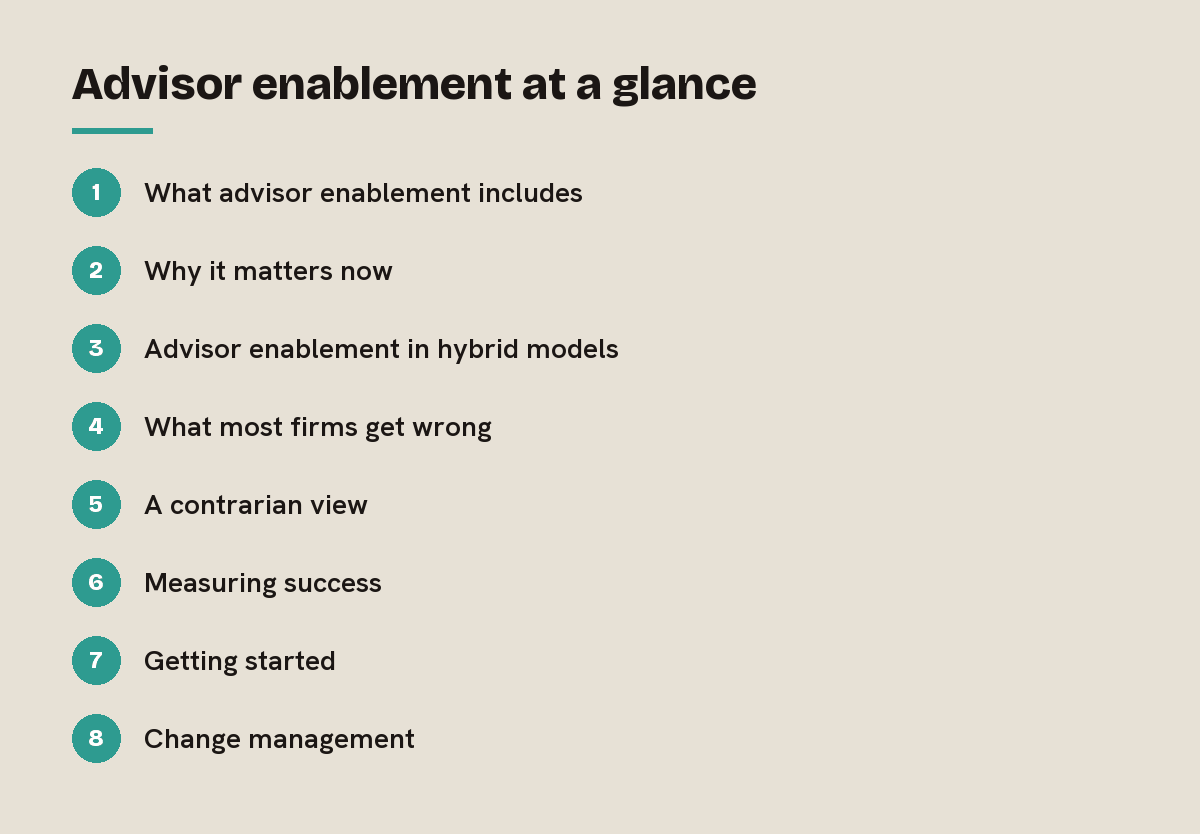
1. What advisor enablement includes
| Tool | What it does | Benefit |
|---|---|---|
| Client and portfolio analytics | Shows holdings, risk and performance in one place | Better-prepared conversations |
| Planning tools | Models goals, cash flows and scenarios | Clearer advice clients can follow |
| Portfolio simulations | Tests changes before recommending them | Evidence for suitability |
| Automated reporting | Generates reviews and statements | Hours saved per client |
| Suitability workflows | Captures and records assessments | Consistent compliance evidence |
2. Why it matters now
- Capacity: experienced advisers are scarce, so each adviser’s capacity matters for growth.
- Regulation: ESMA’s guidelines on the MiFID II suitability requirements set clear expectations for what must be gathered, assessed and recorded, including clients’ sustainability preferences since 2022.
- Skills: the World Economic Forum’s Future of Jobs Report 2025 found that employers expect 39 per cent of workers’ core skills to change by 2030, and advisers are no exception.
- Client expectations: clients increasingly expect digital access to their information between meetings.
3. Advisor enablement in hybrid models
| Client need | Digital self-service | Adviser-led |
|---|---|---|
| Top-ups and simple changes | Yes | Only if requested |
| Statements and reporting | Yes | Explanation in reviews |
| Planning and major decisions | Information and tools | Yes |
| Life events | Prompts and booking | Yes |
The adviser’s view must include everything the client did digitally, so conversations continue rather than restart. That is the difference between hybrid advice and two disconnected channels.
4. What most firms get wrong
- Adding tools without removing tasks: a new system alongside old processes increases workload.
- Designing without advisers: tools built without adviser input rarely get adopted.
- Measuring logins, not capacity: the goal is more client time and more clients served well.
- Treating automation as a threat to advice: in practice, good advisor enablement makes advisers more valuable, not less.
Example: a private bank asked relationship managers to log every manual task for a month. The biggest time drains were re-keying client data, preparing review packs and chasing documents. The bank addressed those three first, before any client-facing change, and relationship managers gained enough time for an extra client review each week.
5. A contrarian view
Advisor enablement is often presented as a technology purchase. The real work is process redesign and adoption: deciding which tasks to remove, which to automate and how advisers will use the time released. Firms that start with those questions get far more from the same tools.
6. Measuring success
Useful measures include client-facing hours per adviser, households served per adviser, review preparation time, the share of suitability records completed without rework, and client satisfaction after reviews. Tracked before and after each change, they show whether advisor enablement is working.
7. Getting started
- Log adviser time for a few weeks to find the biggest drains.
- Fix the top three end to end, with advisers in the design.
- Integrate data so advisers work from one client view.
- Build compliance into the workflow, not alongside it.
8. Change management
Tools change little unless advisers trust them. Successful firms pilot with a small group of respected advisers, fix what they find, and let those advisers show colleagues how much time they save. Training is practical and short, focused on real client reviews rather than system features. Managers set expectations for using the new workflows, especially for suitability records, so that the benefits reach every client.
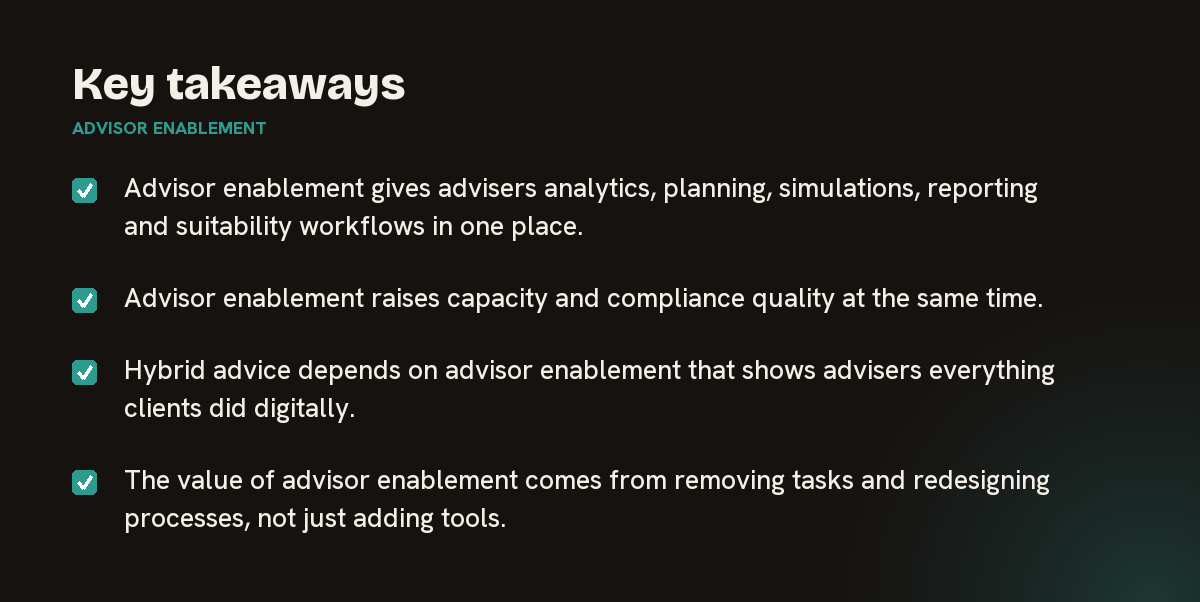
Key takeaways on advisor enablement
- Advisor enablement gives advisers analytics, planning, simulations, reporting and suitability workflows in one place.
- Advisor enablement raises capacity and compliance quality at the same time.
- Hybrid advice depends on advisor enablement that shows advisers everything clients did digitally.
- The value of advisor enablement comes from removing tasks and redesigning processes, not just adding tools.
For wealth leaders, advisor enablement is one of the most direct links between digital investment and financial results. It improves capacity, quality and client experience together, and its effects can be measured within months.
Optimizium helps wealth managers, private banks and advisory firms design and implement advisor enablement. We respect the judgement and client relationships advisers have built, because they are the heart of the business. And we bring compliance and risk colleagues into the design as co-authors, so efficiency and suitability improve together.
Explore how we approach this across Wealth Management, Banking and Beyond Banking, browse the FAQ Hub, or read the related question: Why do frontline and middle management often resist digital?
Related questions
Partner with the experts.
Let's discuss how Optimizium can accelerate your roadmap and navigate complex digital transformation.
Schedule a consultation →