Home › FAQ Hub › What defines “digital intent-to-serve” in financial services?
Digital Ops & Customer ExperienceWhat defines “digital intent-to-serve” in financial services?
Digital intent-to-serve describes how proactively a financial institution helps customers complete their goals with minimal friction, clear guidance and few errors. It blends user experience, product design, AI assistance and operational orchestration, so that the journey anticipates what the customer needs next, prevents mistakes and resolves problems quickly.
Some digital services feel as if they were built to process customers. Others feel as if they were built to help them. The difference is not the technology but the intent behind every design decision.
Digital intent-to-serve describes how proactively a financial institution helps customers complete their goals with minimal friction, clear guidance and few errors. It blends user experience, product design, AI assistance and operational orchestration, so that the journey anticipates what the customer needs next, prevents mistakes and resolves problems quickly.
In banking, digital intent-to-serve shows up in onboarding, payments, credit and problem resolution. In insurance, it shows up in quotes, claims, renewals, disclosures and advice. In wealth, it shows in planning, reporting and timely contact with advisers. The common test is simple: does the service move the customer towards their goal, or does it make the customer work for the institution?
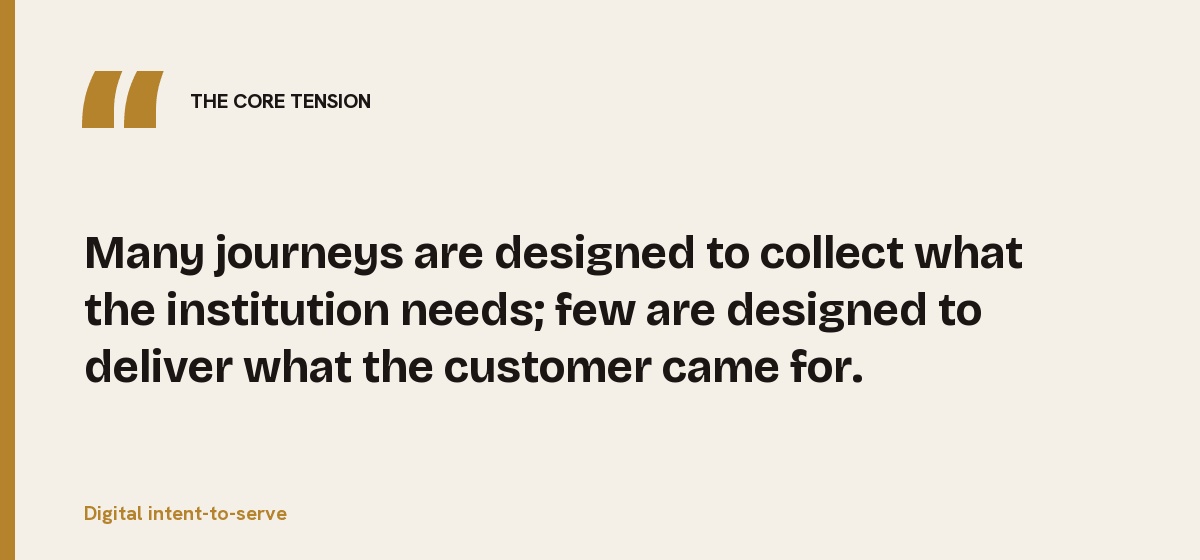
The core tension, in one line:
Many journeys are designed to collect what the institution needs; few are designed to deliver what the customer came for.
a customer’s card is declined abroad. A bank with weak digital intent-to-serve sends a generic alert and a phone number. A bank with strong intent explains why, lets the customer confirm the transaction in the app with one tap, and retries the payment automatically. The problem is solved before the customer reaches the till again.
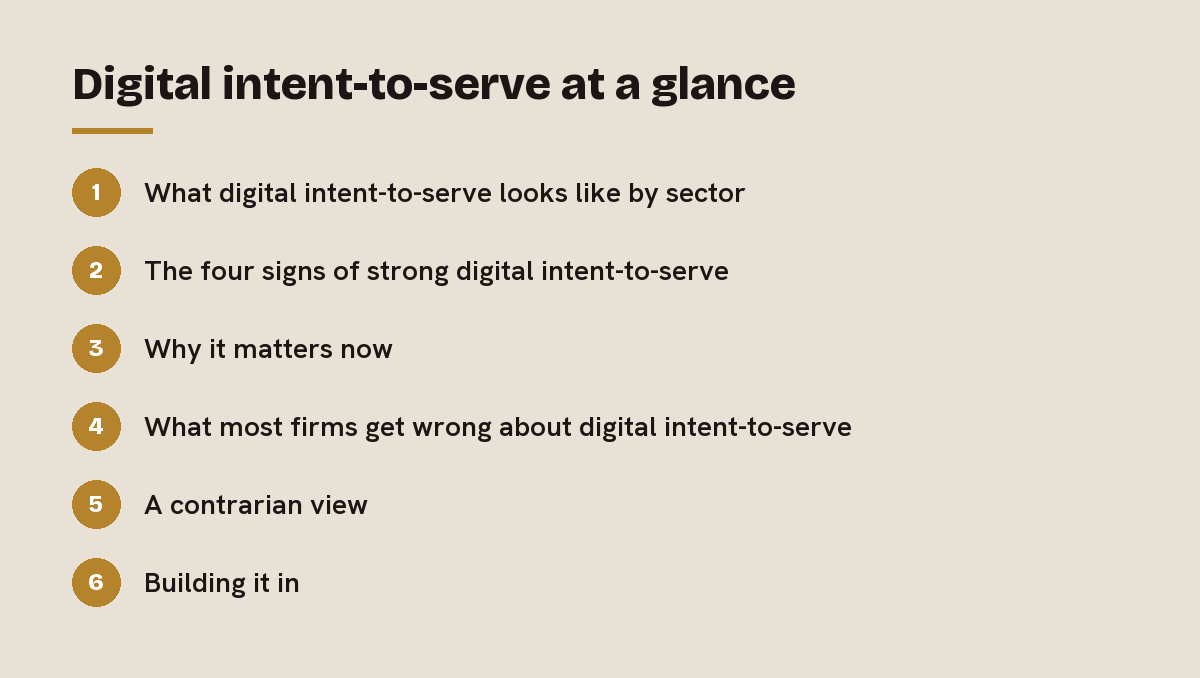
1. What digital intent-to-serve looks like by sector
| Sector | Where it matters most | What strong intent looks like |
|---|---|---|
| Banking | Onboarding, payments, credit, problems | Clear next steps, instant fixes, proactive alerts |
| Insurance | Quotes, claims, renewals, disclosures | Plain cover summaries, claim status, fair renewals |
| Wealth | Planning, reporting, advice | Understandable performance, timely adviser contact |
| Fintech | Onboarding, money movement | Fast, transparent, recoverable journeys |
2. The four signs of strong digital intent-to-serve
- Anticipation: the service prompts customers before problems occur, such as a renewal explanation or a low-balance alert.
- Guidance: each step explains what is needed and why.
- Error prevention: data is validated as it is entered, so mistakes do not surface at the end.
- Fast recovery: when something goes wrong, customers can fix it themselves or reach help quickly.
3. Why it matters now
Customer behaviour and regulation both point the same way. Signicat found that 68 per cent of European consumers had abandoned a financial services application in the previous year, often because journeys asked too much or explained too little. In the UK, the FCA’s Consumer Duty expects firms to give customers the information they need, at the right time, presented in a way they can understand. And under the European Accessibility Act, consumer banking services provided after 28 June 2025 must be accessible, a direct test of whether services are built for all customers.
| Weak intent-to-serve | Strong intent-to-serve |
|---|---|
| Generic error messages | Specific, actionable explanations |
| Repeated data requests | Data reused across journeys |
| Problems found at the end | Validation at each step |
| Phone number as the fallback | In-app resolution, then easy human help |
4. What most firms get wrong about digital intent-to-serve
- Designing around internal processes: journeys mirror the organisation instead of the customer’s goal.
- Measuring completion only: a completed journey that confused the customer still fails the test.
- Treating AI as the answer: chatbots without access to systems or decisions frustrate more than they help.
- Forgetting the unhappy path: strong intent shows most when something goes wrong.
Example: an insurer analysed calls after online claims and found many customers phoned to ask what would happen next. Adding a timeline, named handler and status updates to the digital claim reduced those calls and improved satisfaction, without changing the underlying claims process.
5. A contrarian view
Digital intent-to-serve is often treated as a design or technology goal. It is really an organisational one: it depends on whether product, operations and risk teams are measured on customer outcomes. Without that alignment, the best design work is overridden by internal priorities.
6. Building it in
- Define each journey by the customer’s goal.
- Map the unhappy paths as carefully as the happy ones.
- Give teams outcome measures: goal completion, recovery time, avoidable contact.
- Connect AI assistance to real systems and decisions.
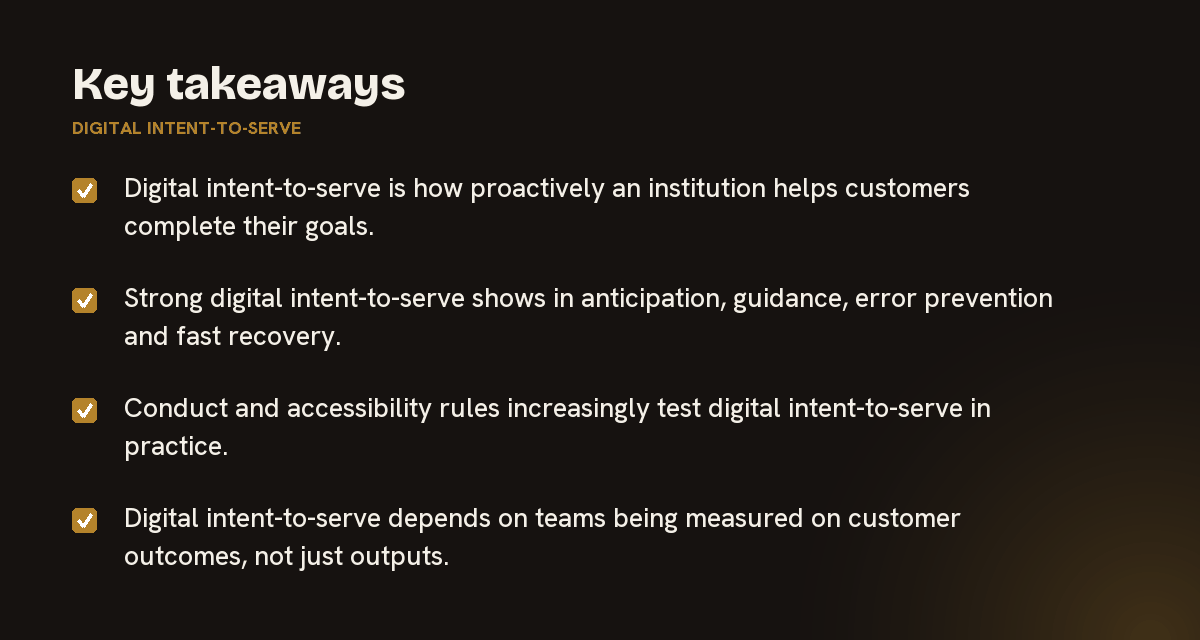
Key takeaways on digital intent-to-serve
- Digital intent-to-serve is how proactively an institution helps customers complete their goals.
- Strong digital intent-to-serve shows in anticipation, guidance, error prevention and fast recovery.
- Conduct and accessibility rules increasingly test digital intent-to-serve in practice.
- Digital intent-to-serve depends on teams being measured on customer outcomes, not just outputs.
For leadership teams, digital intent-to-serve is a useful lens for every investment: does it move customers closer to their goals? Institutions that apply it consistently see fewer complaints, lower service costs and stronger loyalty.
Optimizium helps banks, insurers and wealth managers redesign journeys around customer goals. We respect the operational and risk knowledge behind existing processes, because it explains their constraints. And we bring compliance and operations teams into the design as co-authors, so journeys serve customers and remain well controlled.
Explore how we approach this across Banking, Insurance and Wealth Management, browse the FAQ Hub, or read the related question: What is the role of orchestration engines?
Related questions
Partner with the experts.
Let's discuss how Optimizium can accelerate your roadmap and navigate complex digital transformation.
Schedule a consultation →