Home › FAQ Hub › What is “Embedded Insurance” and how does it redefine MGA distribution?
AI, Data & AnalyticsWhat is “Embedded Insurance” and how does it redefine MGA distribution?
Embedded insurance integrates an insurance offer directly into the purchase journey of a non-insurance product, such as travel cover during a flight booking, device protection at an e-commerce checkout or gap cover with a car lease.
Most people do not wake up wanting to buy insurance. They want to book a flight, buy a laptop or lease a car, and only then think about what might go wrong. Embedded insurance meets them at exactly that point.
Embedded insurance integrates an insurance offer directly into the purchase journey of a non-insurance product, such as travel cover during a flight booking, device protection at an e-commerce checkout or gap cover with a car lease. Instead of the customer searching for a policy, the policy appears where the need arises, priced and bound in a few clicks.
For managing general agents (MGAs), embedded insurance redefines distribution. MGAs can capture customers at the exact moment of need, reduce customer acquisition costs and make insurance a seamless part of the primary transaction. Their speed in product design and technology makes them natural partners for retailers and platforms, while capacity providers carry the risk.
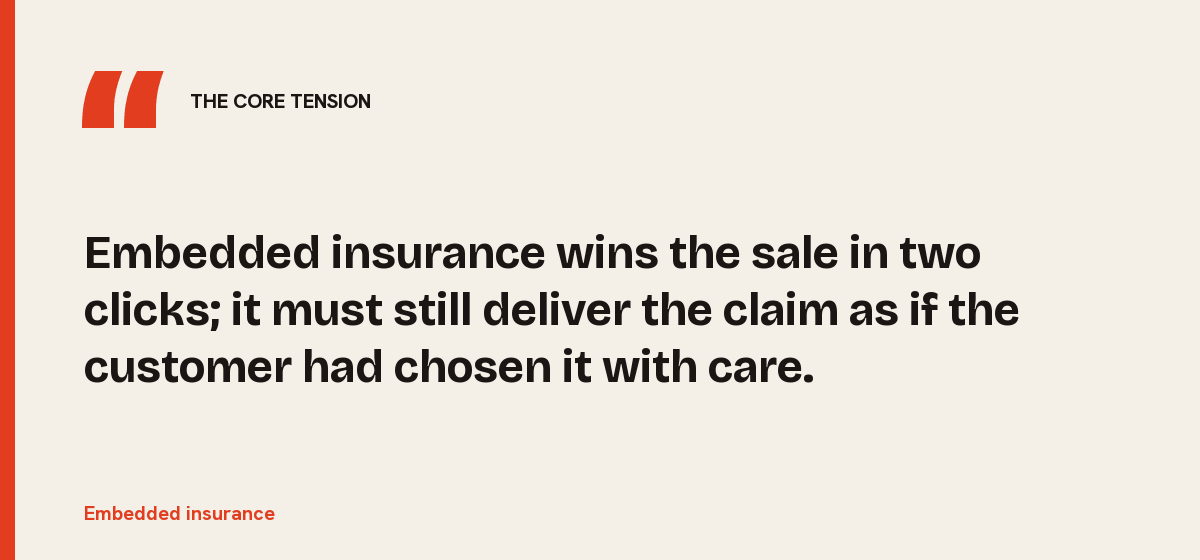
The core tension, in one line:
Embedded insurance wins the sale in two clicks; it must still deliver the claim as if the customer had chosen it with care.
an online electronics retailer partners with an MGA to offer accidental damage cover at checkout. The MGA’s API prices the cover using the device model and price, shows a short summary of what is included and excluded, and issues the policy instantly. When a customer later cracks a screen, the claim is filed in the retailer’s app and settled with a replacement within days.
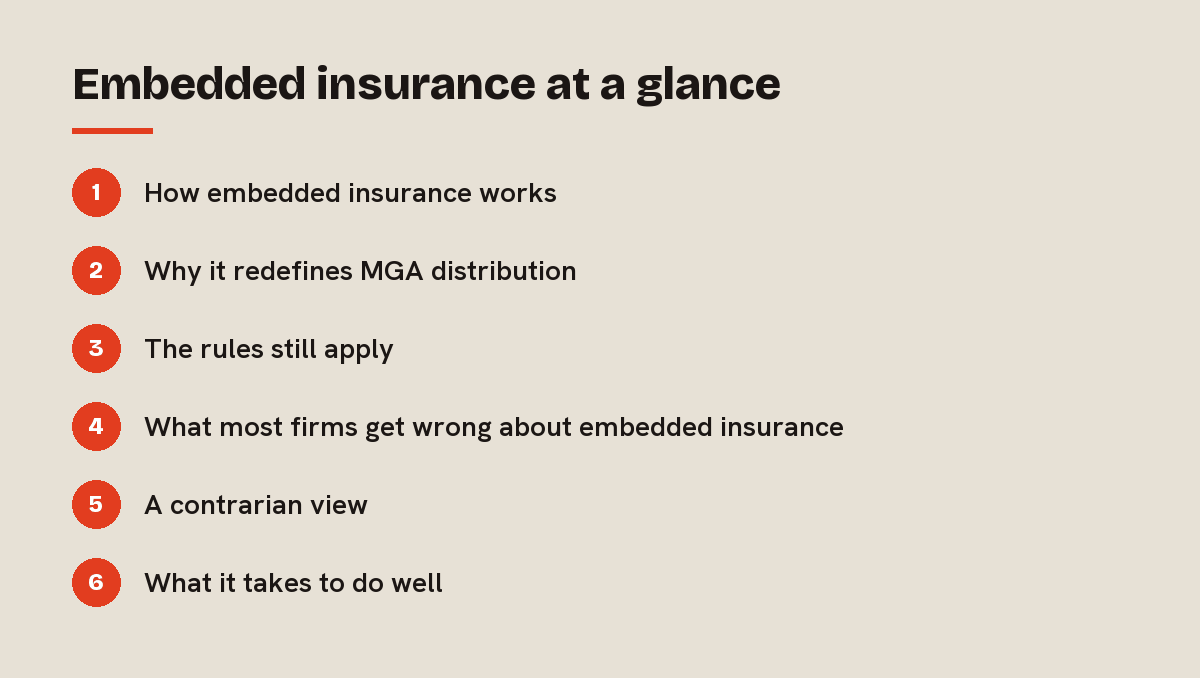
1. How embedded insurance works
| Element | What it looks like on the ground | Who usually provides it |
|---|---|---|
| Moment of need | Checkout, booking or contract signing | Retailer or platform |
| Product | Simple, standard cover matched to the purchase | MGA |
| Pricing and binding | Instant quote and issue via API | MGA systems |
| Risk capacity | Carrying the insured risk | Insurer or reinsurer |
| Claims | Simple, often digital, settlement | MGA or claims partner |
2. Why it redefines MGA distribution
- Lower acquisition cost: the partner brings the customer; the MGA does not pay to find them.
- Higher relevance: cover is offered when the risk is obvious to the customer.
- Speed: MGAs can design and launch partner-specific products quickly.
- Data: partner context, such as the device or trip, improves pricing.
| Traditional MGA distribution | Embedded insurance distribution |
|---|---|
| Brokers and comparison sites | Retailers, platforms and lenders |
| Customer searches for cover | Cover appears at the moment of need |
| Longer forms | Pre-filled from the purchase |
| Separate brand experience | Inside the partner’s journey |
3. The rules still apply
Embedded insurance is still insurance distribution. The Insurance Distribution Directive requires distributors to specify the customer’s demands and needs and, when insurance is sold together with another product, to explain whether the components can be bought separately and show their costs. In the UK, the FCA’s Consumer Duty asks firms to ensure customers get the information they need at the right time, in a way they can understand. A two-click sale must still meet those standards.
The market context supports the model. EIOPA found that digital-only distribution channels still lag well behind physical or hybrid ones, which leaves room for embedded models that make digital buying feel natural rather than separate.
4. What most firms get wrong about embedded insurance
- Complex products in a checkout: embedded insurance works for simple, modular cover, not advice-led products.
- Hidden costs and pre-ticked boxes: they undermine trust and invite regulatory challenge.
- Neglecting claims: the partner’s brand suffers if claims are slow or confusing.
- Weak partner oversight: the MGA and insurer remain responsible for conduct, wherever the sale happens.
Example: a travel platform’s embedded cover had high take-up but also high complaint rates about exclusions. The MGA redesigned the offer with three plain-language bullet points on what was not covered and a link to full terms. Take-up dipped slightly, complaints fell sharply and renewal partnerships with the platform became easier to negotiate.
5. A contrarian view
Embedded insurance is usually celebrated for conversion. Its long-term value depends on claims and trust. MGAs that treat the claim as part of the partner’s customer experience, not as a back-office afterthought, build partnerships that last and products that customers keep.
6. What it takes to do well
- Simple, standard products designed for the partner’s context.
- Fast, reliable APIs for pricing, binding and claims.
- Clear disclosure within the purchase flow.
- Joint governance with partners and capacity providers.
- Outcome monitoring: take-up, cancellations, complaints and claims experience.
Key takeaways on embedded insurance
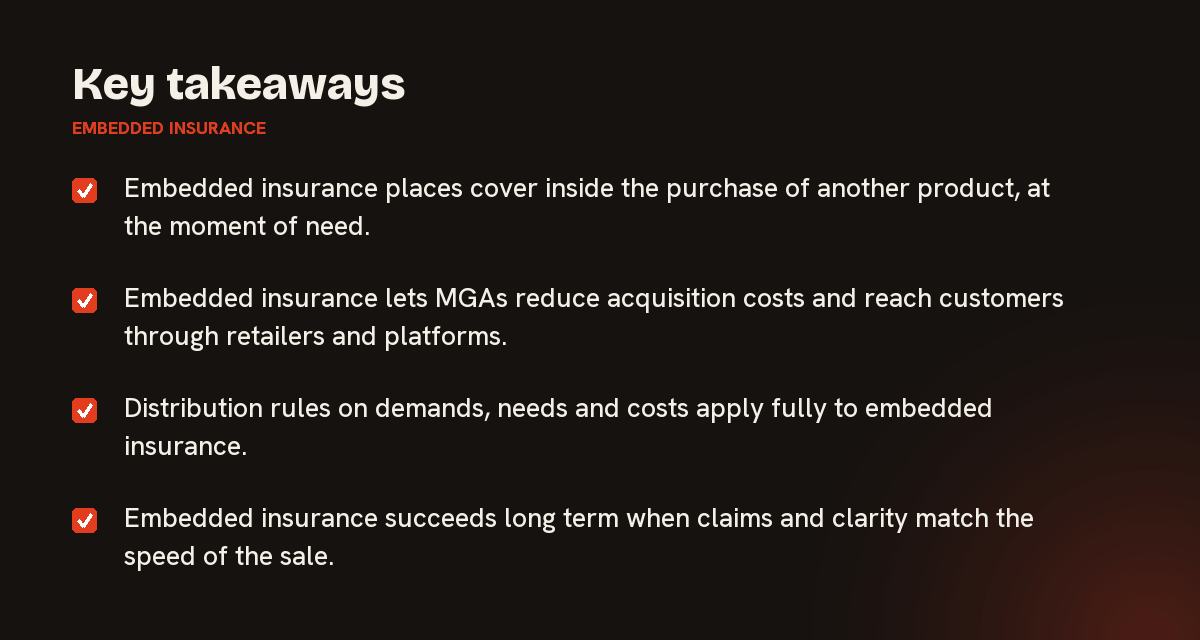
- Embedded insurance places cover inside the purchase of another product, at the moment of need.
- Embedded insurance lets MGAs reduce acquisition costs and reach customers through retailers and platforms.
- Distribution rules on demands, needs and costs apply fully to embedded insurance.
- Embedded insurance succeeds long term when claims and clarity match the speed of the sale.
For leaders of MGAs and insurers, embedded insurance is one of the most promising distribution shifts in years. The firms that benefit will combine product simplicity, strong technology, clear disclosure and claims that keep the promise made at the point of sale.
Optimizium helps MGAs, insurers and their partners design embedded insurance propositions and the operations behind them. We respect the underwriting and claims expertise that makes cover worth buying. And we bring compliance, risk and partner teams into the design as co-authors, so growth through embedded channels is sustainable.
Explore how we approach this across Insurance, Beyond Banking and Banking, browse the FAQ Hub, or read the related question: Why are MGAs considered “innovation sandboxes” for large insurance groups?
Related questions
Partner with the experts.
Let's discuss how Optimizium can accelerate your roadmap and navigate complex digital transformation.
Schedule a consultation →