Home › FAQ Hub › What is “operational digitization” vs. “customer digitization”?
Digital Ops & Customer ExperienceWhat is “operational digitization” vs. “customer digitization”?
Operational digitization replaces internal processes, such as underwriting, servicing, reconciliation and compliance checks, with digital workflows and data; customer digitization replaces the interactions customers see, such as applications, claims, payments and advice, with digital experiences.
Two institutions can spend the same budget on digital change and end up in very different places. One has a slick app sitting on paper-based processes; the other has efficient processes that customers never notice. The difference lies in which kind of digitization came first.
Operational digitization replaces internal processes, such as underwriting, servicing, reconciliation and compliance checks, with digital workflows and data; customer digitization replaces the interactions customers see, such as applications, claims, payments and advice, with digital experiences. Both matter, but they deliver different value: operational digitization lowers cost and error, while customer digitization drives acquisition, engagement and satisfaction. Most incumbents digitize operations first and customers later, because internal efficiency is easier to justify. Digital leaders often invert that order: they redesign the customer interaction first and then rebuild the operations needed to deliver it. The right sequence depends on where an institution’s value is leaking.
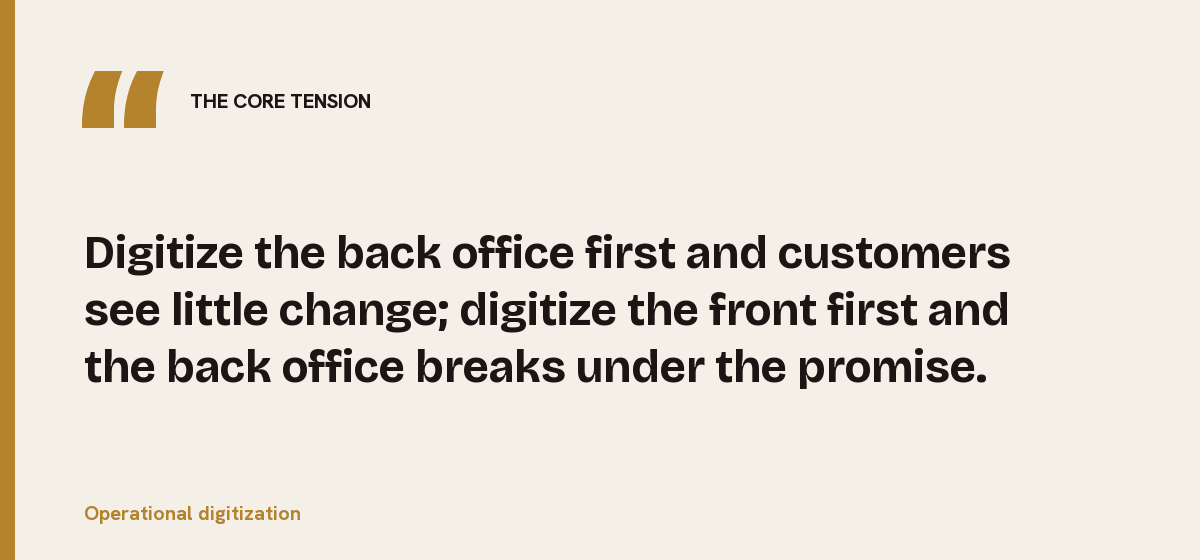
The core tension, in one line:
Digitize the back office first and customers see little change; digitize the front first and the back office breaks under the promise.
an insurer launches online claims notification before automating claims handling. Notifications arrive faster, but handlers still re-key them into the old system, and settlement times do not move. Customers were promised speed and experienced the same wait with a nicer form.
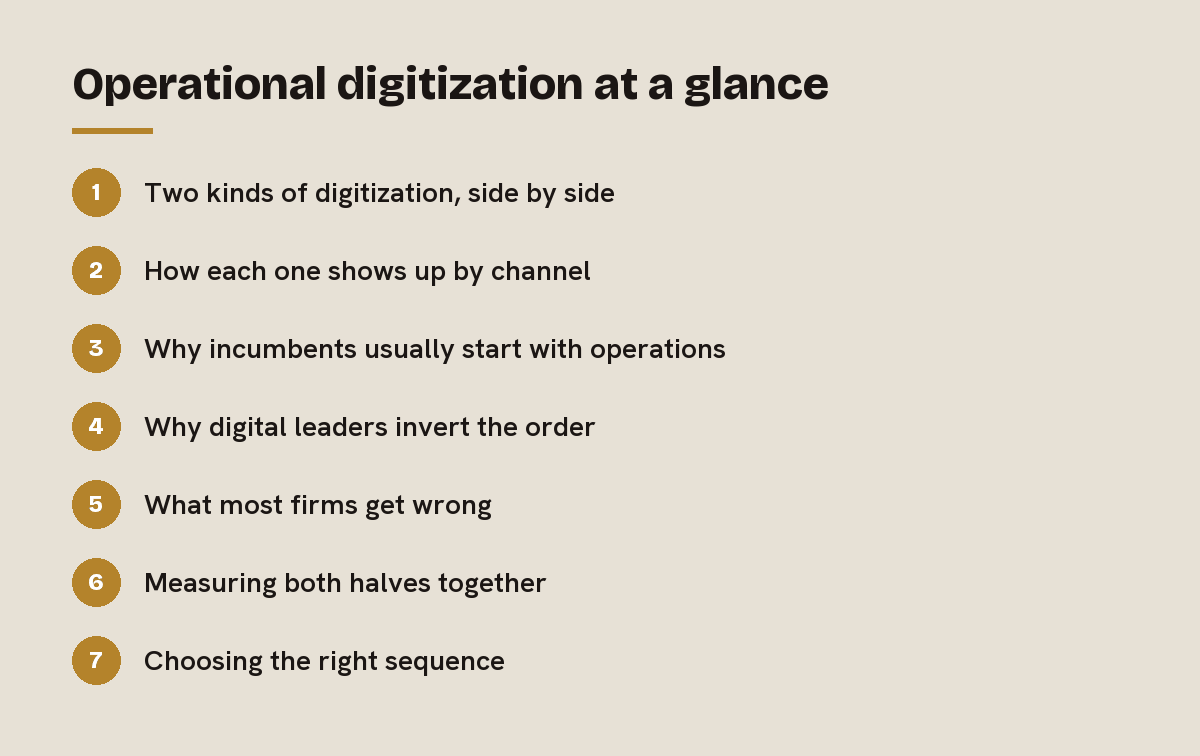
1. Two kinds of digitization, side by side
| Dimension | Operational digitization | Customer digitization |
|---|---|---|
| What changes | Internal workflows, data flows, controls | Applications, servicing, communication, advice |
| Who notices first | Operations, finance, risk | Customers, brokers, advisers |
| Main value | Lower cost-to-serve, fewer errors, faster cycle times | Higher conversion, engagement and satisfaction |
| Typical risk | Efficient processes nobody experiences as better | Attractive front ends on processes that cannot keep the promise |
| Typical measure | Straight-through processing rate, cost per case | Completion rate, digital adoption, complaints |
2. How each one shows up by channel
Distribution channels experience the two forms very differently.
- Branch to workflow tools: in a branch network, operational digitization gives staff digital workflows that replace forms, so the same branch serves customers faster and with fewer errors.
- Broker to portals: in intermediated insurance and lending, the broker portal is the customer interface for the intermediary and the start of the operational process for the insurer. Both kinds of digitization meet here.
- Direct digital to a full-stack experience: in direct channels, customer digitization only works if the full stack behind it is digital as well. There is no branch or broker to absorb the gaps.
3. Why incumbents usually start with operations
There are sound reasons for the conventional order.
- Business cases are clearer: savings from automation are easier to quantify than revenue from better experiences.
- Risk is lower: internal changes are less visible if they go wrong.
- Regulators expect control first: supervisors look for robust processes and data before new customer channels scale.
Investment levels shape the choice too. According to ECB Supervisory Board Chair Claudia Buch, banks under ECB supervision invest on average 2.8 per cent of their operating income in digital transformation projects, around one fifth of total IT spending. With budgets that tight, institutions tend to fund the savings case first.
4. Why digital leaders invert the order
The contrarian view, and the one most digital leaders act on, is that starting with operational digitization often optimises processes that should not exist in their current form.
| Starting point | What happens | Result |
|---|---|---|
| Operations first | Existing steps are automated as they are | Efficient, but the customer journey keeps its old shape |
| Customer first | The ideal interaction is designed, then operations are rebuilt to deliver it | Fewer steps overall; processes exist because customers need them |
Customer behaviour supports the second approach. Eurostat reports that 67 per cent of people aged 16 to 74 in the EU used internet banking in 2024. When most interactions are digital, the customer journey becomes the best specification for what operations must do.
5. What most firms get wrong
- Treating the two as separate programmes: separate budgets and leaders for operational digitization and customer digitization guarantee a gap between promise and delivery.
- Launching the front end without the back end: a digital application that ends in a manual queue creates new frustration.
- Automating exceptions away on paper only: if edge cases still fall to manual teams, operational digitization is incomplete.
- Measuring each side in isolation: completion rates and cost per case need to be read together.
Example: a retail bank planned to automate its account-maintenance back office over two years. A design sprint with customers showed that most maintenance requests came from confusing letters and missing self-service options. The bank redesigned the customer interactions first, removing a large share of the requests altogether, and then automated a much smaller back office. Operational digitization cost less because customer digitization came first.
6. Measuring both halves together
A single scorecard prevents either side from declaring victory alone. For each priority journey, track four numbers side by side: the share of customers who complete it digitally, the time from start to final outcome, the cost per completed case, and the share of cases that need manual intervention. If completion rises while manual intervention stays flat, the front end is ahead of the back end. If cost per case falls while completion stays flat, operations are improving out of sight of customers. Reviewing these together each month, with the owners of both halves in the room, is a simple discipline that keeps the programme honest.
7. Choosing the right sequence
- Where acquisition is the problem, start with customer journeys.
- Where cost-to-serve is the problem, start with operations, but design them around the target customer journey.
- Where both are urgent, run them as one programme, journey by journey, with shared measures.
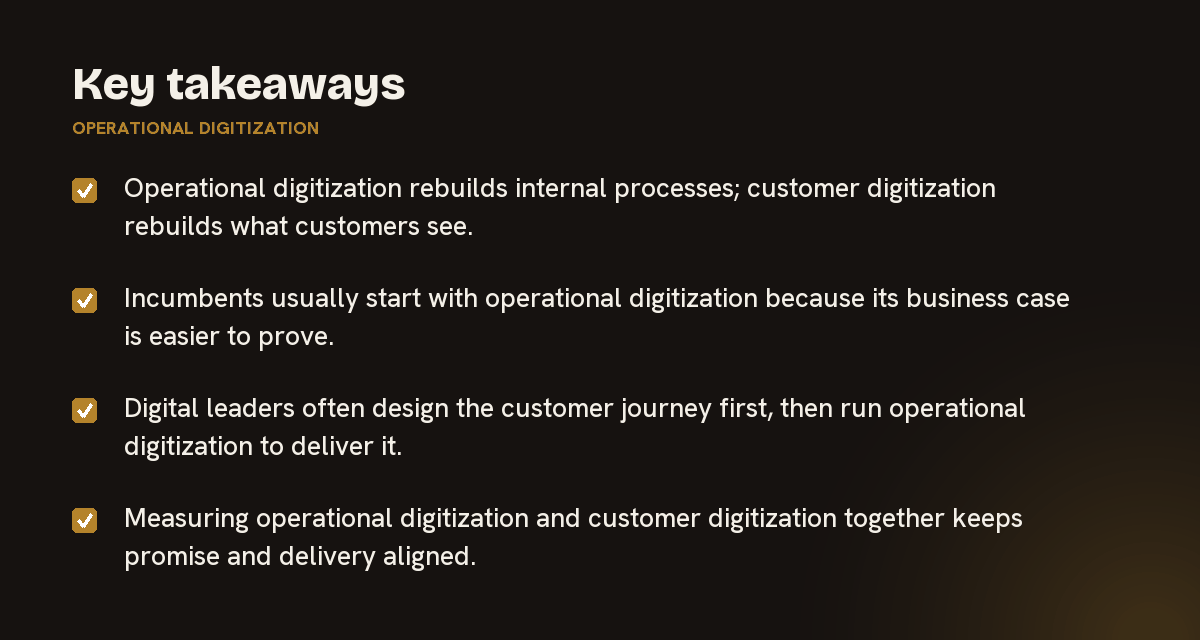
Key takeaways on operational digitization
- Operational digitization rebuilds internal processes; customer digitization rebuilds what customers see.
- Incumbents usually start with operational digitization because its business case is easier to prove.
- Digital leaders often design the customer journey first, then run operational digitization to deliver it.
- Measuring operational digitization and customer digitization together keeps promise and delivery aligned.
For executive teams, the most useful question is not “which kind of digitization should we do?” but “which journeys matter most, and what do customers and operations each need for those journeys to work?” Answering that journey by journey keeps the two halves of the effort aligned.
Optimizium helps banks, insurers and wealth managers plan and deliver both, in the right order. We respect the operational knowledge built up in back offices over decades, because it holds the detail that makes a journey work. And we bring operations, risk and compliance into the design as co-authors, so customer promises and operational reality are written together.
Explore how we approach this across Banking, Insurance and Wealth Management, browse the FAQ Hub, or read the related question: How does customer lifetime value vary across industries?
Related questions
On this page
Partner with the experts.
Let's discuss how Optimizium can accelerate your roadmap and navigate complex digital transformation.
Schedule a consultation →