Home › FAQ Hub › What is the recommended digital operating model for financial institutions?
Tech & Core ModernisationWhat is the recommended digital operating model for financial institutions?
The recommended digital operating model for most financial institutions is federated: centralised platforms for shared capabilities, such as identity, payments, data and security, combined with distributed digital teams aligned to customer journeys like onboarding, lending, claims or advice. Full centralisation improves efficiency and control but slows innovation; full decentralisation speeds experimentation but raises cost and fragmentation.
Many institutions have reorganised for digital more than once: a central digital unit, then embedded teams, then something in between. Each change promised speed. The organisations that achieved it usually landed on a similar answer.
The recommended digital operating model for most financial institutions is federated: centralised platforms for shared capabilities, such as identity, payments, data and security, combined with distributed digital teams aligned to customer journeys like onboarding, lending, claims or advice. Full centralisation improves efficiency and control but slows innovation; full decentralisation speeds experimentation but raises cost and fragmentation.
The federated model takes the strengths of both, provided the interfaces between platforms and journey teams are clearly governed. Wealth managers increasingly adopt hybrid versions that bring advisory, research, product and compliance together around the client. In every version, the key is clear ownership of journeys and capabilities, with risk and compliance built into how teams work.
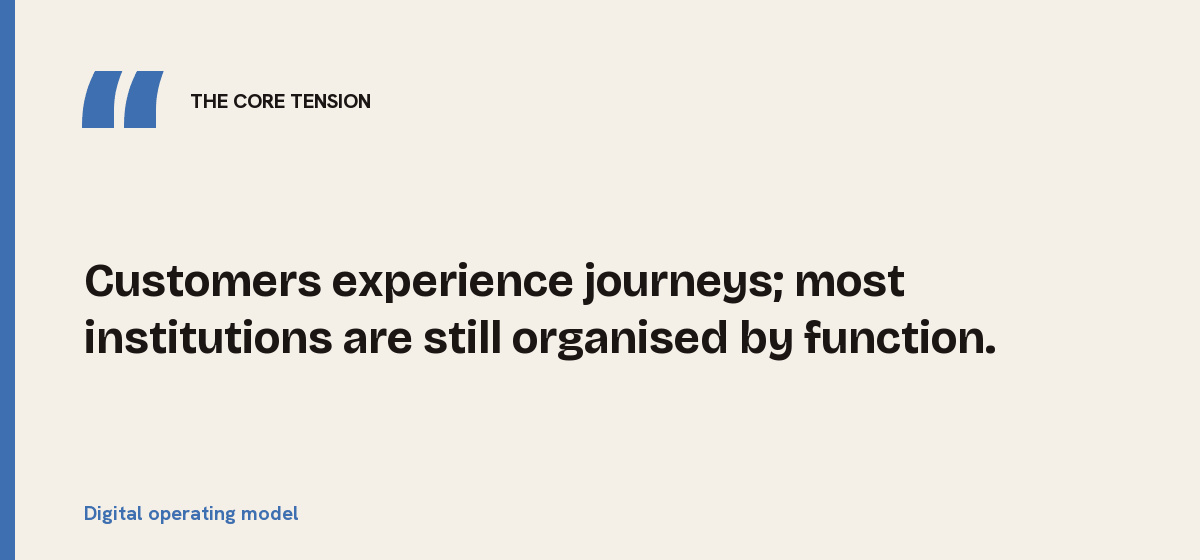
The core tension, in one line:
Customers experience journeys; most institutions are still organised by function.
a bank’s mortgage journey crossed marketing, digital, credit risk, operations and branches, each with its own targets. After creating one mortgage journey team with an accountable owner and embedded risk and operations specialists, time to offer fell and hand-offs between departments largely disappeared.
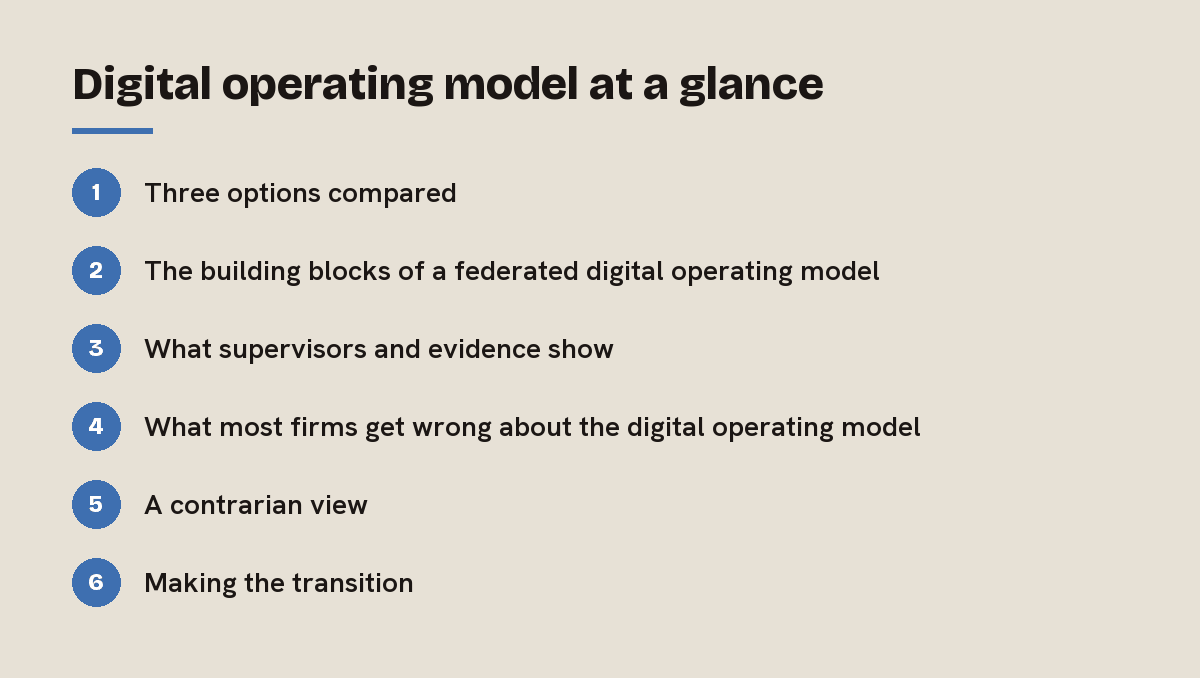
1. Three options compared
| Model | Strengths | Weaknesses |
|---|---|---|
| Centralised | Efficiency, control, common standards | Slow, distant from business, bottleneck |
| Decentralised | Speed, closeness to customers | Duplication, cost, fragmentation |
| Federated | Shared platforms plus agile journey teams | Needs clear governance of interfaces |
2. The building blocks of a federated digital operating model
- Journey teams: stable, cross-functional teams owning a customer journey end to end.
- Platform teams: providing reusable capabilities such as identity, payments or data.
- Product funding: budgets allocated to journeys and products rather than temporary projects.
- Embedded risk: risk and compliance partners working with teams from the start.
- Shared measures: lead time, conversion, cost per case and customer satisfaction.
| Building block | What it solves |
|---|---|
| Journey teams | Hand-offs and waiting between departments |
| Platform teams | Duplicated foundations |
| Product funding | Stop-start delivery |
| Embedded risk | Late reviews and rework |
3. What supervisors and evidence show
The ECB’s 2024 review of digitalisation practices describes digital labs operating as miniature start-ups focused on specific business domains, with shared core competencies, as a sound practice, and assesses governance and execution capability alongside strategy. When it surveyed 105 large banks, it found that almost all had a digital strategy, yet many lacked adequate indicators to steer it. The stakes are high: McKinsey found that only 16 per cent of respondents said their digital transformations had improved performance and been sustained.
4. What most firms get wrong about the digital operating model
- Renaming without restructuring: new team names change nothing if budgets and approvals stay the same.
- Leaving risk outside: teams waiting for late reviews lose most of their speed.
- Too many teams, too few platforms: every team rebuilds the same capabilities.
- No journey owner: each function optimises its part and the customer journey stays fragmented.
Example: an insurer created agile teams for digital channels but left claims, underwriting and broker management in their old structure. Digital journeys improved, yet claim times barely moved. A second phase appointed a claims journey owner with authority across digital, operations and suppliers, and claim times began to fall.
5. A contrarian view
Not everything belongs in a journey team. Regulatory reporting, core system maintenance and actuarial modelling often work better as stable functional teams with clear service levels to journey teams. A good digital operating model organises each type of work in the way that works best, with clear interfaces between them.
6. Making the transition
- Start with one or two journeys where value and pain are high.
- Appoint accountable owners with real decision rights.
- Fund teams for at least a year.
- Build platform teams for capabilities several journeys need.
- Change how leaders govern: review outcomes, delegate decisions, resolve conflicts quickly.
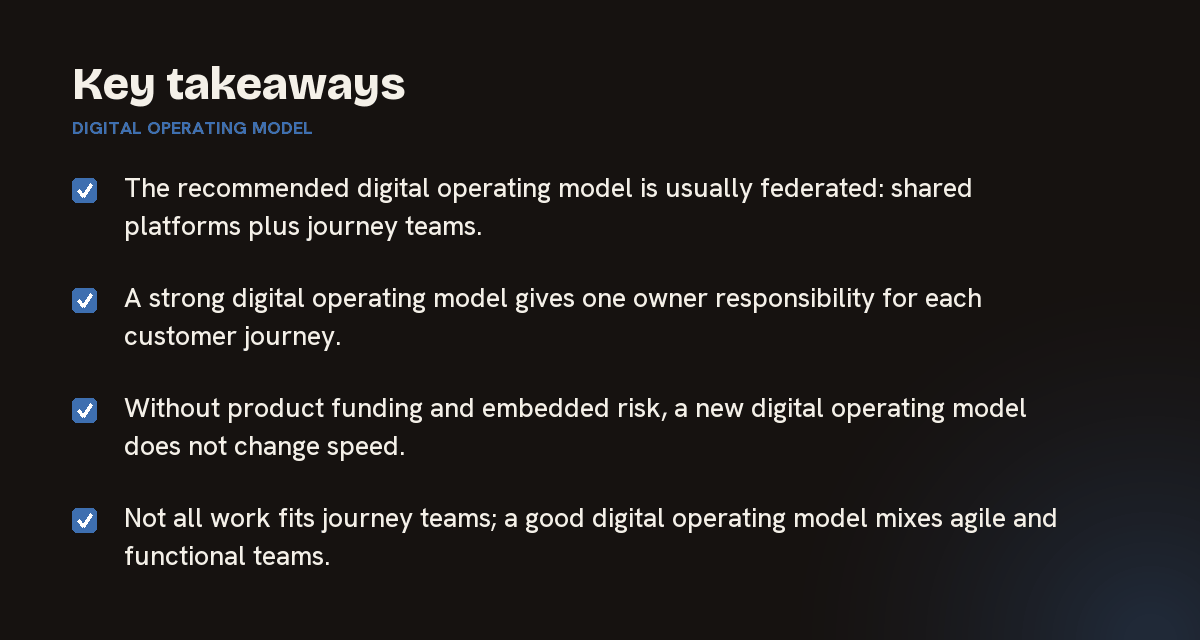
Key takeaways on digital operating model
- The recommended digital operating model is usually federated: shared platforms plus journey teams.
- A strong digital operating model gives one owner responsibility for each customer journey.
- Without product funding and embedded risk, a new digital operating model does not change speed.
- Not all work fits journey teams; a good digital operating model mixes agile and functional teams.
For leadership teams, choosing the operating model is one of the most consequential decisions in a transformation. It shapes speed, cost, quality and control for years, and it is far harder to change later than any technology choice.
Optimizium helps banks, insurers and wealth managers design operating models that fit their products, channels and obligations. We respect the expertise held in existing functions, because journey teams need it to succeed. And we bring HR, risk and compliance into the design as co-authors, so new ways of working are faster and well controlled.
Explore how we approach this across Banking, Insurance, Wealth Management and Beyond Banking, browse the FAQ Hub, or read the related question: How does digital change customer research and insights?
Related questions
On this page
Partner with the experts.
Let's discuss how Optimizium can accelerate your roadmap and navigate complex digital transformation.
Schedule a consultation →