Home › FAQ Hub › Why are product bundles evolving in digital contexts?
Tech & Core ModernisationWhy are product bundles evolving in digital contexts?
Product bundles are evolving in digital contexts because digital channels remove much of the friction that used to make combining products costly, while ecosystem economics reward institutions that can acquire, cross-sell and retain customers within one relationship.
Financial institutions have bundled products for decades: current accounts with overdrafts, mortgages with home insurance, portfolios with cash accounts. What is changing is how easily bundles can be built, personalised and offered, and who is doing the bundling.
Product bundles are evolving in digital contexts because digital channels remove much of the friction that used to make combining products costly, while ecosystem economics reward institutions that can acquire, cross-sell and retain customers within one relationship. Banking bundles payments with lending; insurance bundles life, health and property; wealth bundles cash, advice and execution; fintech bundles financial utilities with non-financial services. Digital technology lets these combinations be assembled dynamically, priced transparently and adjusted as customers’ needs change. The result is a shift from fixed packages designed for the average customer towards modular product bundles that customers can shape themselves.
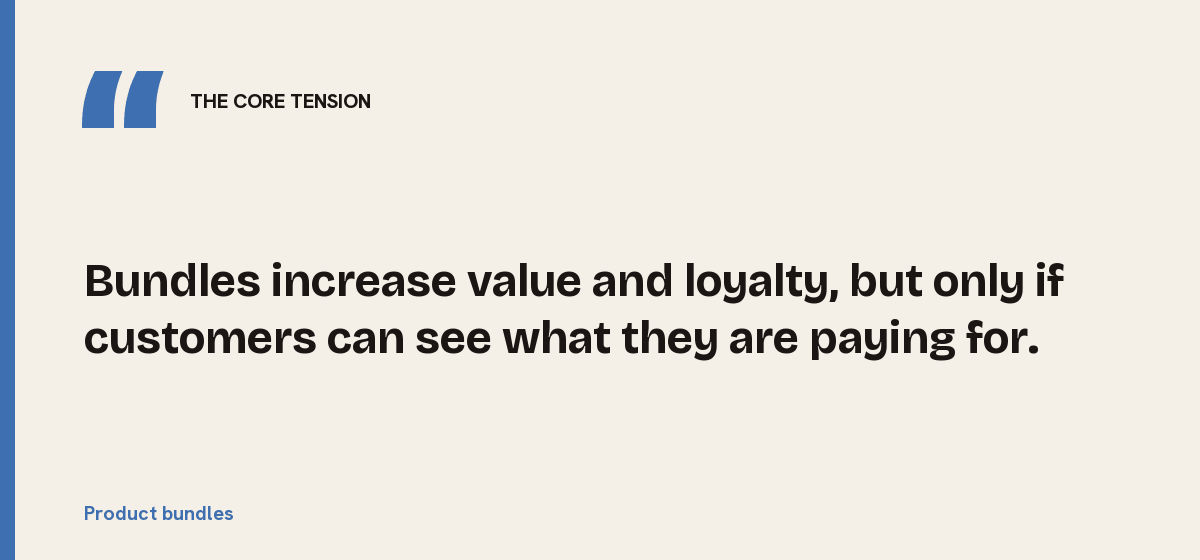
The core tension, in one line:
Bundles increase value and loyalty, but only if customers can see what they are paying for.
a digital bank offers a subscription that combines a premium account, travel insurance, phone cover and a savings boost. Customers can add or remove elements in the app, see the cost of each, and cancel any time. Take-up is strong because the bundle feels like a choice, not a trap.
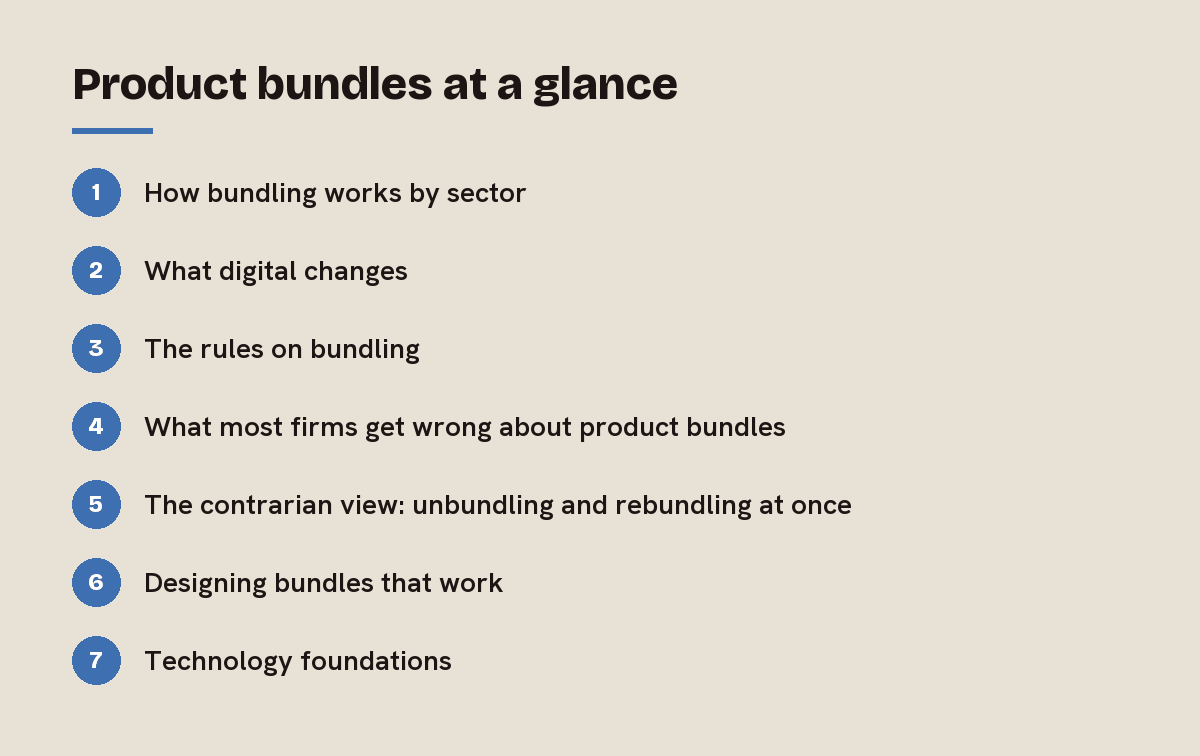
1. How bundling works by sector
| Sector | Typical bundle | Customer value | Institution value |
|---|---|---|---|
| Banking | Payments plus lending, accounts plus cards | Convenience, better rates | Primary relationship, cross-sell |
| Insurance | Life, health and property combined | Simpler cover, multi-policy discounts | Retention, lower acquisition cost |
| Wealth | Cash, advice and execution | One view of wealth | Assets consolidated, deeper relationship |
| Fintech | Financial utilities plus non-financial services | Lifestyle convenience | Engagement, subscription revenue |
2. What digital changes
- Lower execution friction: onboarding, documentation and servicing for several products can happen in one journey.
- Dynamic assembly: product bundles can be configured from modular components, rather than fixed in advance.
- Transparent pricing: costs of each component can be displayed and adjusted in real time.
- Ecosystem bundling: partners can contribute non-financial services, such as mobility or home services, to financial bundles.
- Lifecycle adjustment: bundles can evolve as customers’ circumstances change, with prompts at key moments.
3. The rules on bundling
Bundling in financial services is regulated because it can obscure costs or tie customers into products they do not need.
- Insurance: under Article 24 of the Insurance Distribution Directive, when insurance is offered together with another product or service, the distributor must tell the customer whether the components can be bought separately and provide a description and separate evidence of the costs of each.
- Fair value and understanding: in the UK, the FCA’s Consumer Duty requires products to provide fair value and customers to receive information they can understand, which applies to bundles as a whole and to their components.
| Bundling practice | Generally acceptable | Likely to raise concern |
|---|---|---|
| Optional bundle with clear pricing | Yes | Rarely |
| Discount for combining products | Yes, if costs are clear | If the standalone price is inflated |
| Product only available in a bundle | Depends on market rules | Often, especially for insurance add-ons |
| Hard-to-cancel components | No | Yes |
4. What most firms get wrong about product bundles
- Bundling for the institution, not the customer: packages built to lift cross-sell numbers without clear customer value lead to low usage, complaints and churn.
- Hiding component costs: opaque pricing undermines trust and invites regulatory challenge.
- Fixed bundles in a modular world: customers increasingly expect to choose components, not accept a predefined set.
- Ignoring servicing: bundles that are easy to buy but hard to change or cancel damage satisfaction.
Example: an insurer replaced a fixed home and contents package, which included several rarely used add-ons, with a modular product bundle. Customers chose core cover and added options with transparent prices. Average premium per customer fell slightly, but retention improved and complaints about unwanted cover nearly disappeared.
5. The contrarian view: unbundling and rebundling at once
Digital is often described as unbundling finance: specialists pick off individual products. At the same time, digital makes rebundling easier, because products from different providers can be combined in one interface. Both trends are real. The winners will be institutions that decide which components they should provide themselves, which they should source from partners, and how to present the combination clearly.
6. Designing bundles that work
- Start from customer needs and life events, not product inventory.
- Make each component visible, with its price and value.
- Allow change and exit as easily as purchase.
- Measure usage and outcomes, not only take-up.
- Involve compliance early to test transparency and fair value.
7. Technology foundations
The commercial model matters as much as the technology. Subscription bundles need clear rules on price changes, renewal and cancellation; discount-based bundles need pricing that remains fair when a component is removed.
Modular product bundles depend on product engines that can price components independently, a customer view that shows all holdings, and servicing journeys that handle additions and removals cleanly. Institutions whose products live in separate systems with separate customer records find dynamic bundling very hard, which is why bundling ambitions often start a wider modernisation conversation.
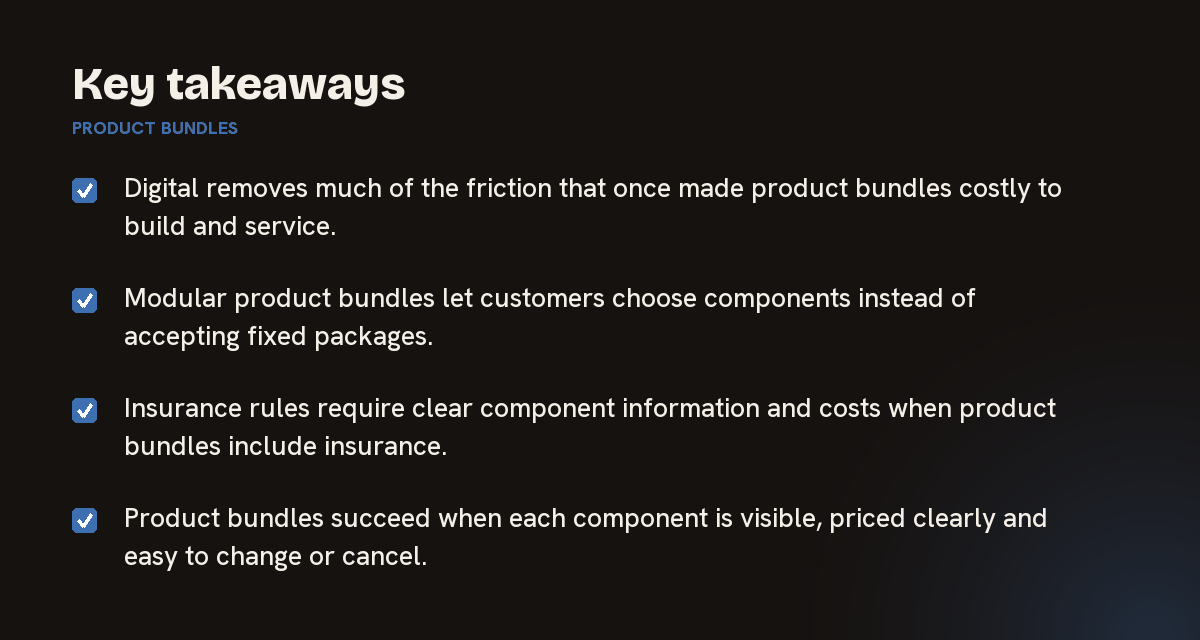
Key takeaways on product bundles
- Digital removes much of the friction that once made product bundles costly to build and service.
- Modular product bundles let customers choose components instead of accepting fixed packages.
- Insurance rules require clear component information and costs when product bundles include insurance.
- Product bundles succeed when each component is visible, priced clearly and easy to change or cancel.
For leaders, evolving product bundles are both an opportunity and a test. They can deepen relationships and lower acquisition costs, but only if they are transparent, flexible and built around customer value.
Optimizium helps banks, insurers and wealth managers design product bundles and the platforms that support them. We respect the product and pricing knowledge institutions already have, because it shows which combinations create value. And we bring pricing, risk and compliance teams into the design as co-authors, so bundles are attractive, fair and easy to defend.
Explore how we approach this across Banking, Insurance, Wealth Management and Beyond Banking, browse the FAQ Hub, or read the related question: How does wealth management differ from retail banking in digital strategy?
On this page
Partner with the experts.
Let's discuss how Optimizium can accelerate your roadmap and navigate complex digital transformation.
Schedule a consultation →