Home › FAQ Hub › Why are product simplification and digitization linked?
Tech & Core ModernisationWhy are product simplification and digitization linked?
Product simplification and digitization are linked because every option, condition and exception in a financial product must be built, tested, explained and serviced in a digital journey, so complexity multiplies the cost and risk of going digital.
Many digital programmes in financial services hit the same wall: the journey is beautifully designed, but the product behind it has so many options, conditions and exceptions that no screen can make it simple. At that point, the problem is no longer technology.
Product simplification and digitization are linked because every option, condition and exception in a financial product must be built, tested, explained and serviced in a digital journey, so complexity multiplies the cost and risk of going digital. Simpler products need less underwriting effort, fewer servicing steps, shorter disclosures and far fewer exceptions. That makes direct digital sales viable and opens up embedded and marketplace channels, where a product must be understood and bought in seconds. In the other direction, digitization exposes complexity that paper and people used to absorb, which is why it so often triggers product simplification. Each makes the other possible.
The core tension, in one line:
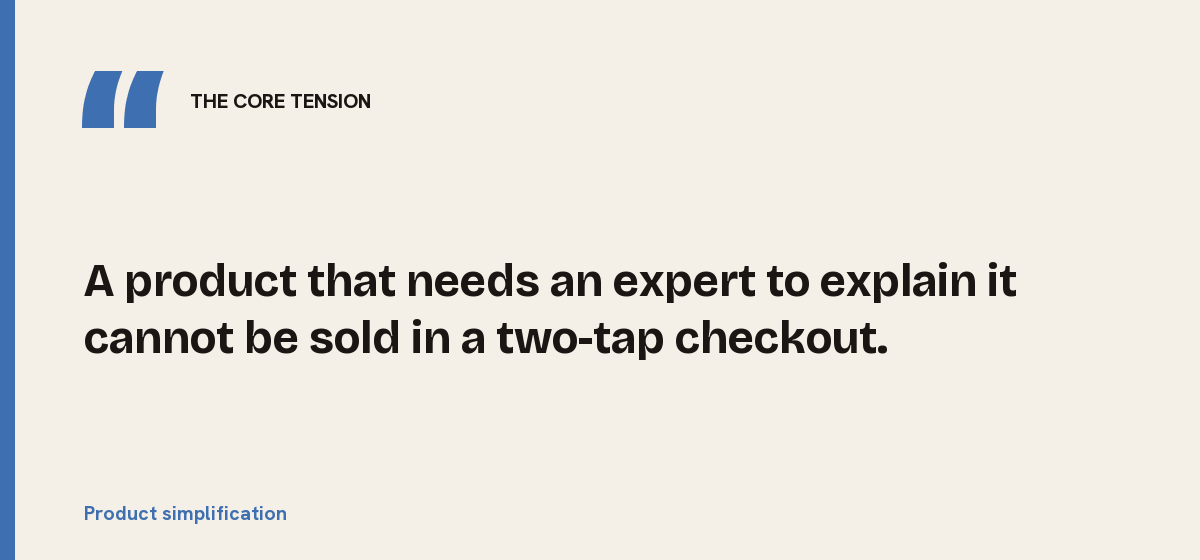
A product that needs an expert to explain it cannot be sold in a two-tap checkout.
a bank’s personal loan range has nine variants with different fees, terms and eligibility rules. Building a digital journey for all nine would take a year. The bank consolidates to two variants with transparent pricing, launches the digital journey in a quarter, and finds that digital sales overtake branch sales within a year.
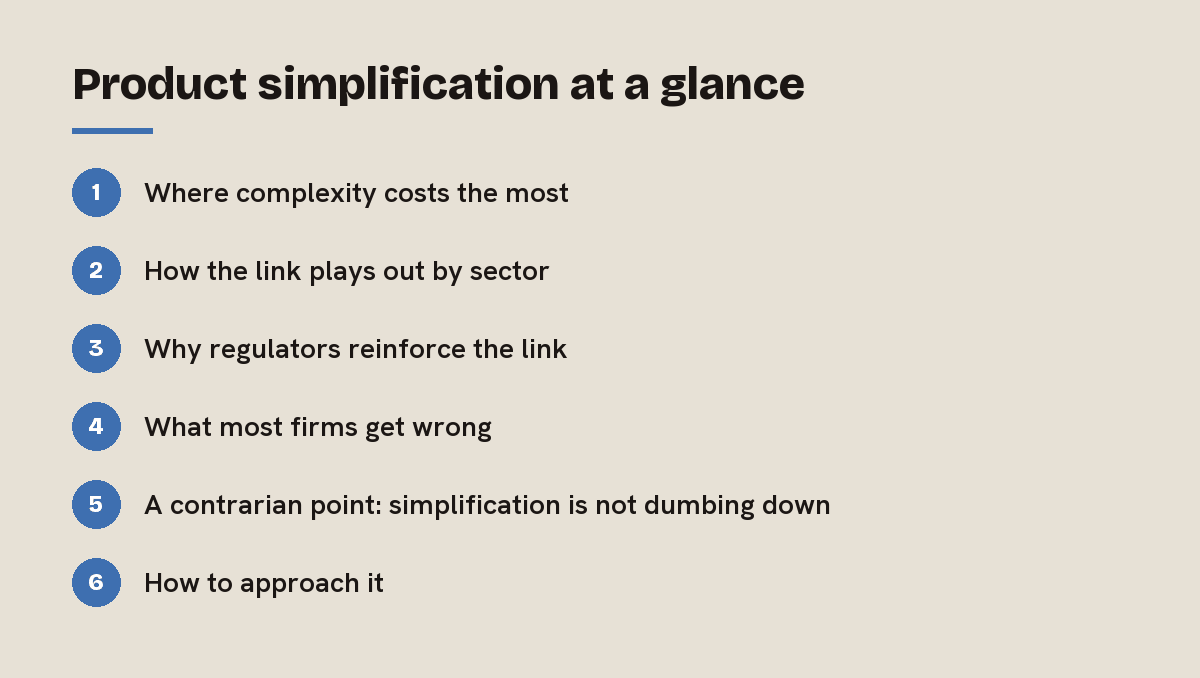
1. Where complexity costs the most
| Area | What complexity looks like on the ground | What product simplification changes |
|---|---|---|
| Underwriting | Many rating factors, manual referrals | Fewer factors, more automated decisions |
| Servicing | Different rules per variant, legacy versions still live | One set of servicing journeys |
| Disclosure | Long documents explaining every option | Short, clear key facts customers can read |
| Exceptions | Edge cases handled by specialists | Fewer edge cases, clearer escalation |
| Testing and change | Every change tested across many variants | Faster, cheaper releases |
2. How the link plays out by sector
- Insurance often redesigns coverage packages: fewer add-ons, clearer tiers and standard exclusions make cover easier to buy online and to embed in partner journeys.
- Banking simplifies lending products: consolidated loan and card ranges with transparent pricing are easier to decide automatically and to explain on a phone screen.
- Wealth simplifies advisory and portfolio options: a small set of model portfolios can serve most clients digitally, with bespoke management kept for those who need it.
- Fintech bundles financial utilities: simple, single-purpose features such as instant savings pots or round-ups are combined into an easy package.
| Sector | Typical simplification | Digital channel it unlocks |
|---|---|---|
| Banking | Fewer loan and card variants | Instant digital lending, embedded credit at checkout |
| Insurance | Tiered packages, standard wording | Online quote and bind, embedded cover |
| Wealth | Model portfolios | Digital and hybrid advice |
| Fintech | Single-purpose features | Fast onboarding and cross-sell |
3. Why regulators reinforce the link
Regulation increasingly rewards product simplification. The FCA’s Consumer Duty asks firms to ensure customers can understand products and that products offer fair value, and it requires firms to consider how customers behave at each stage of a journey. Complex products with many options are harder to evidence against those outcomes.
Customer behaviour points the same way. Signicat’s survey of 7,600 European consumers found that 68 per cent had abandoned a financial services application. Some of that abandonment comes from journeys that ask too much because the product demands it.
4. What most firms get wrong
The usual approach is to digitize the existing product range as it stands and hope design can hide the complexity. It rarely works, because product simplification has to come before the journey, not after it.
- Digitizing every variant: building journeys for products that sell in tiny volumes consumes budget and slows everything else.
- Leaving legacy versions live: closed products still need servicing journeys, so complexity lingers for decades.
- Simplifying on paper only: a simpler brochure on top of the same rating engine and policy wording changes little.
- Treating simplification as a cost exercise: the main prize is growth through channels that complex products cannot reach.
5. A contrarian point: simplification is not dumbing down
A common objection is that product simplification removes choice and value for customers with complex needs. The better view is that simplification moves complexity to where it belongs. Most customers are well served by a small number of clear products; customers with unusual needs are better served by an adviser or specialist than by a product with twenty options that nobody fully understands. Simplification for the many and expertise for the few is a stronger proposition than complexity for everyone.
Example: an insurer offered home cover with fourteen optional add-ons. Analysis showed most customers chose one of three combinations. The insurer launched three clear tiers, kept the rarely used options available through brokers, and rebuilt its online journey around the tiers. Online conversion rose, and complaints about cover misunderstandings fell.
6. How to approach it
- Start from data: which variants and options do customers buy, and which generate complaints and exceptions?
- Design the target range with product, pricing, risk and distribution together.
- Plan the legacy book: decide how existing customers will be migrated or serviced.
- Build digital journeys for the new range first, then retire old variants.
- Measure outcomes: conversion, servicing cost, complaints and customer understanding.
Key takeaways on product simplification
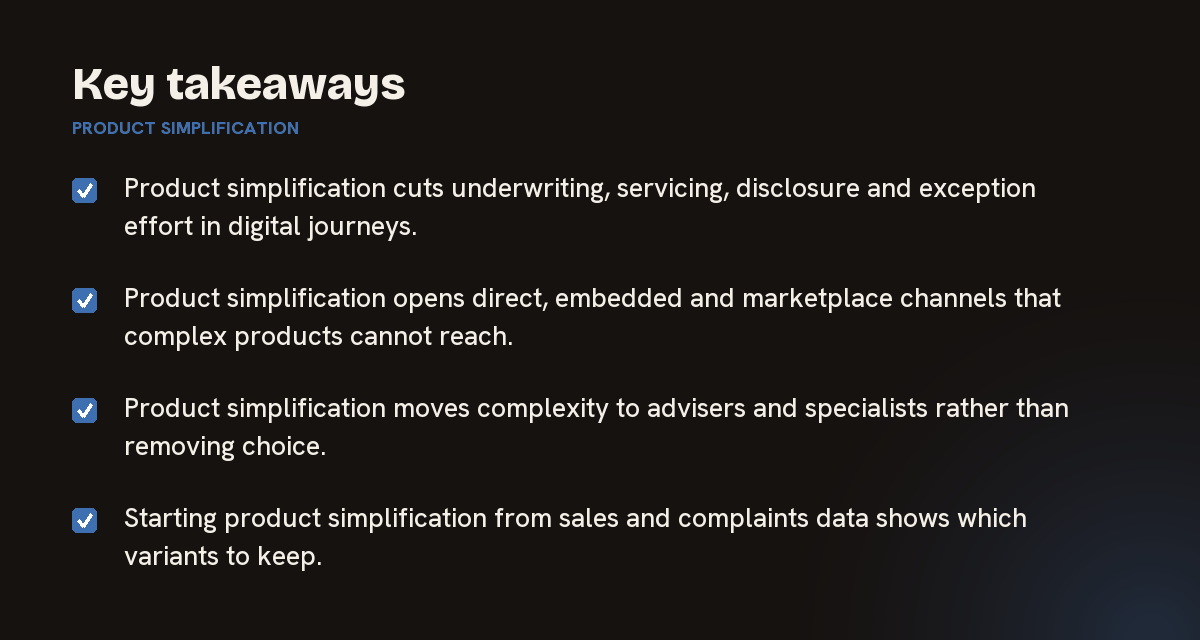
- Product simplification cuts underwriting, servicing, disclosure and exception effort in digital journeys.
- Product simplification opens direct, embedded and marketplace channels that complex products cannot reach.
- Product simplification moves complexity to advisers and specialists rather than removing choice.
- Starting product simplification from sales and complaints data shows which variants to keep.
For executive teams, the lesson is that product strategy and digital strategy cannot be separated. Programmes that digitize complex ranges spend more and deliver less; programmes that simplify first find that technology, distribution and compliance all become easier at once.
Optimizium helps banks, insurers and wealth managers rationalise product ranges and rebuild them for digital distribution. We respect the actuarial, credit and product knowledge behind existing ranges, because it explains why each option was created. And we bring pricing, risk and compliance colleagues into the redesign as co-authors, so product simplification improves value and understanding without creating new risks.
Explore how we approach this across Banking, Insurance, Wealth Management and Beyond Banking, browse the FAQ Hub, or read the related question: How does wealth management differ from retail banking in digital strategy?
Partner with the experts.
Let's discuss how Optimizium can accelerate your roadmap and navigate complex digital transformation.
Schedule a consultation →