Home › FAQ Hub › Why do AI credit models outperform scorecards?
AI, Data & AnalyticsWhy do AI credit models outperform scorecards?
AI credit models outperform traditional scorecards because they capture non-linear relationships and interactions between many variables, and can use alternative and behavioural data such as transaction patterns. That improves predictive power and early-warning detection, helping lenders approve more good borrowers and spot deterioration sooner.
For decades, consumer and small business lending relied on scorecards: a handful of variables, each with a fixed weight, adding up to a score. They are transparent and stable. They also miss much of what modern data can reveal about a borrower.
AI credit models outperform traditional scorecards because they capture non-linear relationships and interactions between many variables, and can use alternative and behavioural data such as transaction patterns. That improves predictive power and early-warning detection, helping lenders approve more good borrowers and spot deterioration sooner. Scorecards rely on linear weighting and a limited number of variables, which makes them easy to explain but less precise.
The advantage comes with obligations. AI credit models are harder to explain, must be monitored for bias and drift, and are treated as high-risk under EU rules. The best results usually come from combining the predictive power of AI with strong governance, interpretable model choices and human oversight.
The core tension, in one line:
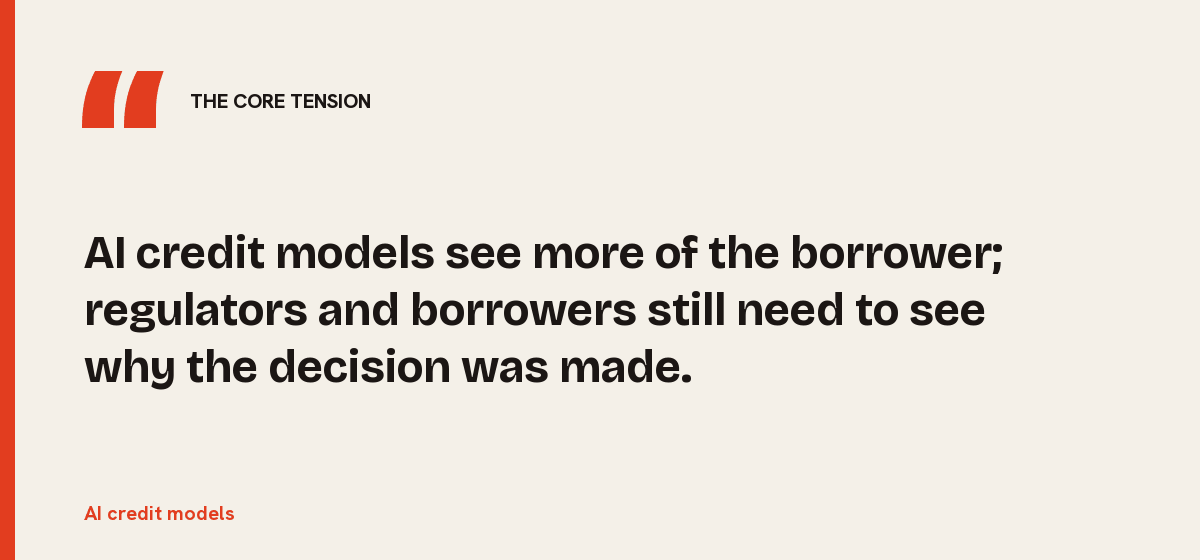
AI credit models see more of the borrower; regulators and borrowers still need to see why the decision was made.
a lender adds transaction-based features to its credit model, such as income stability and regular commitments. Approval rates rise among thin-file applicants with steady finances, while default rates stay flat. The lender documents each feature, tests for unfair outcomes and gives declined applicants clear reasons.
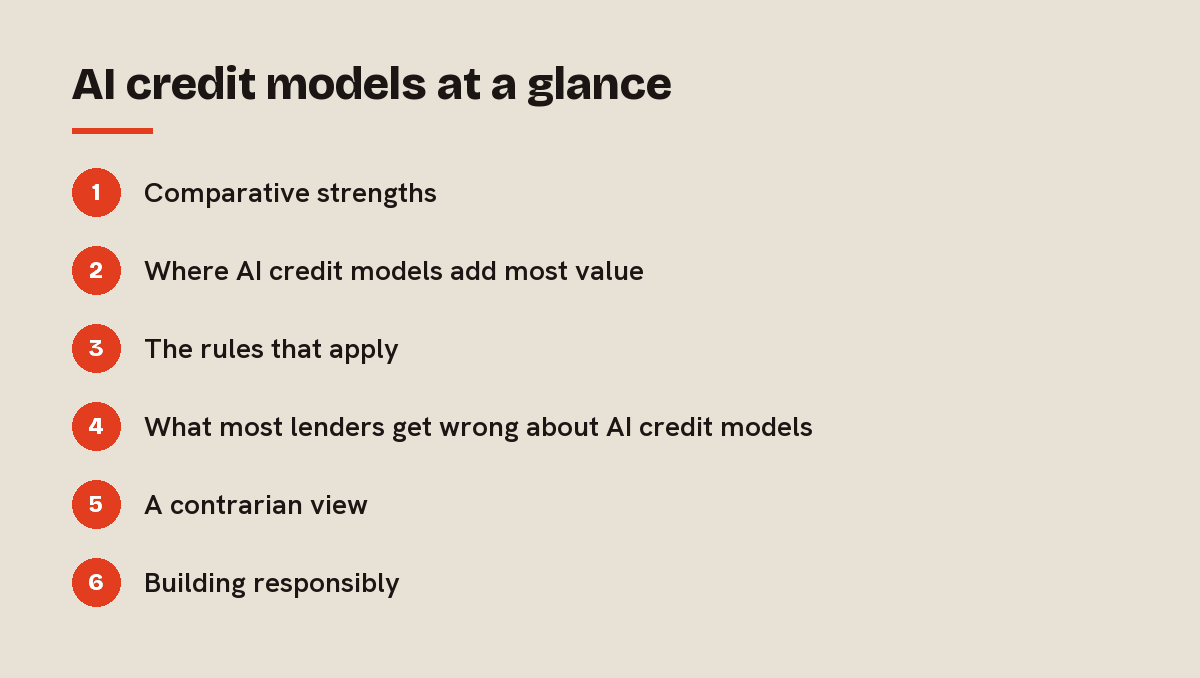
1. Comparative strengths
| Feature | Scorecards | AI credit models |
|---|---|---|
| Variable complexity | Limited | Many variables and interactions |
| Behavioural data | Minimal | Extensive, with consent |
| Pattern detection | Linear | Non-linear |
| Early warning | Periodic | Continuous signals |
| Explainability | High | Requires dedicated methods |
| Governance effort | Lower | Higher |
2. Where AI credit models add most value
- Thin-file customers: young people, newcomers and small businesses with little credit history.
- Early warning: spotting financial stress from changes in spending or income.
- Small business lending: using accounting and transaction data for faster decisions.
- Collections: prioritising support and contact for customers likely to struggle.
Banks are adopting these approaches. The ECB has observed a strong increase in AI use cases among European banks between 2023 and 2024, particularly in credit scoring and fraud detection, and notes that decision tree-based models are mainly used for credit scoring among the banks it examined.
3. The rules that apply
| Rule | What it requires |
|---|---|
| EU AI Act | AI for creditworthiness is high-risk: data quality, documentation, human oversight |
| GDPR automated decisions | Rights around decisions based solely on automated processing |
| Consumer credit rules | Thorough creditworthiness assessment in the consumer’s interest |
The EU Artificial Intelligence Act classifies AI used to evaluate the creditworthiness of individuals as high-risk. In its SCHUFA judgment, the Court of Justice held that a credit score can be an automated decision under the GDPR when it plays a decisive role. And the revised Consumer Credit Directive requires creditworthiness assessments carried out in the consumer’s interest.
4. What most lenders get wrong about AI credit models
- Chasing accuracy over explainability: small gains in prediction are not worth decisions nobody can explain.
- Using data without clear consent and purpose: behavioural data needs a lawful basis and transparency.
- Skipping fairness testing: models can reproduce or amplify bias in historical data.
- Deploying without monitoring: AI credit models drift as economic conditions change.
Example: a bank’s new model performed well in testing but approved fewer applicants in one region. Investigation showed that a location-related feature acted as a proxy for income patterns. Removing it and adding transaction-based affordability features restored fairness and kept most of the predictive gain.
5. A contrarian view
The debate is often framed as AI versus scorecards. Many lenders get the best results from interpretable machine learning, such as tree-based models with explanation tools, or from using AI to improve scorecards rather than replace them. The goal is better decisions that can be defended, not the most complex model available.
6. Building responsibly
- Start with clear use cases, such as thin-file lending or early warning.
- Choose models that can be explained to customers and supervisors.
- Test for fairness and stability before and after deployment.
- Keep humans in the loop for borderline and high-impact decisions.
Key takeaways on AI credit models
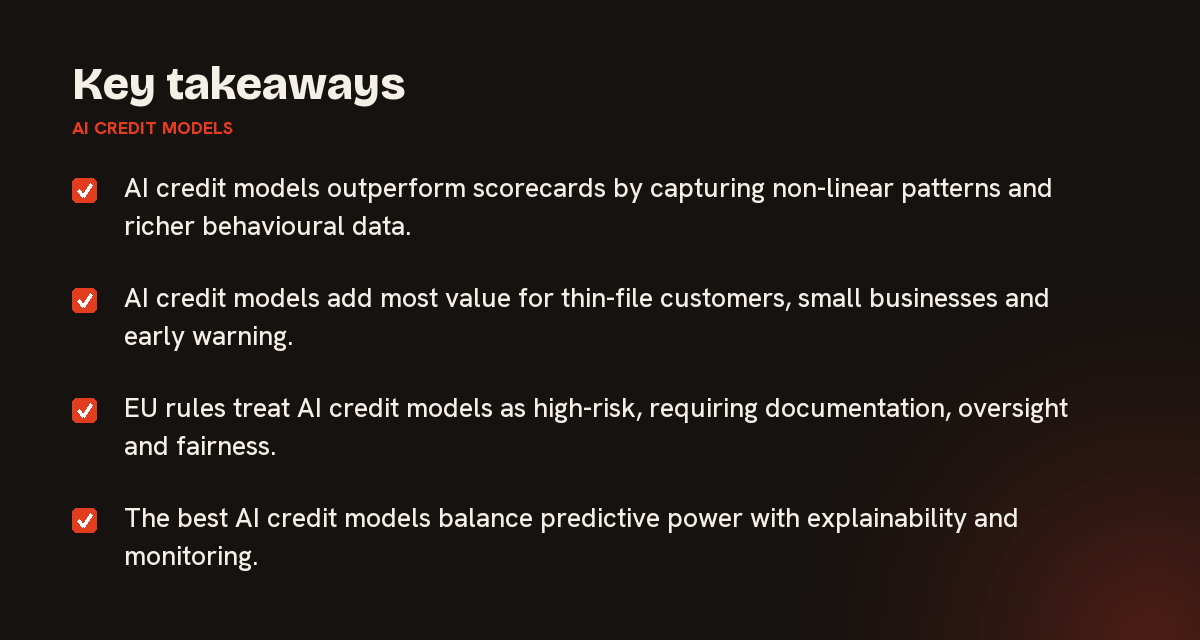
- AI credit models outperform scorecards by capturing non-linear patterns and richer behavioural data.
- AI credit models add most value for thin-file customers, small businesses and early warning.
- EU rules treat AI credit models as high-risk, requiring documentation, oversight and fairness.
- The best AI credit models balance predictive power with explainability and monitoring.
For leadership teams, AI credit models offer real gains in approval rates, risk control and inclusion. Capturing them depends on strong data, interpretable design and governance that satisfies both customers and supervisors.
Optimizium helps banks and lenders develop, govern and deploy AI credit models responsibly. We respect the credit risk and model validation expertise institutions already hold, because it is the foundation of sound decisions. And we bring model risk, compliance and data protection into the design as co-authors, so better models are also defensible ones.
Explore how we approach this across Banking, Beyond Banking and Insurance, browse the FAQ Hub, or read the related question: What distinguishes predictive from prescriptive analytics?
Related questions
Partner with the experts.
Let's discuss how Optimizium can accelerate your roadmap and navigate complex digital transformation.
Schedule a consultation →