Home › FAQ Hub › What distinguishes predictive from prescriptive analytics?
AI, Data & AnalyticsWhat distinguishes predictive from prescriptive analytics?
Predictive analytics forecasts probable outcomes based on historical patterns, such as the likelihood that a loan will go into arrears or a customer will leave.
Many financial institutions have become good at forecasting: which customers might default, which policies might lapse, which portfolios are drifting from their targets. Fewer have taken the next step of systematically deciding what to do about it. That step is the difference between two kinds of analytics.
Predictive analytics forecasts probable outcomes based on historical patterns, such as the likelihood that a loan will go into arrears or a customer will leave. Prescriptive analytics goes further by recommending, or automatically taking, the best action in light of those forecasts, such as offering a restructuring plan, adjusting a price or rebalancing a portfolio. In short, predictive analytics informs and prescriptive analytics decides. Because prescriptive analytics acts on customers more directly, governance becomes more demanding: institutions must be able to justify the action, monitor its effects and keep humans in control where the impact is significant.
The core tension, in one line:
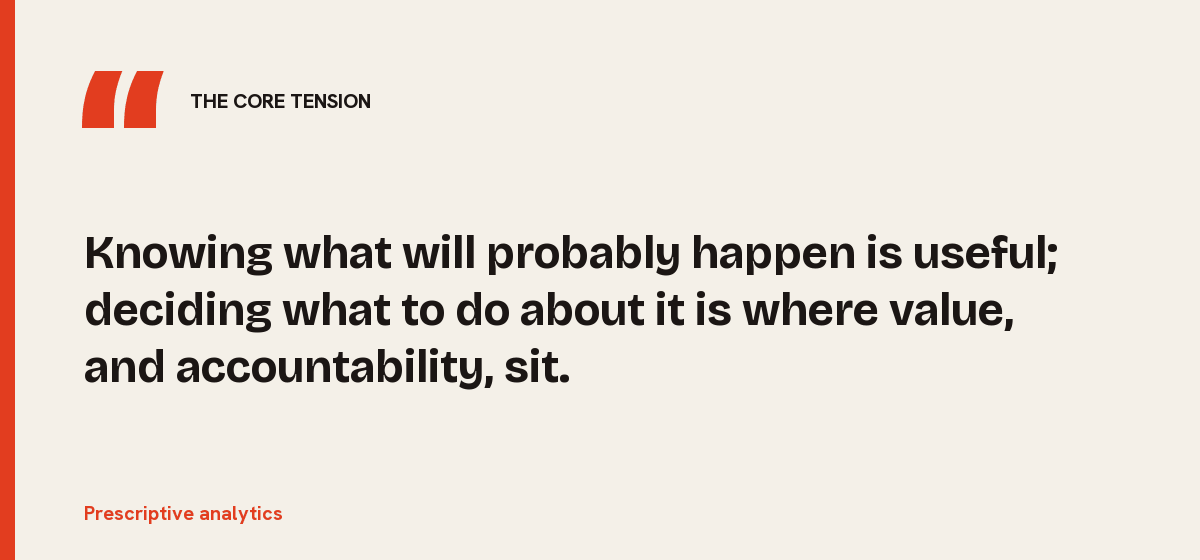
Knowing what will probably happen is useful; deciding what to do about it is where value, and accountability, sit.
a bank’s predictive model flags customers likely to fall behind on their loan payments in the next three months. A prescriptive layer then recommends, for each customer, the most suitable support: a payment holiday, a restructuring option or a budgeting conversation. Collections teams contact customers earlier with tailored options, and both losses and complaints fall.
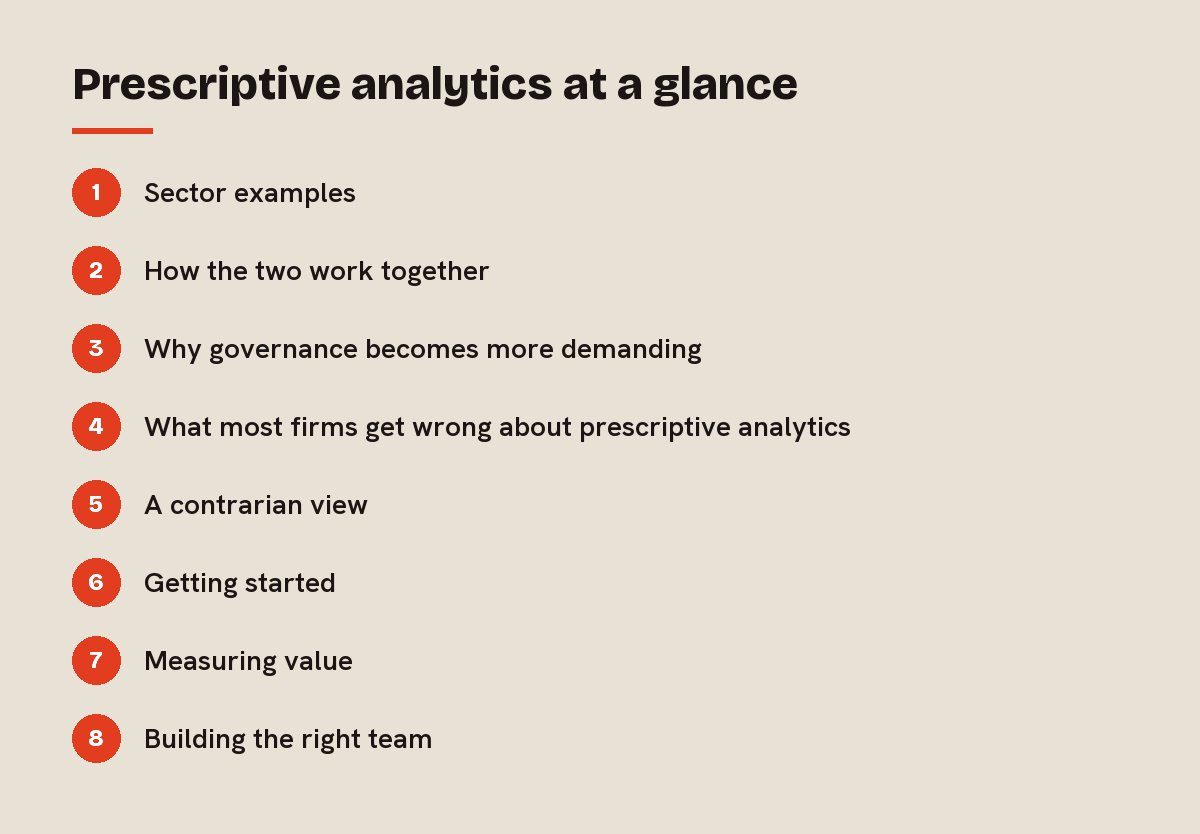
1. Sector examples
| Sector | Predictive | Prescriptive |
|---|---|---|
| Banking | Probability of delinquency | Loan restructuring strategy for each customer |
| Insurance | Expected loss ratio | Dynamic pricing adjustment within approved limits |
| Wealth | Portfolio risk drift | Automated rebalancing proposal |
| Fintech | Likelihood of churn | Targeted retention offer |
2. How the two work together
- Prediction comes first: recommendations depend on reliable forecasts.
- Options are defined: the institution sets out which actions are permitted, such as offers, prices or interventions.
- Optimisation chooses: models or rules select the best action for each case, considering value, risk and constraints.
- Execution follows: actions are carried out automatically or recommended to staff.
- Learning closes the loop: outcomes are measured and fed back to improve both layers.
| Step | Predictive analytics | Prescriptive analytics |
|---|---|---|
| Question answered | What is likely to happen? | What should we do? |
| Output | Probability or forecast | Recommended or automated action |
| Typical user | Analysts, risk teams | Front line, operations, automated systems |
| Governance intensity | Moderate | High |
3. Why governance becomes more demanding
Acting on customers directly raises the bar.
- High-risk uses: the EU AI Act treats AI used to assess creditworthiness, and for risk assessment and pricing in life and health insurance, as high-risk, with requirements for documentation and human oversight.
- Fairness: recommended actions must not treat similar customers unfairly.
- Explainability: staff and customers need to understand why an action was chosen.
- Constraints: regulatory and conduct limits must be built into the optimisation, not checked afterwards.
Adoption of advanced analytics is broad. The ECB reports that more than 90 per cent of the banks it supervises integrate AI into their operations, and it has observed a strong increase in AI use cases among European banks between 2023 and 2024, particularly in credit scoring and fraud detection. Moving from those predictions to recommended actions is the next frontier.
4. What most firms get wrong about prescriptive analytics
- Skipping prediction quality: a recommendation built on an unreliable forecast is worse than none.
- Optimising for one goal: maximising short-term revenue can harm customers and long-term value.
- Removing humans too early: high-impact actions benefit from human review until performance is proven.
- Ignoring feedback: without measuring outcomes, recommendation systems cannot improve.
Example: an insurer used predictive models to estimate claim severity and then introduced prescriptive analytics to recommend the handling route for each claim: fast-track settlement, specialist handler or investigation. Handlers could override recommendations with a reason. Over time, override rates fell as the recommendations improved, and settlement times for simple claims dropped sharply.
5. A contrarian view
The value of prescriptive analytics is often assumed to come from full automation. In regulated financial services, much of the value comes from better human decisions: giving staff a clear, evidence-based recommendation and the reasons behind it. Automation can follow where performance and governance allow, but decision support is often the faster and safer first step.
6. Getting started
- Choose decisions with clear options and measurable outcomes, such as collections, retention or claims routing.
- Make sure predictive models are robust and monitored.
- Define permitted actions and constraints with risk and compliance.
- Start with recommendations to staff, then automate where proven.
- Measure outcomes for customers and the business.
7. Measuring value
The benefit of a recommendation system shows up in outcomes, not in model accuracy alone. Useful measures include losses avoided, customers retained, time saved for staff, complaint rates and how often people override recommendations and why. Comparing outcomes for cases that followed the recommendation with those that did not, where it is fair and safe to do so, gives the clearest evidence of value.
8. Building the right team
Prescriptive analytics needs more than data scientists. It requires business owners who define the options and objectives, risk and compliance specialists who set constraints, engineers who integrate recommendations into workflows, and front-line staff who use them. Institutions that form these mixed teams around specific decisions move faster than those that keep analytics in a central unit.
Key takeaways on prescriptive analytics
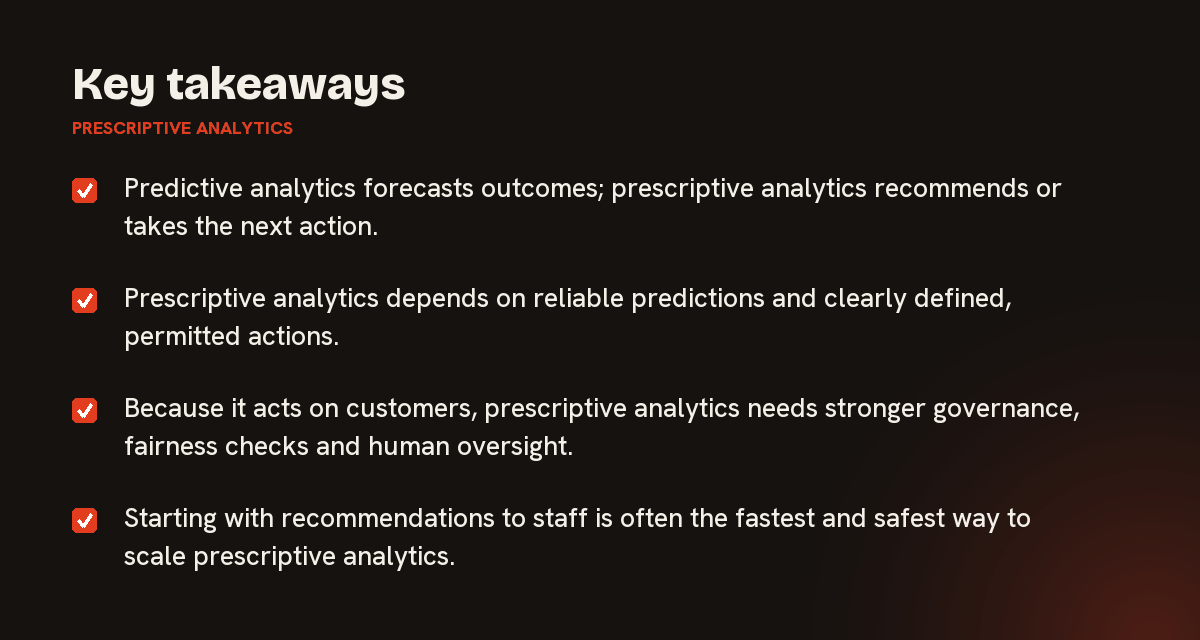
- Predictive analytics forecasts outcomes; prescriptive analytics recommends or takes the next action.
- Prescriptive analytics depends on reliable predictions and clearly defined, permitted actions.
- Because it acts on customers, prescriptive analytics needs stronger governance, fairness checks and human oversight.
- Starting with recommendations to staff is often the fastest and safest way to scale prescriptive analytics.
For leadership teams, prescriptive analytics is where data investment turns into better decisions at scale. It requires stronger governance than prediction alone, but it also delivers more direct value for customers and the business.
Optimizium helps banks, insurers and wealth managers move from predictive to prescriptive analytics responsibly. We respect the analytical and risk expertise institutions already have, because it underpins every good recommendation. And we bring model risk, compliance and operations teams into the design as co-authors, so automated decisions are effective, fair and well governed.
Explore how we approach this across Banking, Insurance, Wealth Management and Beyond Banking, browse the FAQ Hub, or read the related question: How do digital channels create new data assets?
Related questions
Partner with the experts.
Let's discuss how Optimizium can accelerate your roadmap and navigate complex digital transformation.
Schedule a consultation →