Home › FAQ Hub › Why do digital channels compress margins but expand reach?
Leadership, Change & Operating ModelsWhy do digital channels compress margins but expand reach?
Digital channels compress margins because they lower the marginal cost of serving each customer, make prices transparent and comparable, and shift acquisition costs from branches to digital marketing, analytics and platform maintenance.
Digital distribution promises financial institutions more customers at lower cost. Many discover a less comfortable side: prices fall, comparison becomes easy and the margin on each product shrinks. Both effects are real, and the strategy lies in managing them together.
Digital channels compress margins because they lower the marginal cost of serving each customer, make prices transparent and comparable, and shift acquisition costs from branches to digital marketing, analytics and platform maintenance. Competitors can match offers quickly, and customers can switch with a few taps, so unit margins tend to decline.
At the same time, digital channels expand reach. Institutions can serve customers far beyond their branch footprint, profitably serve smaller balances that were uneconomic in person, and add cross-sell and ecosystem revenue. Banks and insurers benefit from long-tail customers and recurring revenue. Digital strategies succeed when the gains in scale and relationship depth outweigh the margin pressure.
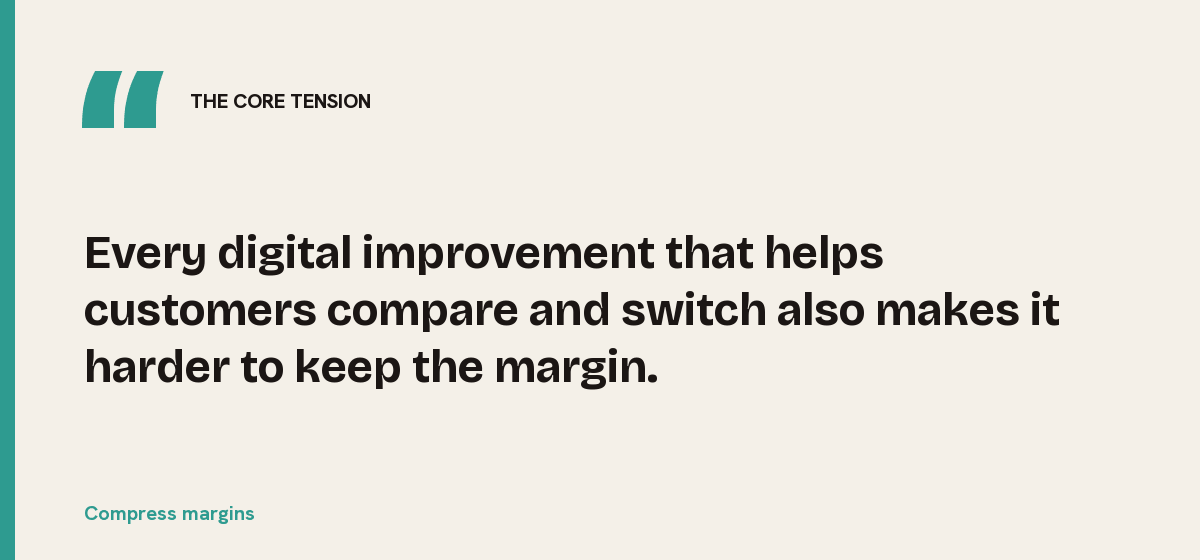
The core tension, in one line:
Every digital improvement that helps customers compare and switch also makes it harder to keep the margin.
a bank launches a digital savings account at a competitive rate. Margin per account is lower than on branch accounts, but it attracts customers from across the country, many of whom later take loans and insurance. Total relationship profit exceeds what the branch model achieved, even with thinner margins on the savings product.
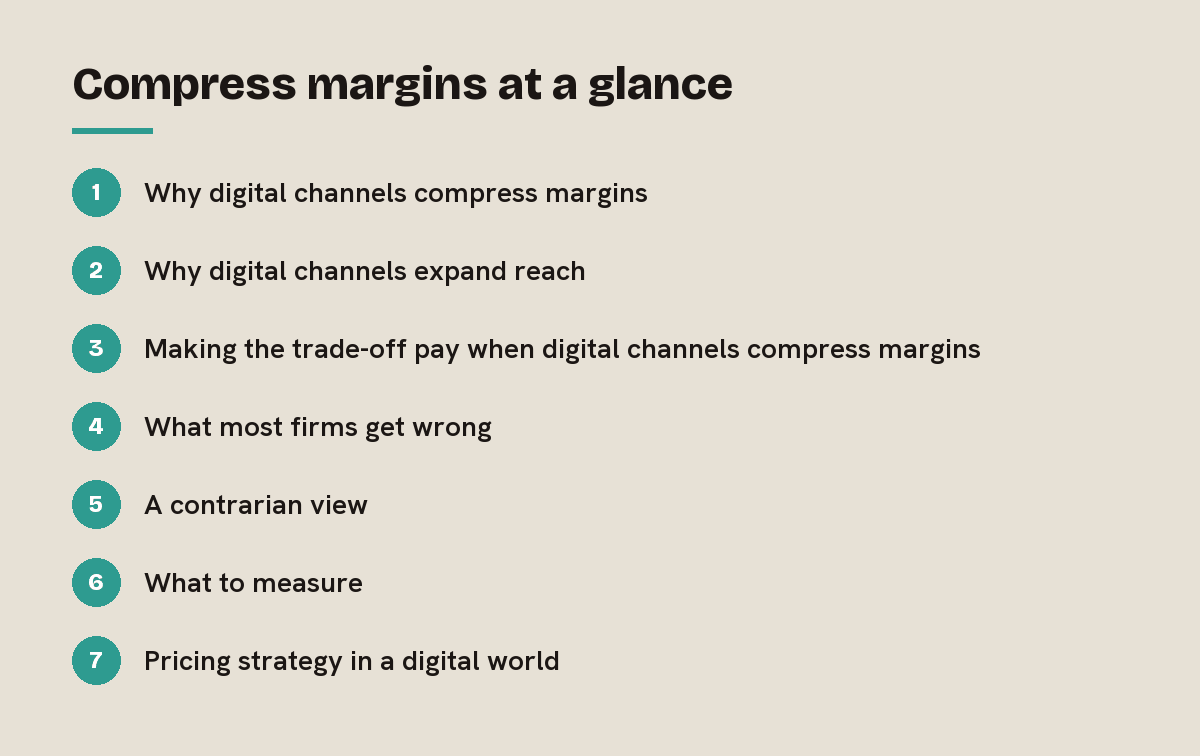
1. Why digital channels compress margins
| Driver | What it looks like on the ground | Effect on margin |
|---|---|---|
| Price transparency | Comparison sites and apps show rates side by side | Pressure to match the best offer |
| Low switching friction | Accounts and policies opened or moved online | Less inertia to rely on |
| Shifted acquisition costs | Spend moves to digital marketing and platforms | New costs replace branch costs |
| Regulated pricing | Rules on charges for certain services | Fewer fee-based margins |
Regulation can compress margins directly. Under the EU’s Instant Payments Regulation, providers may not charge more for instant euro transfers than for standard ones, removing a potential premium from faster payments.
2. Why digital channels expand reach
- Geography: customers can be served anywhere, not only near a branch.
- Small balances: lower cost to serve makes smaller customers profitable.
- Cross-sell: digital relationships make additional products easier to offer and buy.
- Ecosystems and partners: products can be distributed through other firms’ platforms.
Digital reach is large and growing. Eurostat reports that 67 per cent of people aged 16 to 74 in the EU used internet banking in 2024. Yet purely digital banks held a market share below 4 per cent in the euro area in 2024, which suggests reach alone does not guarantee success: trust, product breadth and relationship depth still matter.
3. Making the trade-off pay when digital channels compress margins
| Lever | How it offsets margin pressure |
|---|---|
| Lower cost to serve | Automation and self-service reduce cost per customer |
| Relationship depth | More products per customer raise lifetime value |
| Targeted acquisition | Spending on customers likely to stay and grow |
| Differentiation | Service quality and trust, not price alone |
4. What most firms get wrong
- Competing on price alone: digital channels compress margins fastest when the only offer is a better rate.
- Ignoring cannibalisation: moving existing customers to cheaper digital products without growing the base destroys value.
- Underestimating acquisition costs: digital marketing can be as expensive as branches if poorly targeted.
- Measuring product profit, not relationship profit: thin-margin entry products can lead to profitable relationships.
Example: an insurer launched a lower-priced direct motor product. Initially, many existing broker customers switched, reducing margins without adding volume. The insurer redesigned the offer for new segments that brokers did not serve, kept broker pricing distinct and introduced multi-product discounts. Overall volume grew and margin per customer stabilised.
5. A contrarian view
It is tempting to see margin compression as a reason to slow digital distribution. That rarely works: customers move anyway, and competitors capture them. The better response is to accept that digital channels compress margins on individual products, and to redesign the business so profit comes from scale, efficiency and the depth of each relationship.
6. What to measure
- Cost to serve and acquire per customer, by channel.
- Products per customer and their growth over time.
- Lifetime value by acquisition channel.
- Cannibalisation of existing, higher-margin business.
7. Pricing strategy in a digital world
Pricing needs to reflect channel economics openly. Some institutions price digital products lower because they cost less to serve, while keeping advice-led or assisted products at a level that reflects the service. Others use bundles and loyalty benefits so that relationship value, not a single headline rate, drives decisions. Whatever the approach, pricing must remain fair across customer groups, which regulators increasingly test.
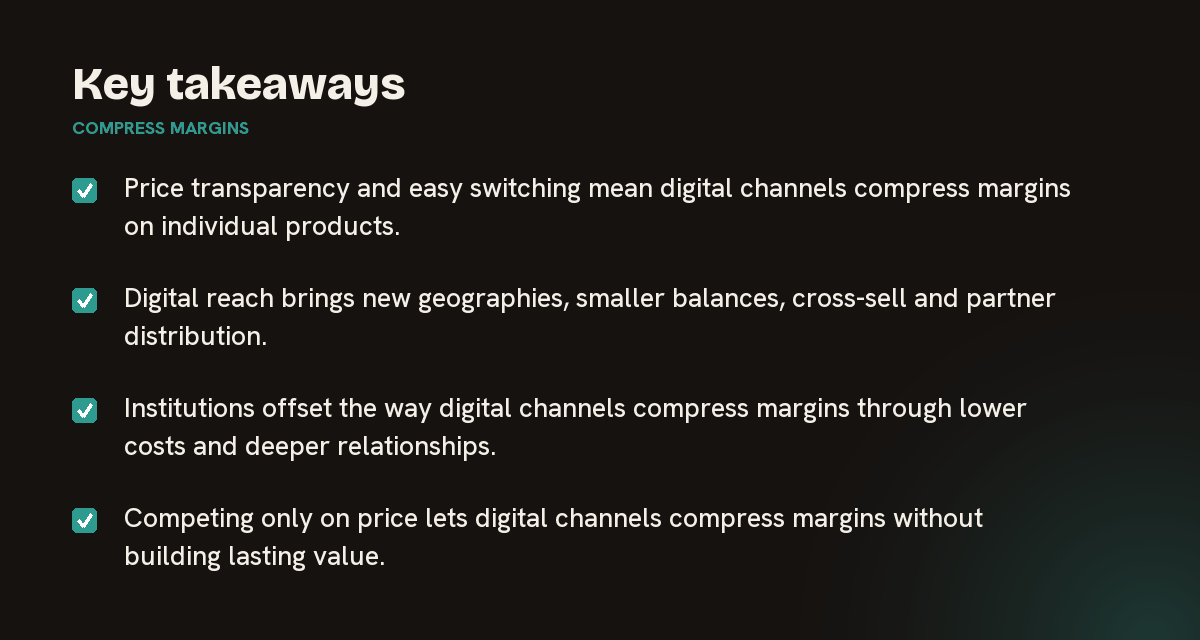
Key takeaways on compress margins
- Price transparency and easy switching mean digital channels compress margins on individual products.
- Digital reach brings new geographies, smaller balances, cross-sell and partner distribution.
- Institutions offset the way digital channels compress margins through lower costs and deeper relationships.
- Competing only on price lets digital channels compress margins without building lasting value.
For leadership teams, the margin and reach trade-off is one of the central economic questions of digital transformation. Answering it requires looking beyond product margins to customer relationships, channel economics and the cost base as a whole.
Optimizium helps banks, insurers and wealth managers design digital distribution that grows profitably. We respect the relationship and pricing expertise institutions already have, because it defines where value can be protected. And we bring finance, risk and distribution teams into the design as co-authors, so growth and margin are managed together.
Explore how we approach this across Banking, Insurance, Wealth Management and Beyond Banking, browse the FAQ Hub, or read the related question: Why is cross-functional governance particularly difficult in financial services?
On this page
Partner with the experts.
Let's discuss how Optimizium can accelerate your roadmap and navigate complex digital transformation.
Schedule a consultation →