Home › FAQ Hub › Why do digital channels struggle with exception processing?
Digital Ops & Customer ExperienceWhy do digital channels struggle with exception processing?
Exception processing is the handling of cases that do not follow the standard path, such as missing documents, mismatched data, complex eligibility, unusual risks or additional disclosures, and digital channels struggle with it because most financial journeys are built as straight lines while exceptions require branching.
Digital journeys in financial services are usually designed for the customer whose documents are complete, whose details match, and whose needs fit the product. A large share of real customers are not that customer.
Exception processing is the handling of cases that do not follow the standard path, such as missing documents, mismatched data, complex eligibility, unusual risks or additional disclosures, and digital channels struggle with it because most financial journeys are built as straight lines while exceptions require branching. Legacy business process management tools and siloed decision engines rarely support branching logic gracefully, so exceptions fall out of the digital journey into email, phone calls and manual queues. The result is a channel that works well for simple cases and badly for everyone else. Because exceptions are often where the most valuable or most vulnerable customers sit, poor exception processing has commercial and conduct consequences.
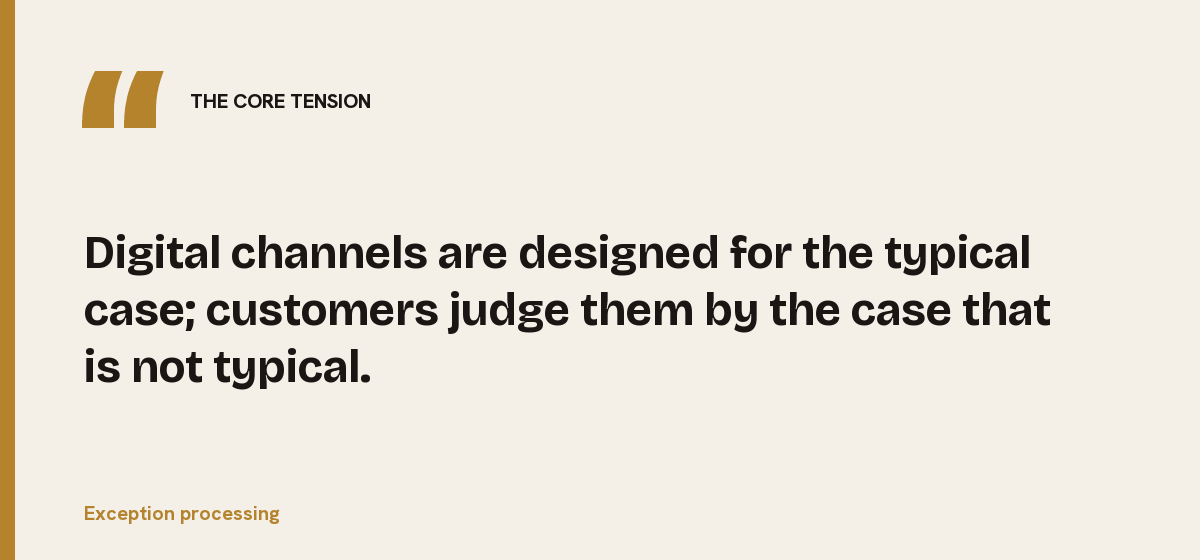
The core tension, in one line:
Digital channels are designed for the typical case; customers judge them by the case that is not typical.
a self-employed customer applies for a mortgage online. The journey expects payslips; she has two years of accounts. The application stalls, she receives a generic email asking her to call, and after three calls she applies elsewhere. Her case was not unusual for a self-employed applicant; it was only unusual for the journey.
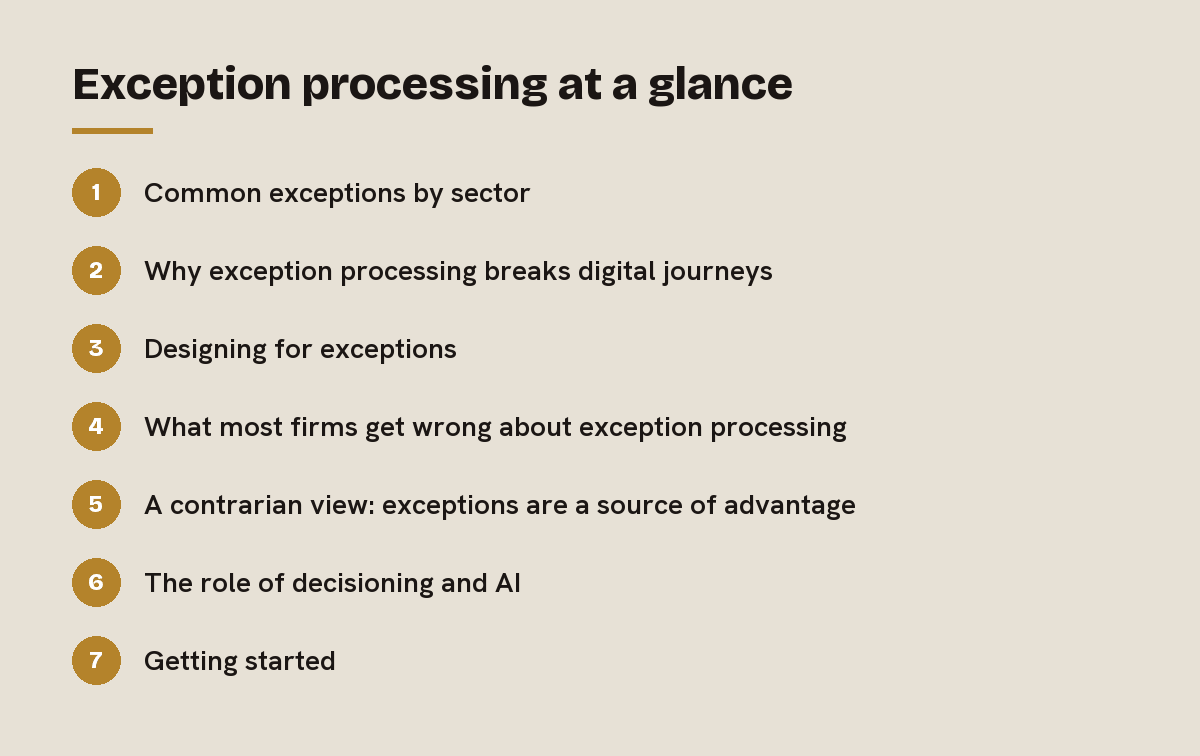
1. Common exceptions by sector
| Sector | Typical exceptions | What happens in many digital channels |
|---|---|---|
| Insurance | Underwriting complexity: medical history, unusual property, claims history | Referral to an underwriter outside the journey, often by email |
| Banking | Credit and AML: thin files, complex income, screening matches | Application paused, customer asked to visit a branch or call |
| Wealth | Suitability and tax: complex circumstances, multiple wrappers, vulnerability | Adviser call booked, data re-collected |
| Payments | Name mismatches, fraud alerts, failed transfers | Payment held, customer uncertain what to do |
2. Why exception processing breaks digital journeys
- Linear design: journeys are mapped as a sequence of screens. Branching paths are added later, if at all.
- Fragmented decisioning: eligibility, risk and compliance decisions sit in separate engines that cannot agree on what should happen next.
- No shared case: when a case leaves the digital channel, staff often start again in a different system.
- Poor communication: customers are told something is wrong, but not what, why or what to do.
The pressure is rising as payments speed up. Under the EU’s Instant Payments Regulation, euro instant transfers must be completed within seconds, at any time of day, and providers must offer a service that checks the payee’s name before a payment is authorised. When transactions are instant, exception processing has to be instant as well, or it becomes the customer’s problem.
3. Designing for exceptions
| Principle | What it looks like on the ground |
|---|---|
| Map exceptions explicitly | Each journey has a documented list of known exceptions and their handling |
| Keep the case digital | Exceptions stay in the same case; specialists work inside it |
| Ask for what is needed | Customers can upload alternative evidence or answer extra questions in the journey |
| Explain clearly | Messages say what happened, why, and what the customer can do now |
| Set service levels | Exception queues have owners, targets and visible status |
4. What most firms get wrong about exception processing
- Treating exceptions as rare: in many journeys, exceptions are a significant share of cases. Designing them out of scope means designing many customers out.
- Measuring straight-through rates only: a high straight-through rate can hide long, painful waits for everyone else.
- Separating digital and operations teams: the people who handle exceptions rarely shape the digital journey.
- Overlooking vulnerability: customers with complex needs or circumstances are often exactly those who fall into exception paths. Under suitability rules such as ESMA’s MiFID II suitability guidelines, firms must still gather and assess the information needed, so the path matters.
5. A contrarian view: exceptions are a source of advantage
Many institutions see exception processing purely as cost. The better view is that exceptions are where competitors are weakest. A lender that handles self-employed income well, or an insurer that underwrites unusual properties quickly, wins customers that others turn away. Designing excellent exception paths can be a deliberate positioning choice, not just an operational fix.
Example: an insurer analysed its online home insurance referrals and found that a handful of property types caused most of them. It added specific questions for those cases, gave underwriters a single digital case view, and committed to a same-day decision. Referred cases converted at a much higher rate, and the insurer began targeting those segments deliberately.
6. The role of decisioning and AI
Modern decision engines and AI models can reduce the number of cases that become exceptions in the first place. Document recognition can accept alternative evidence, such as accounts instead of payslips. Data enrichment can resolve mismatches automatically. Risk models can approve more cases with confidence and route only the uncertain ones to people. The caution is that automation must stay explainable and fair, especially in credit and insurance pricing, where rules on automated decisions apply. The goal is not to remove human judgement, but to reserve it for the cases where it adds most value, and to give specialists the full context when they step in.
7. Getting started
- Measure exceptions: volume, type, resolution time and drop-off, by journey.
- Prioritise the largest groups and redesign their paths end to end.
- Introduce a shared case across digital and operations.
- Rewrite customer messages with clear next steps.
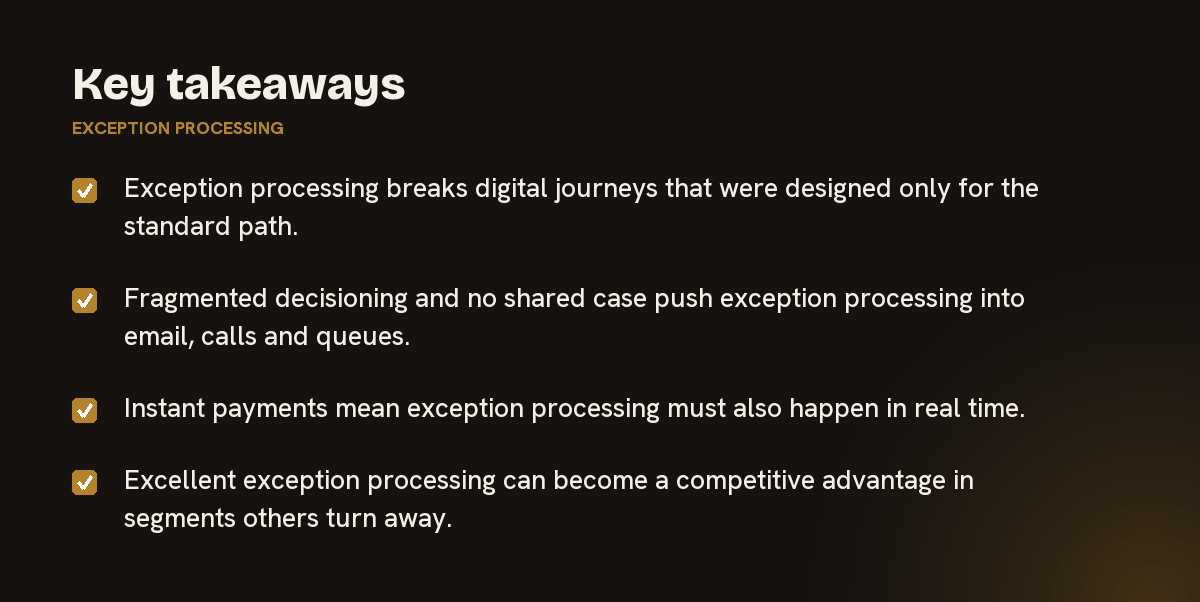
Key takeaways on exception processing
- Exception processing breaks digital journeys that were designed only for the standard path.
- Fragmented decisioning and no shared case push exception processing into email, calls and queues.
- Instant payments mean exception processing must also happen in real time.
- Excellent exception processing can become a competitive advantage in segments others turn away.
For executives, exception processing is a revealing test of a digital channel. Journeys that handle exceptions well are usually backed by coherent decisioning, shared case management and teams that work across digital and operations. Those that do not will keep pushing customers back to the phone, however attractive the front end.
Optimizium helps financial institutions redesign journeys so exceptions are handled within the digital channel. We respect the expertise of operations and underwriting teams, because they know which cases matter and why. And we bring risk and compliance colleagues into the design as co-authors, so exception paths are fast, fair and well evidenced.
Explore how we approach this across Banking, Insurance and Wealth Management, browse the FAQ Hub, or read the related question: How does personalization differ by industry?
Related questions
On this page
Partner with the experts.
Let's discuss how Optimizium can accelerate your roadmap and navigate complex digital transformation.
Schedule a consultation →