Home › FAQ Hub › Why do digital transformation programmes underperform in incumbent banks?
Leadership, Change & Operating ModelsWhy do digital transformation programmes underperform in incumbent banks?
Digital transformation programmes underperform in incumbent banks for four systemic reasons. First, technical debt: layered legacy cores restrict modular change and slow regulatory adaptation.
Incumbent banks have spent heavily on digital transformation for over a decade. Many have modern apps and cloud platforms to show for it. Far fewer can show a lasting change in cost, growth or customer loyalty. The reasons are remarkably consistent.
Digital transformation programmes underperform in incumbent banks for four systemic reasons. First, technical debt: layered legacy cores restrict modular change and slow regulatory adaptation. Second, an operating model mismatch: business and technology remain siloed, and compliance and risk enter too late. Third, value ambiguity: programmes measure outputs, such as features shipped, instead of outcomes like unit economics, retention or customer satisfaction. Fourth, talent and leadership gaps in product ownership and digital delivery.
None of these is solved by buying new technology. Incumbent banks that succeed treat transformation as a change in how the bank decides, funds and measures work, with technology modernised in steps behind clearly owned customer journeys.
The core tension, in one line:
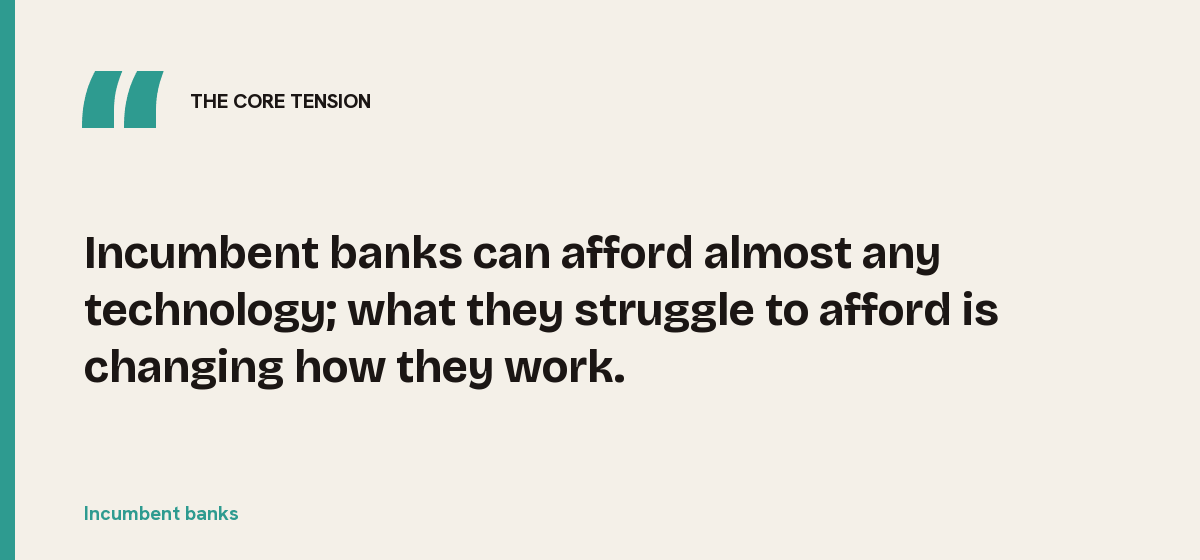
Incumbent banks can afford almost any technology; what they struggle to afford is changing how they work.
a bank’s transformation programme delivered a new app, a cloud data platform and dozens of features. Two years later, cost-to-income and customer satisfaction were almost unchanged. A reset reorganised delivery around five customer journeys with accountable owners, outcome targets and embedded risk partners, and results began to move within a year.
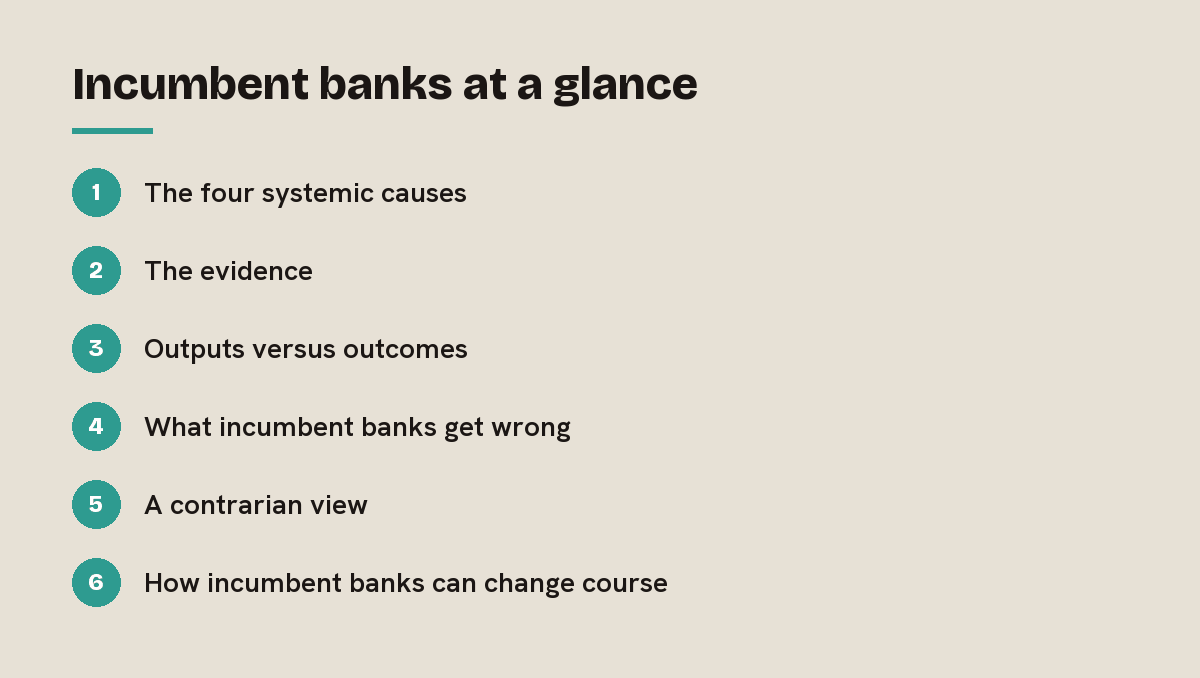
1. The four systemic causes
| Cause | What it looks like on the ground | Effect |
|---|---|---|
| Technical debt | Tightly coupled legacy cores | Every change is slow and risky |
| Operating model mismatch | Silos, late risk and compliance input | Rework and delay |
| Value ambiguity | Measuring features, not outcomes | Activity without results |
| Talent gaps | Few experienced product owners | Weak prioritisation |
2. The evidence
The track record is clear. McKinsey found that only 16 per cent of respondents said their digital transformations had improved performance and been sustained, a lower success rate than for organisational transformations in general. In euro area banking, the ECB found that almost all large banks had a digital strategy, yet many lacked adequate indicators to steer it. And investment is constrained: according to ECB Supervisory Board Chair Claudia Buch, banks invest on average 2.8 per cent of operating income in digital transformation projects. With limited budgets, focus matters.
3. Outputs versus outcomes
| Output measures | Outcome measures |
|---|---|
| Features released | Cost per customer and per transaction |
| Systems migrated | Customer retention and primary relationships |
| App downloads | Digital sales and completion rates |
| Projects completed | Lead time from idea to customer |
4. What incumbent banks get wrong
- Treating transformation as an IT programme: business ownership is essential.
- Waiting for core replacement: value can start earlier, with APIs and orchestration in front of legacy.
- Spreading investment thinly: many initiatives, few completed outcomes.
- Bringing risk in late: reviews at the end create the longest delays.
Example: a regional bank cut its transformation portfolio from forty initiatives to eight, each tied to a customer journey and an outcome target. Budgets followed results quarterly. Within eighteen months, digital account opening and lending journeys showed clear gains in completion and cost, which the previous programme had never achieved.
5. A contrarian view
It is often said that incumbent banks fail because they move too slowly. Many fail because they move in too many directions at once. Fewer, deeper changes, owned by the business and measured by outcomes, usually beat broad programmes that touch everything and transform little.
6. How incumbent banks can change course
- Reset around a few customer journeys with accountable owners.
- Fund products and outcomes, not projects and outputs.
- Embed risk and compliance in delivery teams.
- Modernise technology in steps behind stable interfaces.
- Build product and engineering talent, combining reskilling and selective hiring.
Key takeaways on incumbent banks
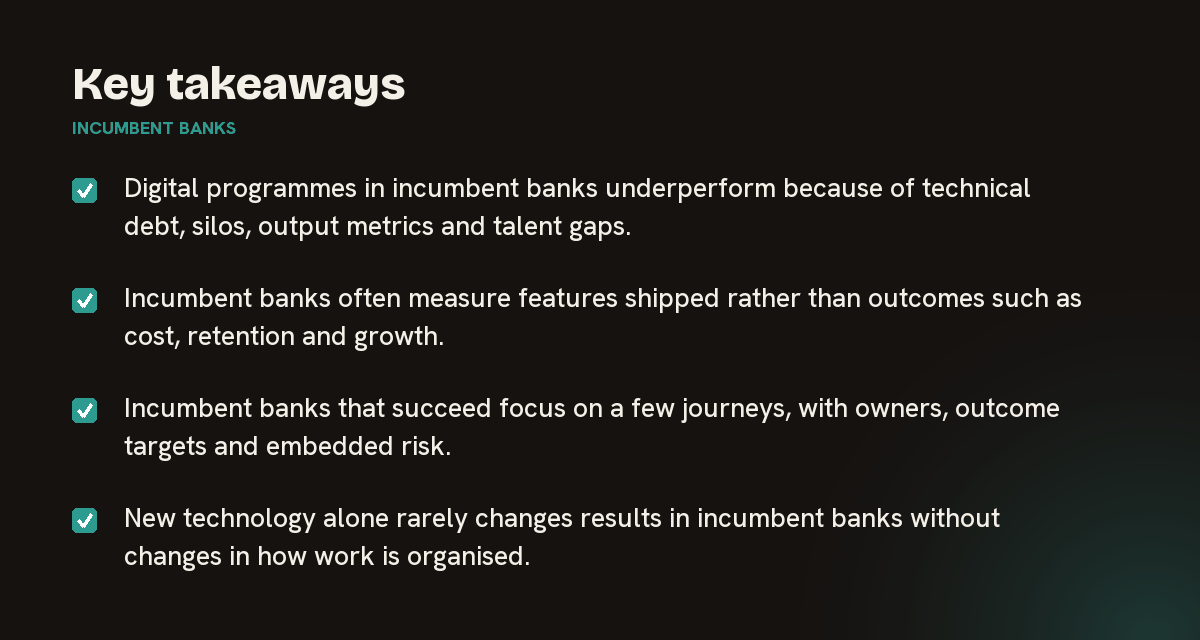
- Digital programmes in incumbent banks underperform because of technical debt, silos, output metrics and talent gaps.
- Incumbent banks often measure features shipped rather than outcomes such as cost, retention and growth.
- Incumbent banks that succeed focus on a few journeys, with owners, outcome targets and embedded risk.
- New technology alone rarely changes results in incumbent banks without changes in how work is organised.
For leaders of incumbent banks, the lesson from a decade of programmes is to change how transformation is run before changing more technology. Focus, ownership and outcome measures make the difference between activity and results.
Optimizium helps incumbent banks reset transformation around journeys, outcomes and operating model change. We respect the risk discipline and customer trust these institutions have built, because they are real advantages. And we bring risk, compliance and finance into the design as co-authors, so faster change remains controlled and measurable.
Explore how we approach this across Banking, Beyond Banking and Wealth Management, browse the FAQ Hub, or read the related question: What is the difference between modernisation and transformation in financial services?
Partner with the experts.
Let's discuss how Optimizium can accelerate your roadmap and navigate complex digital transformation.
Schedule a consultation →