Home › FAQ Hub › Why do embedded finance models accelerate product penetration?
Leadership, Change & Operating ModelsWhy do embedded finance models accelerate product penetration?
Embedded finance models accelerate product penetration because they place financial products at the point of customer need, inside non-financial platforms such as e-commerce checkouts, payroll software or logistics apps. They reduce friction, improve conversion and use context, such as the item being bought or the invoice being paid, to make the offer relevant.
Most people do not set out to buy a loan, an insurance policy or a payment account. They set out to buy a sofa, pay staff or ship goods. Embedded finance places the financial product inside that moment, and that changes how many customers take it up.
Embedded finance models accelerate product penetration because they place financial products at the point of customer need, inside non-financial platforms such as e-commerce checkouts, payroll software or logistics apps. They reduce friction, improve conversion and use context, such as the item being bought or the invoice being paid, to make the offer relevant.
For financial institutions, that means lower acquisition costs and shorter sales cycles. It also requires API-based integration, compliance workflows and real-time decisions, and it attracts regulatory attention to consumer protection, because a product sold in two clicks must still be suitable, affordable and clearly explained.
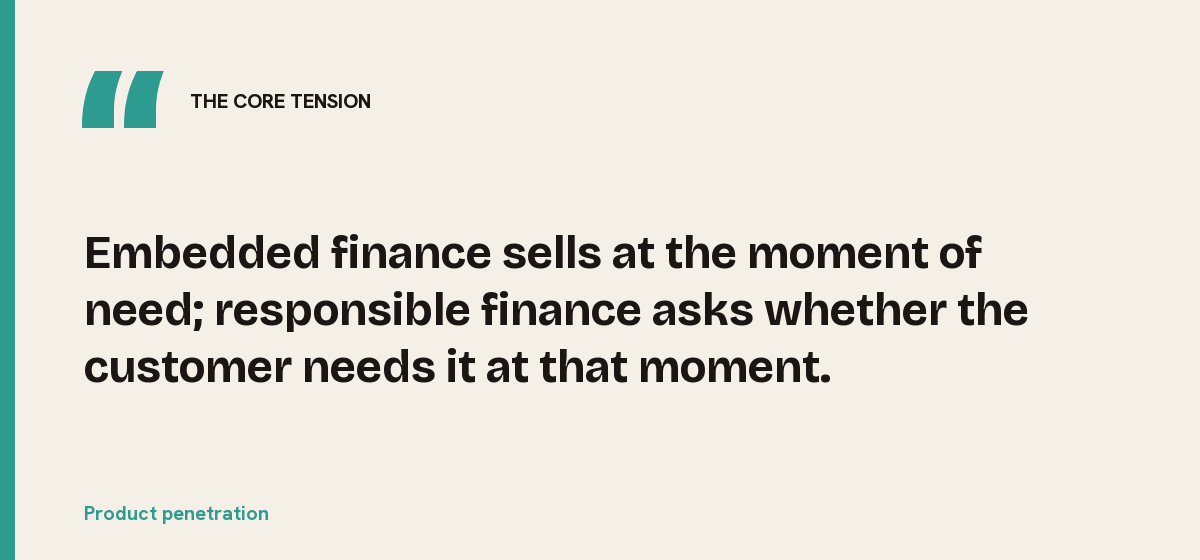
The core tension, in one line:
Embedded finance sells at the moment of need; responsible finance asks whether the customer needs it at that moment.
a payroll software provider offers its small business users a working capital line from a partner bank, priced using their payroll and cash-flow data. Take-up among eligible businesses is far higher than the bank achieves through its own channels, because the offer appears exactly when payroll and receivables are out of step.
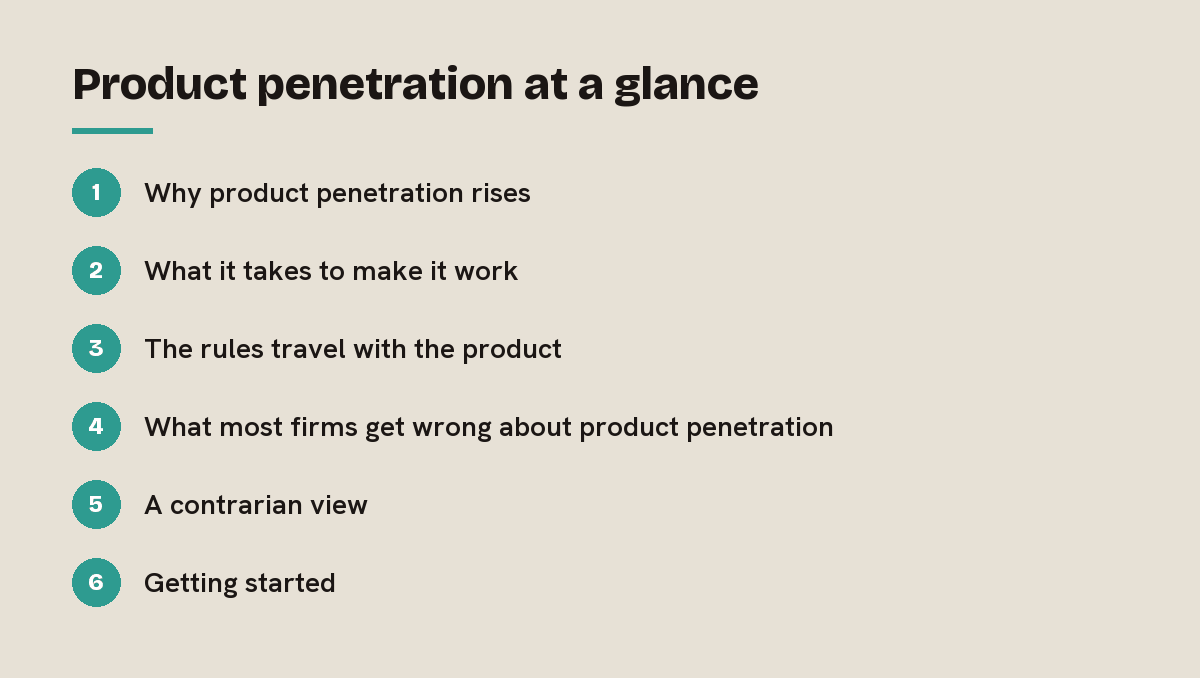
1. Why product penetration rises
| Factor | What it looks like on the ground | Effect on product penetration |
|---|---|---|
| Point of need | Offer appears during a relevant purchase or task | Higher relevance and take-up |
| Less friction | Data pre-filled from the platform | Fewer drop-outs |
| Context | Item, invoice or trip informs the offer | Better-fitting products |
| Trust in the platform | Customers already use and trust the partner | Lower hesitation |
2. What it takes to make it work
- APIs: quoting, decisioning, issuance and servicing available in real time.
- Compliance workflows: affordability, suitability or demands-and-needs checks built into the flow.
- Real-time decisions: credit or underwriting decisions in seconds.
- Partner governance: contracts, monitoring and complaint handling across both firms.
3. The rules travel with the product
Regulators are paying close attention. The revised EU Consumer Credit Directive explicitly brings buy now pay later schemes into scope and requires a thorough creditworthiness assessment in the consumer’s interest, with Member States applying the new rules from 20 November 2026. For insurance sold alongside other products, the Insurance Distribution Directive requires clear information on whether components can be bought separately and what each costs. Data access will also matter: the European Commission’s Financial Data Access proposal would widen permissioned data sharing that embedded offers can draw on.
| Product | Typical embedded setting | Key safeguard |
|---|---|---|
| Point-of-sale credit | E-commerce checkout | Creditworthiness assessment |
| Device or travel cover | Purchase or booking | Clear cover and costs |
| Working capital | Business software | Affordability using real data |
| Payments and accounts | Platforms and marketplaces | KYC and fraud controls |
4. What most firms get wrong about product penetration
- Chasing take-up alone: high product penetration with high cancellations or arrears destroys value.
- Weak affordability checks: speed at checkout must not replace responsible lending.
- Unclear disclosure: two-click journeys still need customers to understand what they buy.
- Neglecting servicing and claims: the experience after the sale decides whether customers keep the product.
Example: a lender’s checkout credit achieved strong product penetration, but early arrears rose among younger borrowers. By adding open banking-based affordability checks and clearer repayment summaries, the lender reduced arrears while keeping most of the conversion gains.
5. A contrarian view
Embedded finance is often judged by how many products it sells. A better test is how many it sells that customers keep and benefit from. Institutions that design for retained, well-understood products build partnerships that last; those that design for volume alone tend to meet regulators sooner or later.
6. Getting started
- Choose simple, modular products suited to the point of need.
- Build robust APIs and real-time decisioning.
- Embed safeguards for affordability, suitability and disclosure.
- Measure outcomes, not only take-up: retention, arrears, cancellations and complaints.
Key takeaways on product penetration
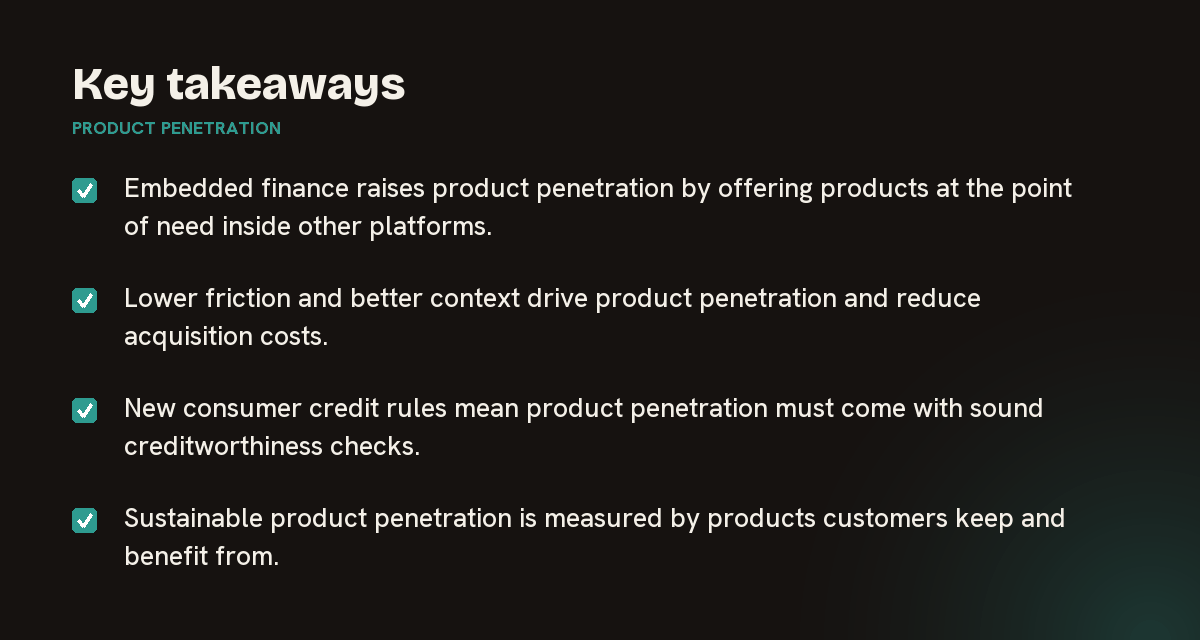
- Embedded finance raises product penetration by offering products at the point of need inside other platforms.
- Lower friction and better context drive product penetration and reduce acquisition costs.
- New consumer credit rules mean product penetration must come with sound creditworthiness checks.
- Sustainable product penetration is measured by products customers keep and benefit from.
For leadership teams, embedded finance is one of the most effective ways to grow product penetration at lower cost. Success depends on combining the convenience of the moment with the safeguards and service that make financial products worth having.
Optimizium helps banks, insurers and lenders design embedded finance propositions and the partnerships behind them. We respect the credit and underwriting expertise that makes products sound. And we bring risk, compliance and partner teams into the design as co-authors, so growth through embedded channels is responsible and durable.
Explore how we approach this across Beyond Banking, Banking and Insurance, browse the FAQ Hub, or read the related question: How should transformation be governed in regulated financial institutions?
Partner with the experts.
Let's discuss how Optimizium can accelerate your roadmap and navigate complex digital transformation.
Schedule a consultation →