Home › FAQ Hub › Why do institutions segment customers by channel?
Leadership, Change & Operating ModelsWhy do institutions segment customers by channel?
Institutions segment customers by channel because customers and products differ in their economics, risk, service expectations and adoption of digital tools. Direct digital channels suit mass-market, low-complexity products and customers comfortable with self-service; adviser channels handle complex or high-value needs; branches provide credibility and reassurance for customers who are more cautious; embedded channels offer convenience at the moment of need.
Not every customer needs the same route to a financial institution. Some want to do everything on their phone; others want a conversation with an expert before any important decision. Serving both well, at a sustainable cost, depends on matching customers and needs to the right channels.
Institutions segment customers by channel because customers and products differ in their economics, risk, service expectations and adoption of digital tools. Direct digital channels suit mass-market, low-complexity products and customers comfortable with self-service; adviser channels handle complex or high-value needs; branches provide credibility and reassurance for customers who are more cautious; embedded channels offer convenience at the moment of need. When institutions segment customers well, they allocate resources sensibly, align pricing with the cost of each channel and achieve the right channel mix. When they do it poorly, they either overspend on expensive channels for simple needs or push complex needs into channels that cannot handle them.
The core tension, in one line:
The cheapest channel for the institution is not always the right channel for the customer’s need.
a bank finds that many simple account queries reach its relationship managers, while some customers with complex lending needs struggle through a self-service journey. It redesigns its routing so simple requests are handled digitally and complex ones go straight to specialists. Costs fall and satisfaction rises in both groups.
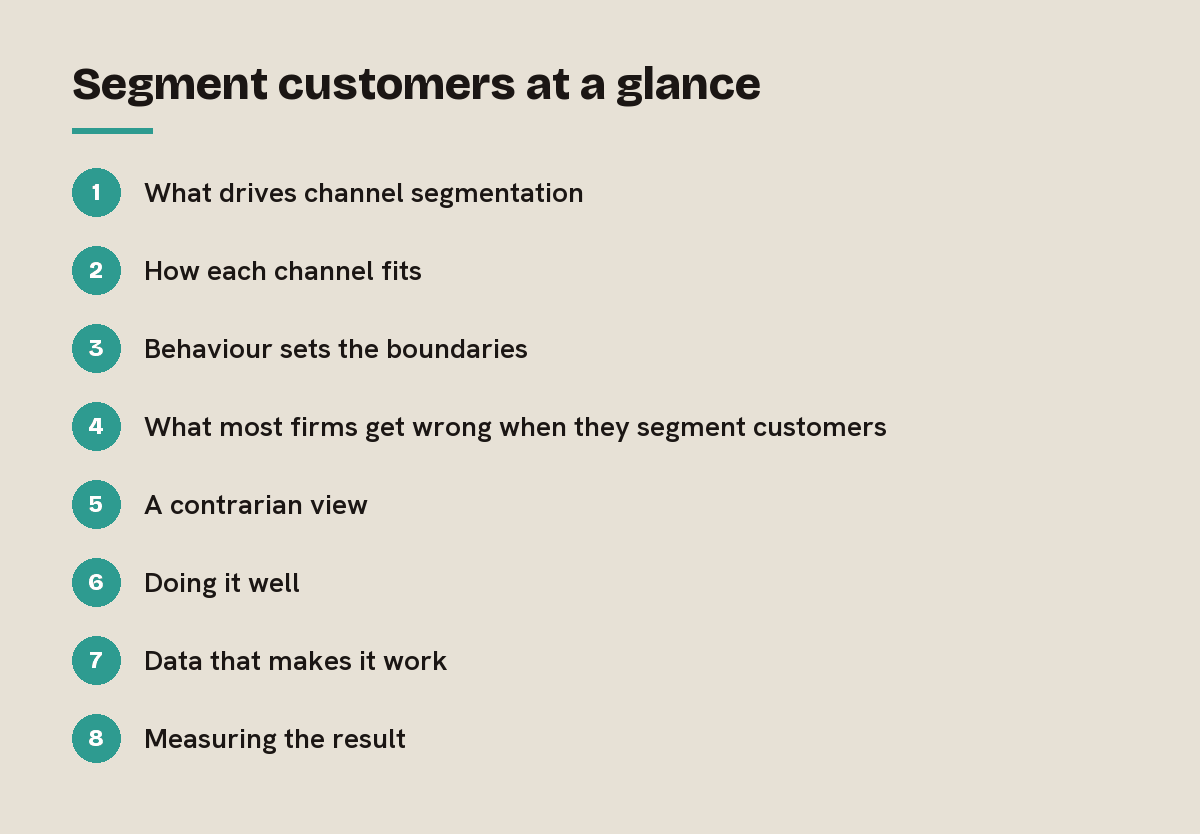
1. What drives channel segmentation
| Driver | What it means | Effect on channel choice |
|---|---|---|
| Economics | Revenue and cost to serve per customer and product | High-value or complex needs justify human channels |
| Risk | Credit, conduct and suitability risk | Higher risk needs more expertise and control |
| Service expectations | Speed, convenience, reassurance | Different customers value different things |
| Adoption behaviour | Comfort with digital tools | Determines what share can self-serve |
2. How each channel fits
- Direct digital: mass-market, low-complexity products such as payments, savings, simple insurance and basic investment accounts.
- Advisers and relationship managers: complex or high-value needs, such as mortgages, business lending, pensions and wealth planning.
- Branches: credibility and reassurance, especially for older or more cautious customers and for significant decisions.
- Embedded channels: convenience at the point of need, such as finance at checkout or insurance with a purchase.
3. Behaviour sets the boundaries
Digital adoption is high but uneven. Eurostat reports that 67 per cent of people aged 16 to 74 in the EU used internet banking in 2024, which leaves a significant minority who do not. In insurance, EIOPA found that digital-only distribution channels still lag well behind physical or hybrid ones, especially for life insurance, where consumers prefer in-person meetings. Institutions must segment customers in ways that reflect these realities rather than assuming everyone will move online.
| Customer and need | Typical best channel |
|---|---|
| Digitally confident customer, simple product | Direct digital |
| Any customer, complex or high-value decision | Adviser or specialist, supported digitally |
| Cautious customer, significant decision | Branch or adviser, with digital follow-up |
| Customer in a partner’s journey, simple need | Embedded |
4. What most firms get wrong when they segment customers
- Segmenting by customer only: the same customer may want digital for payments and an adviser for a pension. Segment by need as well as by person.
- Forcing channel migration: pushing customers into digital channels before they are ready damages trust.
- Ignoring vulnerability: customers in vulnerable circumstances may need human support even for simple tasks.
- Pricing without regard to channel cost: prices that ignore channel economics either lose money or lose customers.
Example: an insurer segmented its customers by need rather than by age or product. Simple renewals and changes moved to self-service with clear routes to help, while claims and complex cover questions were routed to experienced staff. The proportion of interactions handled digitally rose, and complaint volumes fell because complex cases reached the right people faster.
5. A contrarian view
Channel segmentation is often treated as a way to cut costs by moving customers online. Its real value is in matching: putting expensive expertise where it matters most and freeing it from tasks digital tools handle better. Institutions that segment customers to improve outcomes, not only to reduce costs, usually achieve both. Those that segment customers only to cut costs often see the savings return as complaints and attrition.
6. Doing it well
- Map needs, not just products, and the channel each need is best served in.
- Use data on behaviour, value and risk to guide routing.
- Keep channels connected, so customers can move between them without starting again.
- Protect vulnerable customers with clear access to human help.
- Review regularly, as adoption and expectations change.
7. Data that makes it work
To segment customers well, institutions need a joined-up view of each customer’s products, interactions and preferences across channels. Many lack it, because channel systems were built separately. A shared customer record, even a simple one at first, allows routing rules to send each need to the right place and lets staff see what happened in other channels before they respond.
8. Measuring the result
Good channel segmentation shows up in a handful of measures: cost to serve by need, resolution at first contact, satisfaction by channel, the share of complex cases reaching specialists quickly, and complaints related to channel access. Tracking these together shows whether the channel mix is serving customers and the institution well.
Key takeaways on segment customers
- Institutions segment customers by channel because economics, risk, service needs and adoption differ.
- It works best to segment customers by need as well as by person, since one customer uses many channels.
- Vulnerable customers need clear access to people even when institutions segment customers towards digital.
- Firms that segment customers to improve outcomes, not only to cut costs, usually achieve both.
For leadership teams, deciding how to segment customers by channel is one of the most practical levers for balancing cost, experience and risk. Done well, it lets institutions invest in digital and human channels with confidence, knowing each is doing the work it is best at.
Optimizium helps banks, insurers and wealth managers design channel segmentation grounded in customer needs and channel economics. We respect the knowledge of frontline teams, because they see every day which needs belong where. And we bring risk, compliance and distribution leaders into the design as co-authors, so channel choices are fair, sustainable and well controlled.
Explore how we approach this across Banking, Insurance, Wealth Management and Beyond Banking, browse the FAQ Hub, or read the related question: How should transformation be governed in regulated financial institutions?
Partner with the experts.
Let's discuss how Optimizium can accelerate your roadmap and navigate complex digital transformation.
Schedule a consultation →