Home › FAQ Hub › Why do insurers invest heavily in broker enablement platforms?
Leadership, Change & Operating ModelsWhy do insurers invest heavily in broker enablement platforms?
Insurers invest heavily in broker enablement platforms because brokers drive a significant share of premiums, especially in commercial and complex lines, and they choose where to place business partly on how easy each insurer is to deal with. Broker enablement platforms streamline quoting, policy issuance, endorsements and renewals, reduce processing errors and shorten time to market for new products.
For many insurers, especially in commercial and complex lines, brokers are not one channel among many. They are the channel. Winning business depends on being the insurer brokers find easiest to work with.
Insurers invest heavily in broker enablement platforms because brokers drive a significant share of premiums, especially in commercial and complex lines, and they choose where to place business partly on how easy each insurer is to deal with. Broker enablement platforms streamline quoting, policy issuance, endorsements and renewals, reduce processing errors and shorten time to market for new products.
Good platforms also give brokers dashboards, exception management and compliance tracking, which improves loyalty, and many support comparison across several insurers to help brokers advise their clients. In a market where products are often similar, service to the broker becomes a real source of advantage.
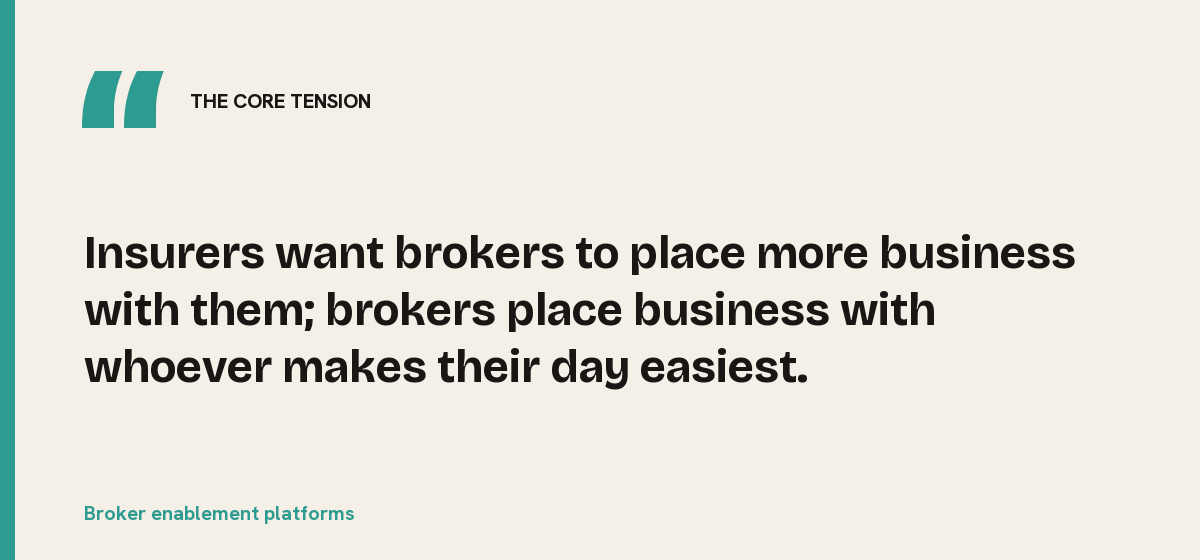
The core tension, in one line:
Insurers want brokers to place more business with them; brokers place business with whoever makes their day easiest.
a commercial insurer’s brokers used email and spreadsheets to request quotes, waiting days for responses. After launching a broker enablement platform with instant quotes for standard risks, referral workflows for complex ones and live case status, quote turnaround fell to hours and the insurer’s share of brokers’ placements rose.
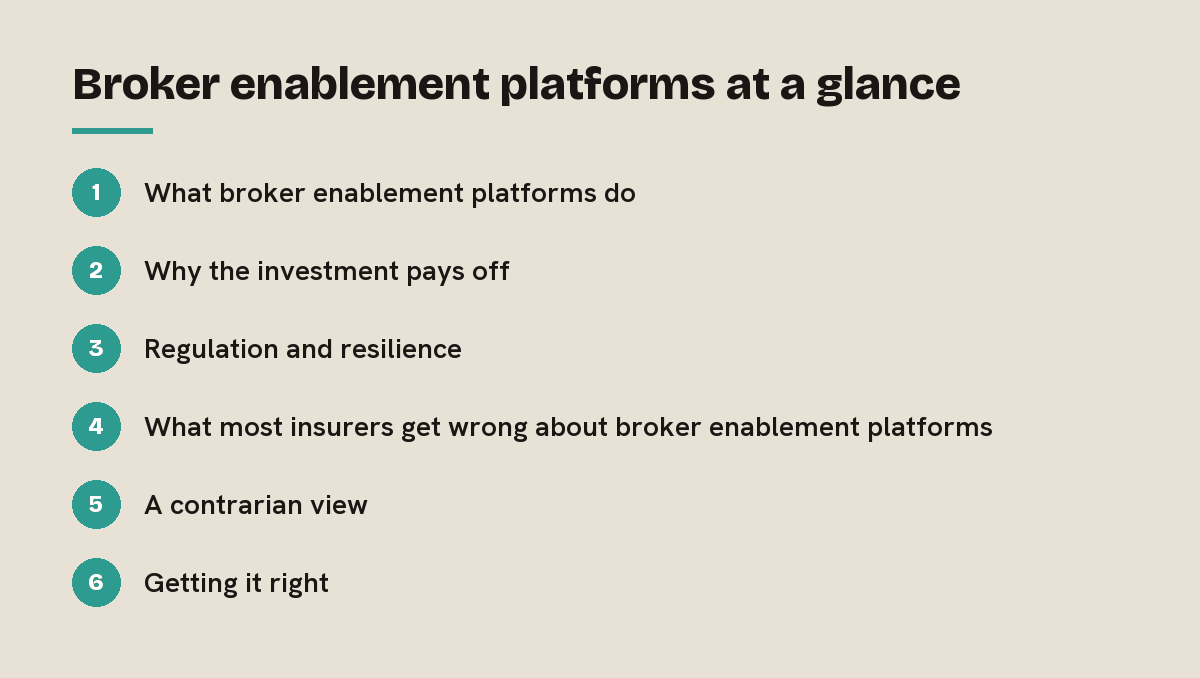
1. What broker enablement platforms do
| Capability | What it looks like on the ground | Benefit |
|---|---|---|
| Quote and bind | Instant pricing for standard risks | Faster wins, fewer lost quotes |
| Policy issuance | Documents generated automatically | Fewer errors and rework |
| Endorsements and renewals | Self-service changes and renewal workflows | Lower processing cost |
| Referral management | Complex risks routed to underwriters with full context | Faster decisions on complex cases |
| Dashboards and tracking | Live status, commissions, compliance tasks | Transparency and trust |
2. Why the investment pays off
- Premium concentration: a few large brokers often account for a large share of premiums.
- Speed to quote: in competitive placements, the first credible quote often wins.
- Lower cost to serve: fewer emails, calls and manual corrections.
- Faster product launches: new products reach brokers through the same platform.
- Better data: structured submissions improve pricing and portfolio insight.
The channel context makes this essential. EIOPA found that digital-only distribution channels still lag well behind physical or hybrid ones in European insurance. Intermediaries remain central, so digitising their experience is often the fastest route to digital scale.
3. Regulation and resilience
Broker enablement platforms carry regulatory weight. Under the Insurance Distribution Directive, distributors must specify customers’ demands and needs and meet information requirements; platforms that capture this consistently help both broker and insurer evidence good conduct. Many platforms are cloud-based or supplied by third parties, which brings them within ICT risk management under the Digital Operational Resilience Act, applicable since 17 January 2025.
| Design choice | Broker benefit | Insurer benefit |
|---|---|---|
| Pre-filled data | Less typing | Better data quality |
| Clear referral rules | Predictable decisions | Underwriters focus on complex risks |
| API connections | Works with broker systems | Higher submission volumes |
| Compliance prompts | Easier evidence | Lower conduct risk |
4. What most insurers get wrong about broker enablement platforms
- Building for the insurer, not the broker: portals that mirror internal systems frustrate brokers.
- Ignoring broker software: many brokers prefer data to flow from their own systems through APIs.
- Automating only simple risks: complex cases still need fast, well-supported referral paths.
- No feedback loop: without broker input and usage data, platforms stagnate.
Example: an insurer launched a broker portal with dozens of features, but usage stayed low. Interviews showed brokers wanted three things: faster quotes on standard risks, clear status on referrals and fewer duplicate data requests. A focused redesign around those needs doubled active usage within a year.
5. A contrarian view
Some insurers see broker enablement platforms as a step towards cutting brokers out. In most commercial and complex lines, the opposite is true: platforms make brokers more productive and more loyal, which grows the insurer’s share of their business. Treating brokers as partners in design produces better results than treating them as a channel to be replaced.
6. Getting it right
- Start from broker journeys, not internal processes.
- Offer APIs as well as portals.
- Design referral paths as carefully as instant quotes.
- Measure broker experience: quote turnaround, hit rate, usage, satisfaction.
Key takeaways on broker enablement platforms
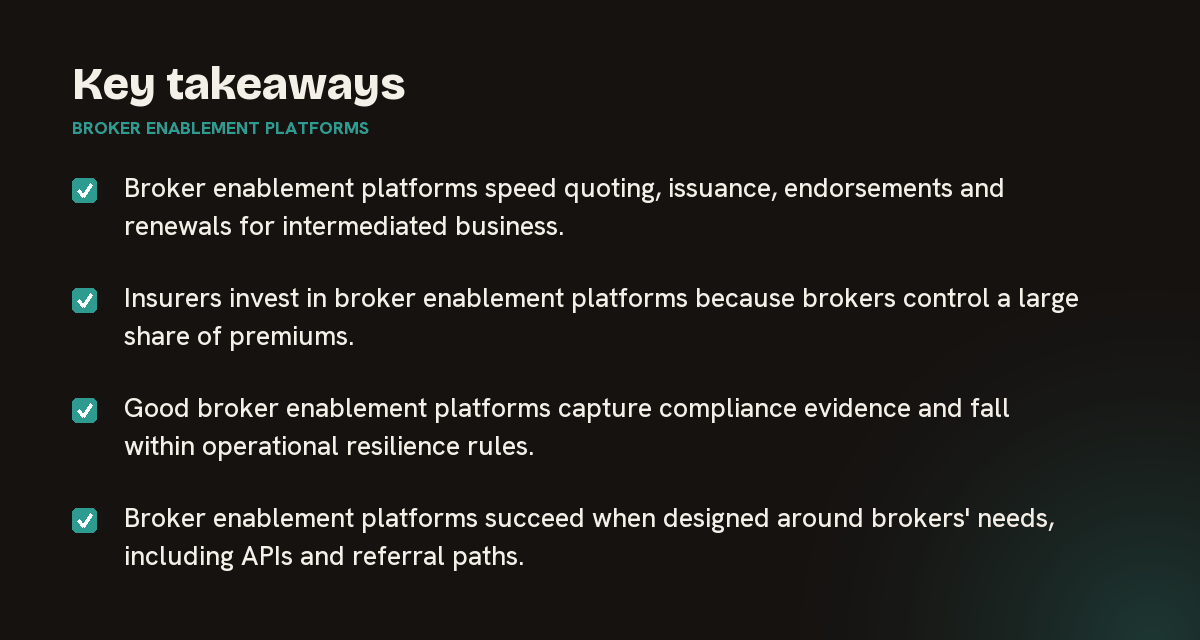
- Broker enablement platforms speed quoting, issuance, endorsements and renewals for intermediated business.
- Insurers invest in broker enablement platforms because brokers control a large share of premiums.
- Good broker enablement platforms capture compliance evidence and fall within operational resilience rules.
- Broker enablement platforms succeed when designed around brokers’ needs, including APIs and referral paths.
For insurance leaders, broker enablement platforms are among the most direct levers on growth and cost in intermediated lines. Designed with brokers, they turn service into a competitive advantage.
Optimizium helps insurers design and implement broker enablement that brokers adopt. We respect the relationships and expertise brokers bring, because they shape how customers buy cover. And we bring underwriting, distribution, risk and compliance teams into the design as co-authors, so platforms are fast for brokers and well controlled for insurers.
Explore how we approach this across Insurance, Banking and Beyond Banking, browse the FAQ Hub, or read the related question: Why do frontline and middle management often resist digital?
Related questions
Partner with the experts.
Let's discuss how Optimizium can accelerate your roadmap and navigate complex digital transformation.
Schedule a consultation →