Home › FAQ Hub › Why is AI adoption uneven across financial services?
AI, Data & AnalyticsWhy is AI adoption uneven across financial services?
AI adoption is uneven across financial services because it depends on data maturity, regulatory intensity, legacy architecture and product complexity. Institutions with cleaner data environments, modern technology and lighter supervisory constraints deploy AI faster; heavily regulated and legacy-dependent businesses progress more cautiously.
Some financial institutions run hundreds of AI models in production; others are still running their first pilots. The gap is not only about ambition or budget. It reflects deep structural differences between sectors and firms.
AI adoption is uneven across financial services because it depends on data maturity, regulatory intensity, legacy architecture and product complexity. Institutions with cleaner data environments, modern technology and lighter supervisory constraints deploy AI faster; heavily regulated and legacy-dependent businesses progress more cautiously.
The pattern shows across sectors. Banks, with high transaction volumes and long experience of credit and fraud models, are generally ahead. Insurers vary widely, with non-life moving faster than life. Wealth managers often focus on supporting advisers before automating advice. Fintechs pursue end-to-end automation where legacy constraints are light. Understanding these differences helps each institution set realistic goals rather than copying another’s roadmap.
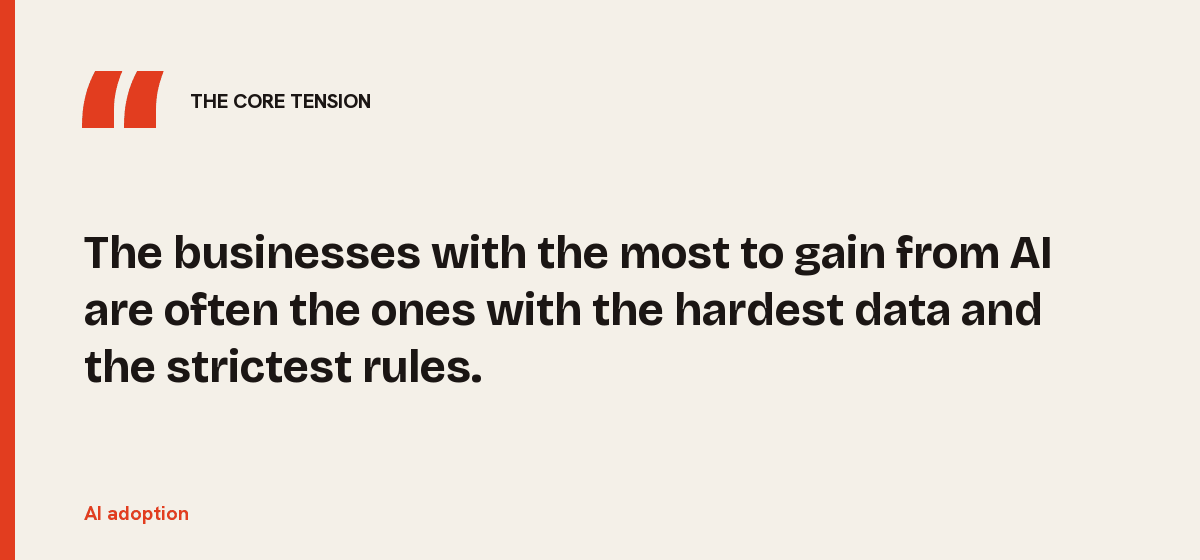
The core tension, in one line:
The businesses with the most to gain from AI are often the ones with the hardest data and the strictest rules.
a financial group finds that its bank runs many AI models in production while its life insurer has almost none. The difference lies in data volume, decision horizons and regulatory treatment. The group shares its AI platform and governance across both businesses but sets separate, realistic priorities for each.
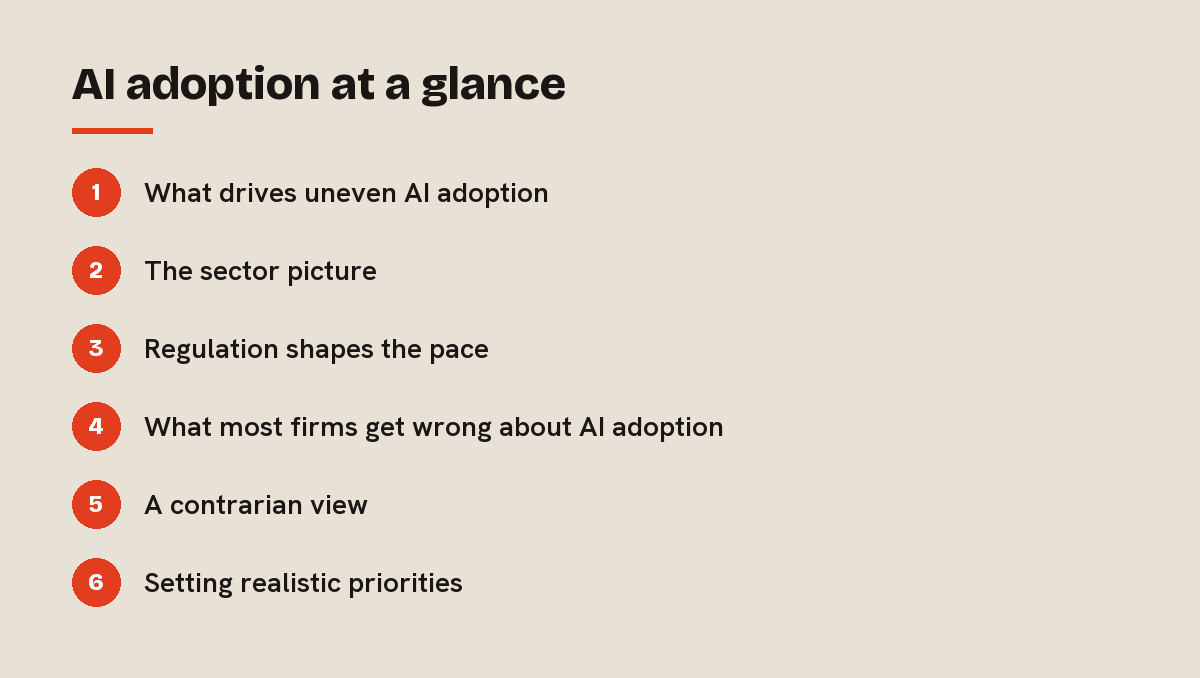
1. What drives uneven AI adoption
| Driver | Faster adoption when | Slower adoption when |
|---|---|---|
| Data maturity | Clean, connected, high-volume data | Fragmented, legacy or thin data |
| Regulation | Low-risk uses, clear guidance | High-risk uses such as credit or life pricing |
| Legacy architecture | Modern, API-based systems | Monolithic cores |
| Product complexity | Standard, frequent decisions | Long-term, bespoke products |
2. The sector picture
| Sector | AI focus | Structural constraint |
|---|---|---|
| Banking | Fraud, credit, customer service | Legacy cores, model governance |
| Insurance (non-life) | Pricing, claims triage | Data quality, claims partners |
| Insurance (life) | Underwriting support | Long horizons, high-risk rules |
| Wealth | Adviser support, reporting | Suitability, smaller data sets |
| Fintech | End-to-end automation | Scaling controls and resilience |
The numbers confirm the gap. According to ECB Supervisory Board Chair Claudia Buch, more than 90 per cent of banks directly supervised by the ECB integrate AI into their operations, and 85 per cent use generative AI. In insurance, EIOPA found that AI was used by 50 per cent of respondents in non-life and 24 per cent in life.
3. Regulation shapes the pace
The EU Artificial Intelligence Act classifies AI used to assess creditworthiness, and for risk assessment and pricing in life and health insurance, as high-risk. Those uses require data governance, documentation, human oversight and monitoring, which naturally slows adoption compared with lower-risk uses such as document processing or internal analytics.
4. What most firms get wrong about AI adoption
- Benchmarking against the wrong peers: a life insurer comparing itself with a retail bank sets unrealistic targets.
- Starting with high-risk uses: early projects in tightly regulated decisions often stall in governance.
- Ignoring data foundations: AI adoption rarely outpaces data quality.
- Measuring pilots, not production: the number of experiments says little about value delivered.
Example: an insurer began its AI programme with life underwriting automation and spent a year in validation. It then shifted to lower-risk uses first, such as claims document reading and fraud triage, delivering value within months and building the governance experience it later used for underwriting support.
5. A contrarian view
Uneven AI adoption is often presented as laggards falling behind leaders. Sometimes caution is rational: where data is thin, decisions are long-term and rules are strict, moving slowly and carefully can create more value than racing to automate. The goal is the right adoption for each business, not the most adoption.
6. Setting realistic priorities
- Map use cases by value and risk, starting with lower-risk, high-value ones.
- Invest in data foundations before scaling models.
- Share platforms and governance across business lines.
- Measure value in production, not the number of pilots.
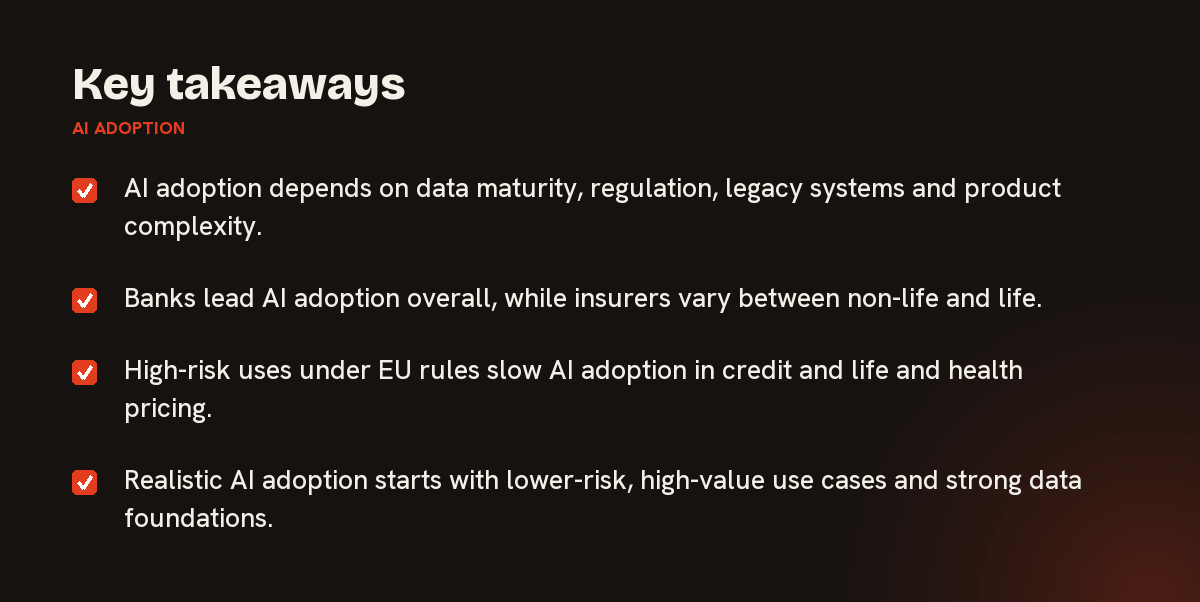
Key takeaways on AI adoption
- AI adoption depends on data maturity, regulation, legacy systems and product complexity.
- Banks lead AI adoption overall, while insurers vary between non-life and life.
- High-risk uses under EU rules slow AI adoption in credit and life and health pricing.
- Realistic AI adoption starts with lower-risk, high-value use cases and strong data foundations.
For leadership teams, understanding why AI adoption is uneven helps set priorities that fit their own business rather than a competitor’s. Shared foundations, realistic use cases and strong governance move adoption forward steadily.
Optimizium helps banks, insurers and wealth managers plan and scale AI responsibly. We respect the modelling and risk expertise institutions already hold, because it is the basis of trustworthy AI. And we bring model risk, compliance and data protection into the design as co-authors, so AI adoption creates value without unwelcome surprises.
Explore how we approach this across Banking, Insurance, Wealth Management and Beyond Banking, browse the FAQ Hub, or read the related question: How does data lineage affect transformation programmes?
Related questions
Partner with the experts.
Let's discuss how Optimizium can accelerate your roadmap and navigate complex digital transformation.
Schedule a consultation →