Home › FAQ Hub › Why is customer experience harder to fix than user interface?
Tech & Core ModernisationWhy is customer experience harder to fix than user interface?
Customer experience is harder to fix than user interface because most of what customers find painful does not come from screens. A user interface change is surface-level; transforming the experience means re-architecting products, policies, servicing rules, data and workflows.
Many financial institutions have invested heavily in redesigned apps and websites. The screens look modern, the fonts are clean, the buttons are where customers expect them. And yet complaints, call volumes and satisfaction scores barely move.
Customer experience is harder to fix than user interface because most of what customers find painful does not come from screens. A user interface change is surface-level; transforming the experience means re-architecting products, policies, servicing rules, data and workflows. Customer pain points often originate in legacy processes and risk controls rather than in design: a claim that takes weeks, a document requested twice, a decision nobody can explain. Each sector has its own centre of gravity: in insurance, experience hinges on claims decisions; in wealth, on advisory interactions; in banking, on servicing and the reliability of payments. Redesigning screens is necessary, but it is rarely sufficient.
The core tension, in one line:
Customers see the interface; they feel everything behind it.
an insurer launches a beautifully designed claims app. Customers can file a claim in minutes, but the claim then waits for manual review, a loss adjuster’s visit and several approvals. Satisfaction falls, because the app makes the speed of the first step a promise the rest of the process cannot keep.
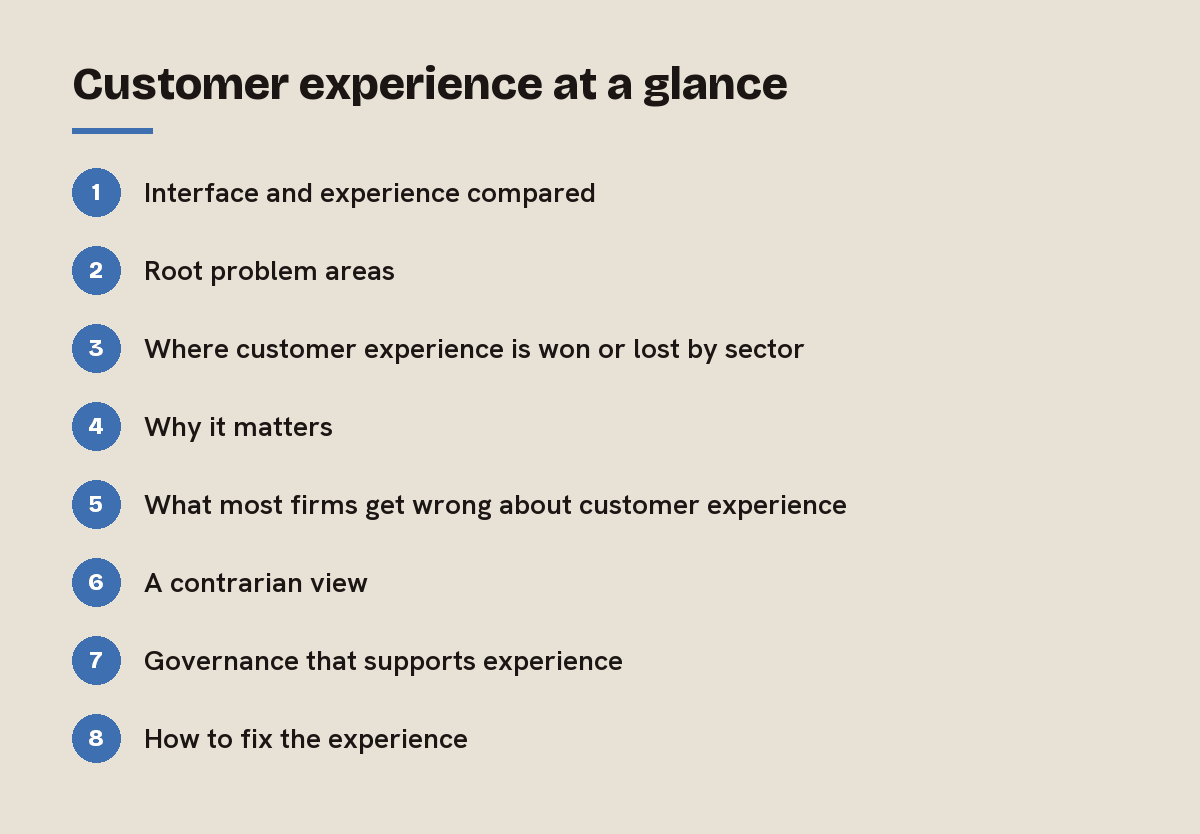
1. Interface and experience compared
| Dimension | User interface | Customer experience |
|---|---|---|
| What it covers | Screens, layout, wording, interactions | The whole journey, including what happens out of sight |
| Who owns it | Design and digital teams | Product, operations, risk, technology, channels together |
| Typical fix | Redesign, usability testing | Changes to products, policies, data and processes |
| Speed of change | Weeks | Months to years |
| Typical pain points | Confusing screens | Delays, repeated requests, unexplained decisions |
2. Root problem areas
- Policy rules: internal rules that require extra steps, approvals or documents customers do not understand.
- Regulatory constraints: necessary requirements that are implemented in ways that add more friction than needed.
- Operational gating: manual reviews and hand-offs that pause journeys.
- Risk and fraud controls: checks applied too broadly or explained poorly.
- Data latency: information that takes days to update, so customers see outdated status or balances.
3. Where customer experience is won or lost by sector
| Sector | Moment that matters most | What usually needs to change |
|---|---|---|
| Insurance | Claims decisions | Claims process, approvals, data from partners |
| Wealth | Advisory interactions | Adviser tools, reporting, suitability processes |
| Banking | Servicing and payment reliability | Core systems, fraud handling, problem resolution |
| Fintech | Support when things go wrong | Escalation, human support, account controls |
4. Why it matters
Design remains valuable. McKinsey’s study of 300 listed companies found that firms in the top quartile of its design index achieved 32 percentage points higher revenue growth and 56 percentage points higher shareholder returns than peers over five years, with retail banking among the industries studied. But the firms that benefited treated design as a way of making decisions about the whole experience, not just the screens.
Regulators look at the whole experience too. The FCA’s Consumer Duty sets expectations for consumer support, including that customers should be able to switch, exit or complain without unreasonable barriers. A polished interface does not satisfy those expectations if the process behind it is slow or obstructive.
5. What most firms get wrong about customer experience
- Starting with the app: redesigning screens first locks in old processes behind a new front.
- Separating digital from operations: design teams cannot fix what operations, risk and product teams own.
- Measuring screen metrics only: click-through and app ratings miss delays and failures after submission.
- Treating controls as untouchable: many controls can be redesigned to be equally effective and far less painful.
Example: a bank’s complaint data showed that most frustration came not from the app but from blocked payments with no explanation. A joint team from fraud, operations and digital redesigned the process: clearer real-time messages, faster review of flagged payments and a simple way for customers to confirm legitimate transactions. Complaints about blocked payments fell sharply, with no loss of fraud protection.
6. A contrarian view
Interface work is often criticised as cosmetic. It is better understood as the cheapest way to reveal deeper problems: when a beautifully designed journey still fails, it shows exactly where policies, data and processes need to change. Used that way, interface redesign is the start of experience transformation rather than a substitute for it.
7. Governance that supports experience
Experience improvements often stall because no single executive owns the end-to-end journey. Appointing journey owners with authority across product, operations and channels, and reviewing journey outcomes at executive level alongside financial results, gives experience work the weight it needs. It also creates a forum where risk and compliance can agree changes to controls quickly, instead of in sequence.
8. How to fix the experience
- Map the full journey, including steps customers never see.
- Find where time and effort go, using operational and complaint data.
- Bring owners together: product, operations, risk, compliance, technology and design.
- Redesign policies and controls, not just screens.
- Measure end-to-end outcomes: time to resolution, repeat contacts, complaints.
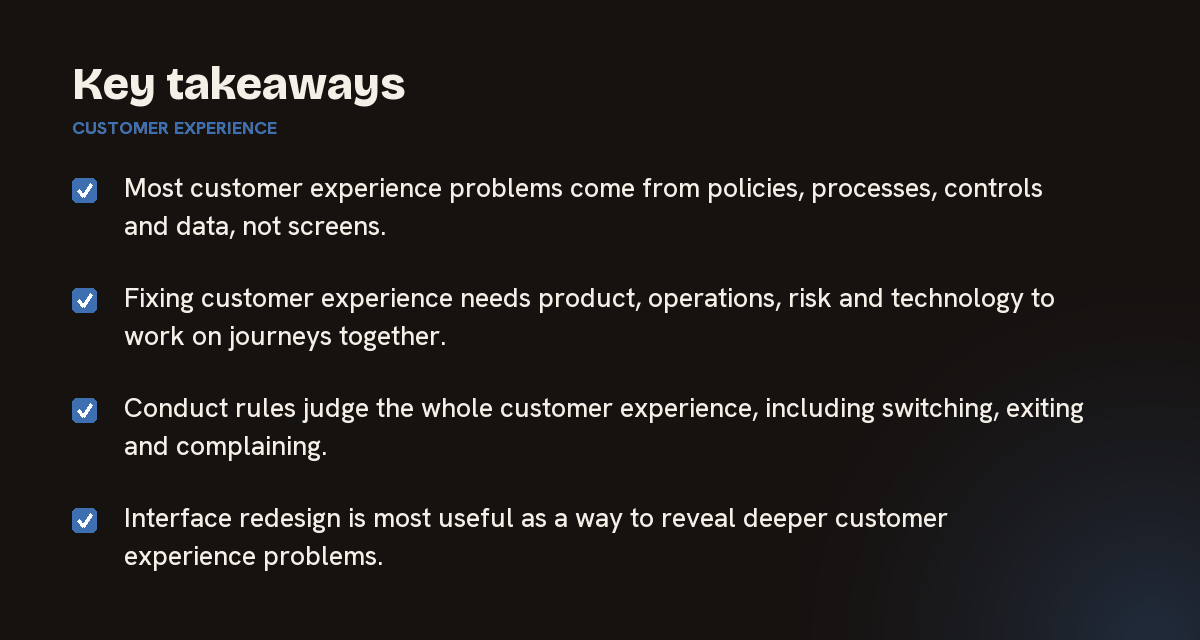
Key takeaways on customer experience
- Most customer experience problems come from policies, processes, controls and data, not screens.
- Fixing customer experience needs product, operations, risk and technology to work on journeys together.
- Conduct rules judge the whole customer experience, including switching, exiting and complaining.
- Interface redesign is most useful as a way to reveal deeper customer experience problems.
For leadership teams, the lesson is that customer experience is an operating model question. It requires the people who own products, processes, risk and data to work together on journeys, with design as the common language rather than the last step.
Optimizium helps banks, insurers and wealth managers improve customer experience end to end, from policy and process to screen. We respect the operational and risk expertise behind today’s processes, because it explains why they exist. And we bring risk, compliance and operations colleagues into the design as co-authors, so better customer experience comes with control, not at its expense.
Explore how we approach this across Banking, Insurance, Wealth Management and Beyond Banking, browse the FAQ Hub, or read the related question: Why are digital customer journeys often fragmented in banks and insurers?
On this page
Partner with the experts.
Let's discuss how Optimizium can accelerate your roadmap and navigate complex digital transformation.
Schedule a consultation →