Home › FAQ Hub › Why are digital customer journeys often fragmented in banks and insurers?
Tech & Core ModernisationWhy are digital customer journeys often fragmented in banks and insurers?
Digital customer journeys are often fragmented in banks and insurers because of siloed product ownership, legacy policy and account systems, and digital features added without connecting them. Most incumbents digitised around existing processes instead of redesigning them end to end, so each product line built its own front end on top of its own back end.
A customer opens an account in the app, buys insurance on the website and has to phone to change their address on both. To the customer it is one relationship; to the institution it is three systems, three teams and three processes that do not talk to each other.
Digital customer journeys are often fragmented in banks and insurers because of siloed product ownership, legacy policy and account systems, and digital features added without connecting them. Most incumbents digitised around existing processes instead of redesigning them end to end, so each product line built its own front end on top of its own back end.
Insurance complexities, such as claims and underwriting, and banking controls, such as know-your-customer, anti-money-laundering and credit checks, add further layers of coordination. Wealth management adds suitability and custody. Without someone accountable for the whole journey, each area optimises its own part, and the customer experiences the seams.
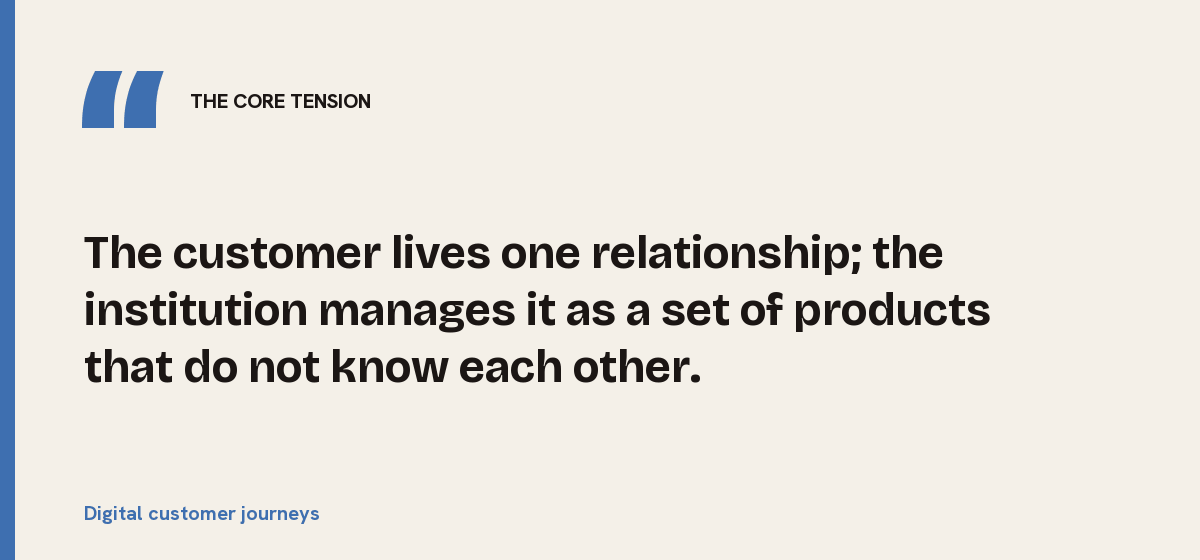
The core tension, in one line:
The customer lives one relationship; the institution manages it as a set of products that do not know each other.
a customer updates their address in their bank’s app, and weeks later receives a home insurance renewal at the old address from the same group’s insurer. The two businesses had separate customer records. Unifying contact data and change events removed the problem and a share of complaints.
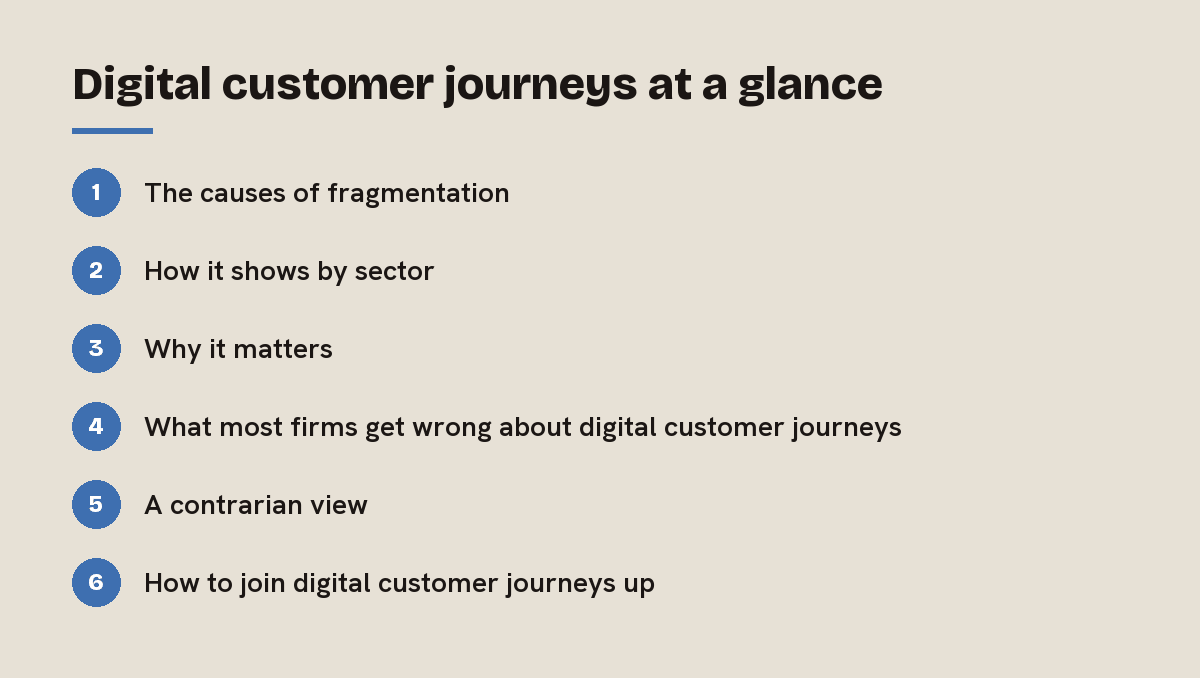
1. The causes of fragmentation
| Cause | What it looks like on the ground | Effect on digital customer journeys |
|---|---|---|
| Product silos | Each product line with its own app, data and team | Customers repeat information |
| Legacy systems | Disconnected account and policy cores | Changes do not propagate |
| Disconnected add-ons | Digital features added without redesign | Journeys jump between channels |
| Late controls | Checks outside the journey | Unexpected pauses and documents |
2. How it shows by sector
- Banking: KYC, AML and credit checks interrupt opening and lending journeys.
- Insurance: claims and underwriting pass through handlers, loss adjusters and suppliers.
- Wealth: suitability, custody and execution live in different systems.
| Moment | Banking | Insurance |
|---|---|---|
| Onboarding | Identity and source-of-funds checks | Underwriting questions and documents |
| Servicing | Data changes across products | Policy amendments |
| Critical moment | Fraud or failed payment | Claim |
3. Why it matters
Fragmentation costs customers and revenue. Signicat found that 68 per cent of European consumers had abandoned a financial services application in the previous year. Since 28 June 2025, the European Accessibility Act has required consumer banking services to be accessible, which forces a review of journeys often built piece by piece. And digital is the main channel for most customers: Eurostat reports that 67 per cent of people aged 16 to 74 in the EU used internet banking in 2024.
4. What most firms get wrong about digital customer journeys
- Redesigning screens, not journeys: a better app on fragmented processes does not remove the seams.
- One app per product: customers must learn several apps from the same institution.
- Duplicated customer data: each system holds its own version, none complete.
- No end-to-end owner: each area measures its part and nobody measures the journey.
Example: an insurer mapped the full journey of a home insurance claim and found eleven hand-offs between teams and suppliers. By appointing a journey owner, sharing a single digital case and connecting loss adjusters directly, it halved the hand-offs, and customers stopped calling to ask where their claim stood.
5. A contrarian view
The usual fix is a large customer experience platform. But fragmentation is mainly a problem of ownership and data: as long as each product has its own owner and its own customer records, any new layer will fragment too. Starting with journey ownership and a single customer record usually delivers more than any technology purchase.
6. How to join digital customer journeys up
- Map full journeys from the customer’s perspective.
- Appoint journey owners with authority across functions.
- Unify customer data and propagate changes.
- Build controls into journeys, not at the end.
- Measure hand-offs, channel switches and data-related complaints.
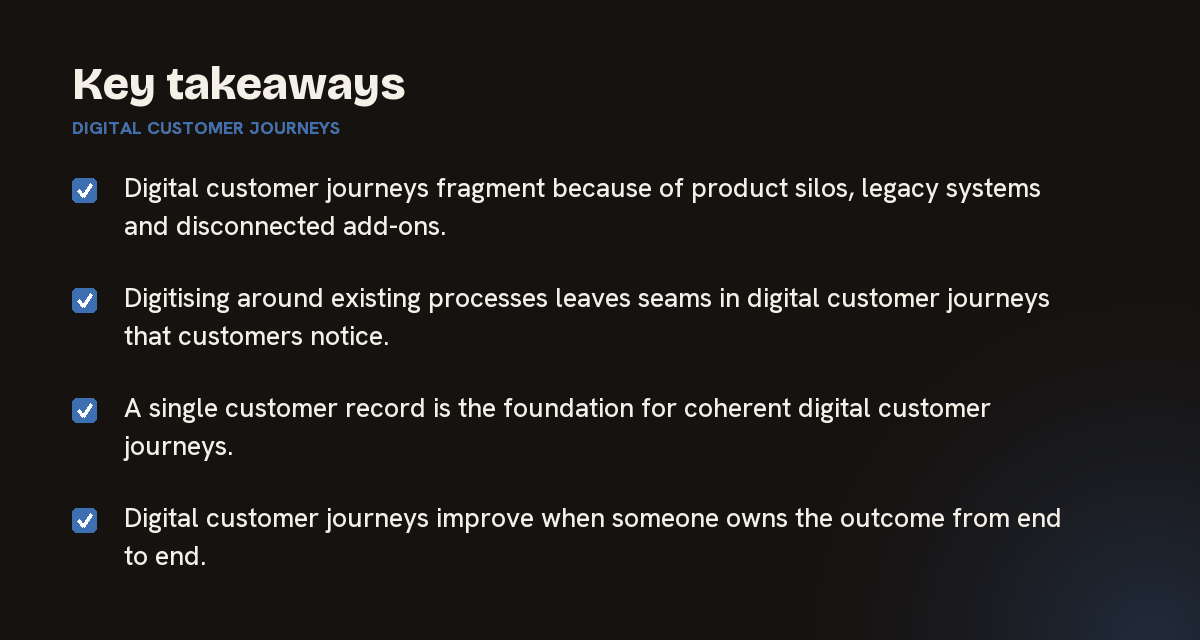
Key takeaways on digital customer journeys
- Digital customer journeys fragment because of product silos, legacy systems and disconnected add-ons.
- Digitising around existing processes leaves seams in digital customer journeys that customers notice.
- A single customer record is the foundation for coherent digital customer journeys.
- Digital customer journeys improve when someone owns the outcome from end to end.
For leadership teams, fragmented journeys are a symptom of how the institution is organised. Fixing them requires decisions about ownership, data and governance as well as technology, and results show quickly in satisfaction, cost and complaints.
Optimizium helps banks and insurers redesign digital customer journeys end to end. We respect the knowledge of each product area, because it explains why processes are as they are. And we bring risk, compliance and operations into the design as co-authors, so journeys are simple for customers and well controlled.
Explore how we approach this across Banking, Insurance and Wealth Management, browse the FAQ Hub, or read the related question: How does wealth management differ from retail banking in digital strategy?
Partner with the experts.
Let's discuss how Optimizium can accelerate your roadmap and navigate complex digital transformation.
Schedule a consultation →