Home › FAQ Hub › Why is digital onboarding critical for financial performance?
Tech & Core ModernisationWhy is digital onboarding critical for financial performance?
Digital onboarding is critical for financial performance because it directly shapes customer acquisition cost, funnel conversion, fraud losses and time to revenue.
Every financial relationship starts with onboarding, and for many customers it is the first real test of whether an institution is easy to deal with. It is also the point where marketing spend either turns into revenue or quietly disappears.
Digital onboarding is critical for financial performance because it directly shapes customer acquisition cost, funnel conversion, fraud losses and time to revenue. Every customer who abandons an application wastes the marketing spend that brought them there; every manual check adds cost and delay; every weak control invites fraud. Poor onboarding produces abandonment, pushes customers back to branches and call centres, and creates manual exception handling. The challenge differs by sector: insurance onboarding integrates underwriting, banking integrates KYC and anti-money-laundering checks, wealth integrates suitability and custody workflows, and fintechs optimise for speed and automation. Getting digital onboarding right is one of the highest-return investments a financial institution can make.
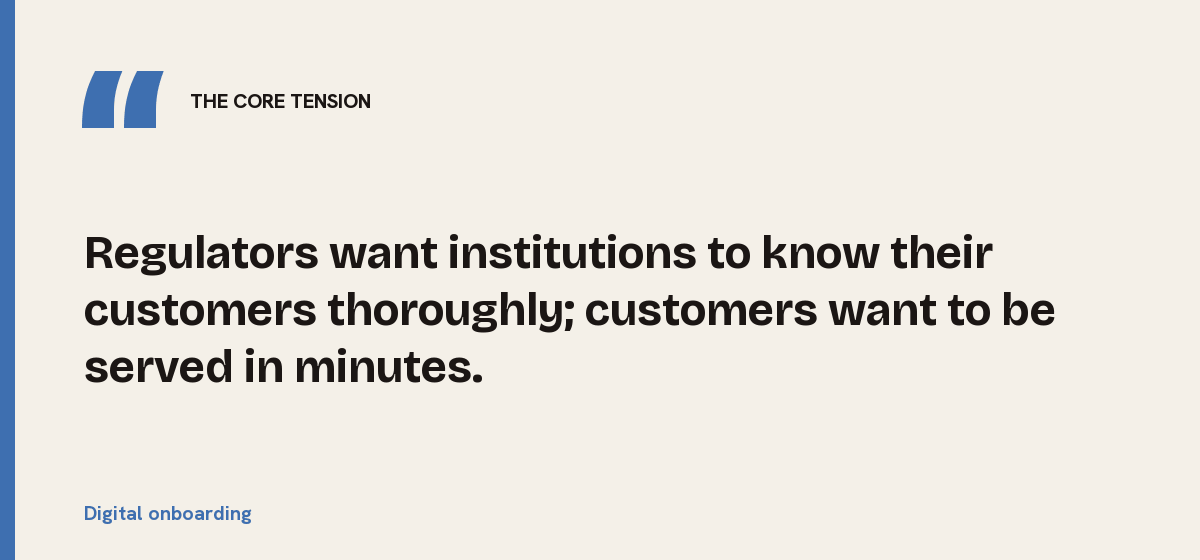
The core tension, in one line:
Regulators want institutions to know their customers thoroughly; customers want to be served in minutes.
a bank’s online account opening asks for documents customers rarely have to hand and sends many applications to manual review. After adding digital identity verification, pre-filling data where possible and allowing save-and-return, completion rises sharply and manual reviews fall, while fraud controls are strengthened rather than weakened.
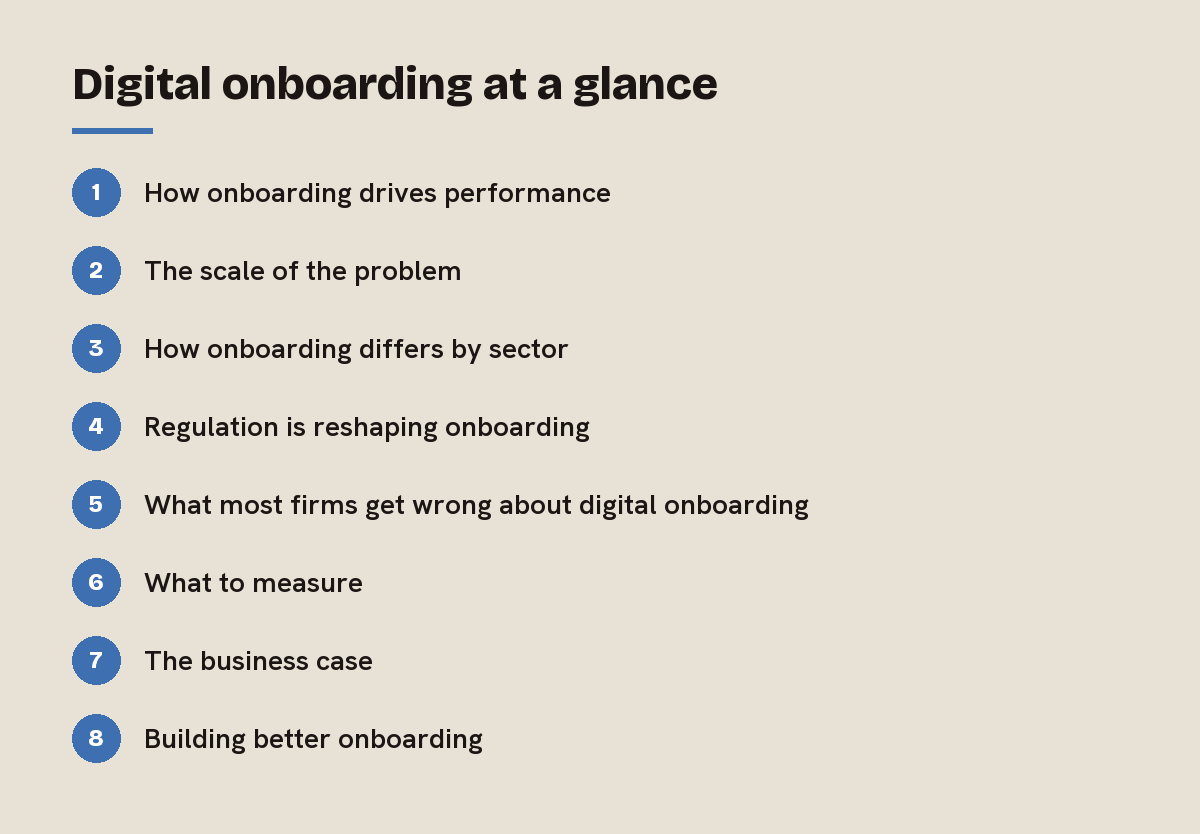
1. How onboarding drives performance
| Performance driver | How digital onboarding affects it |
|---|---|
| Customer acquisition cost | Higher completion means more customers per unit of marketing spend |
| Funnel conversion | Every unnecessary step or unclear instruction loses applicants |
| Fraud losses | Strong, automated identity checks stop synthetic and stolen identities |
| Time to revenue | Faster approval means earlier deposits, premiums or assets |
| Cost to serve | Fewer manual reviews and exceptions reduce operating cost |
2. The scale of the problem
Abandonment remains high across Europe. Signicat’s survey of 7,600 consumers found that 68 per cent had abandoned a financial services application in the previous year, up from 63 per cent in 2020. For institutions spending heavily on acquisition, that is a direct and measurable loss.
3. How onboarding differs by sector
- Insurance integrates underwriting: applicants answer risk questions, sometimes medical ones, and complex cases are referred to underwriters.
- Banking integrates KYC and AML: identity, address, source of funds and sanctions checks must be completed and evidenced.
- Wealth integrates suitability and custody: risk profiling, investment objectives and custody account opening must all be completed before investing.
- Fintech optimises speed and automation: simple products and automated checks allow onboarding in minutes.
| Sector | Main onboarding complexity | Typical failure point |
|---|---|---|
| Banking | KYC, AML, credit checks | Document upload, manual review queues |
| Insurance | Underwriting questions and referrals | Medical disclosures, referral delays |
| Wealth | Suitability, multiple accounts and wrappers | Long fact-finds, paperwork for transfers |
| Fintech | Fraud prevention at speed | Identity verification failures |
4. Regulation is reshaping onboarding
Two EU regulations will change how digital onboarding works. The European Digital Identity Regulation requires private services, explicitly including banking and financial services, that must use strong user authentication to accept the European Digital Identity Wallet, which promises faster, reusable identity verification. At the same time, the EU’s Anti-Money Laundering Regulation, which applies from 10 July 2027, creates a single rulebook for customer due diligence across Member States. Institutions that design flexible onboarding now will adapt more easily.
5. What most firms get wrong about digital onboarding
- Digitising paper forms: putting the same questions on a screen keeps all the friction of the paper process.
- Asking for everything upfront: collecting data before it is needed increases abandonment.
- Treating fraud and experience as opposites: modern verification can be both stronger and faster.
- Ignoring exceptions: applicants who do not fit the standard path often drop out entirely.
- Measuring only completion: early activation and fraud rates matter as much as sign-ups.
Example: a wealth manager’s digital onboarding took clients through a single long questionnaire. Analysis showed most drop-offs occurred at questions about existing investments. The firm moved those questions after account opening, pre-filled data from transfer requests and added a short adviser call option. Completion improved and advisers received better-quality information.
6. What to measure
- Funnel conversion at each step, not only overall.
- Abandonment rate and where it happens.
- Verification success at first attempt.
- Time to use: from application to first transaction, premium or investment.
- Acquisition cost payback: how quickly a new customer covers the cost of acquiring them.
- Early fraud rate among new customers.
7. The business case
The economics are usually compelling. Suppose an institution spends heavily on marketing to bring applicants to its website and loses a large share of them during onboarding. Raising completion by even a few percentage points lowers the effective acquisition cost of every customer, without spending more on marketing. Fewer manual reviews cut operating cost, faster approval brings revenue forward, and better verification reduces fraud write-offs. Because each of these effects can be measured, onboarding programmes are among the easiest transformation investments to evidence to a board.
8. Building better onboarding
- Map the full journey, including manual steps and exceptions.
- Use data and digital identity to reduce what customers must type or upload.
- Ask only what is needed, when it is needed.
- Keep exceptions inside the digital case, with specialist review.
- Design controls with compliance, so speed and assurance improve together.
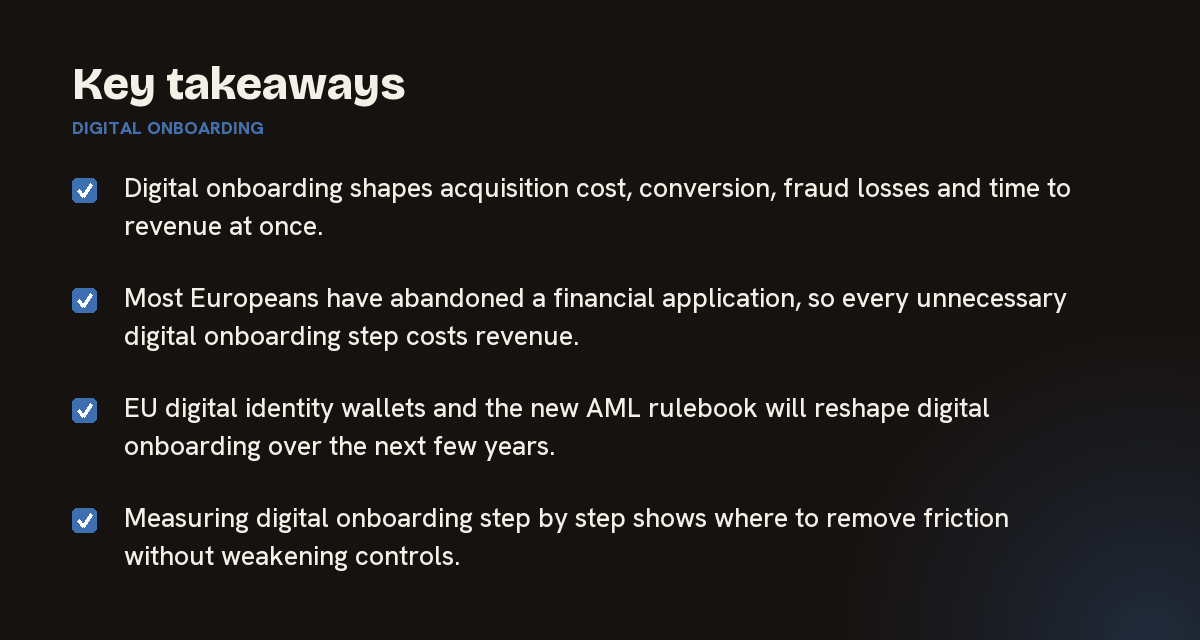
Key takeaways on digital onboarding
- Digital onboarding shapes acquisition cost, conversion, fraud losses and time to revenue at once.
- Most Europeans have abandoned a financial application, so every unnecessary digital onboarding step costs revenue.
- EU digital identity wallets and the new AML rulebook will reshape digital onboarding over the next few years.
- Measuring digital onboarding step by step shows where to remove friction without weakening controls.
For leadership teams, digital onboarding deserves board-level attention. It is measurable, it affects revenue, cost and risk at the same time, and improvements typically show results within months.
Optimizium helps banks, insurers and wealth managers redesign digital onboarding end to end. We respect the know-your-customer and underwriting expertise institutions have built, because it protects customers and the business. And we bring financial crime, risk and compliance teams into the design as co-authors, so onboarding becomes faster and safer together.
Explore how we approach this across Banking, Insurance, Wealth Management and Beyond Banking, browse the FAQ Hub, or read the related question: How does wealth management differ from retail banking in digital strategy?
On this page
Partner with the experts.
Let's discuss how Optimizium can accelerate your roadmap and navigate complex digital transformation.
Schedule a consultation →