Home › FAQ Hub › Why is distribution more complex in financial services than in other industries?
Leadership, Change & Operating ModelsWhy is distribution more complex in financial services than in other industries?
Financial distribution is more complex than distribution in most industries because the products are heavily regulated, transfer risk between customer and provider, and deliver their value over long periods rather than at the moment of purchase. Many require multi-step transactions, formal approvals and detailed disclosures, and some depend on assessing the customer's circumstances before a sale can happen.
Selling a pair of trainers online is simple: show the product, take payment, ship it. Selling a mortgage, a pension or a life policy involves checks, advice, disclosures and commitments that last for years. That difference shapes every decision in financial distribution.
Financial distribution is more complex than distribution in most industries because the products are heavily regulated, transfer risk between customer and provider, and deliver their value over long periods rather than at the moment of purchase. Many require multi-step transactions, formal approvals and detailed disclosures, and some depend on assessing the customer’s circumstances before a sale can happen.
Channels add to the complexity: direct digital, branches, advisers, brokers, partners and embedded platforms each bring different operational and compliance demands. Human intermediaries remain critical where advice, suitability or underwriting judgement is needed. That is why financial distribution is harder than consumer retail, and why copying retail playbooks rarely works.
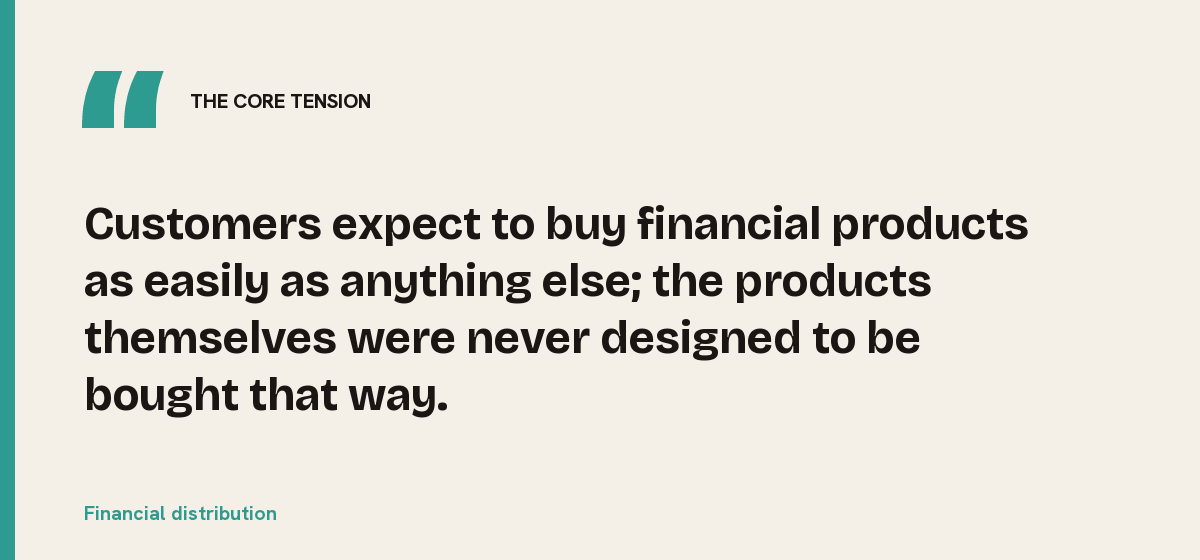
The core tension, in one line:
Customers expect to buy financial products as easily as anything else; the products themselves were never designed to be bought that way.
an online retailer wants to offer its own branded savings account. It discovers it needs a licensed bank partner, identity and anti-money-laundering checks, deposit protection information and complaint handling. A two-week product launch in retail becomes a six-month partnership project in finance.
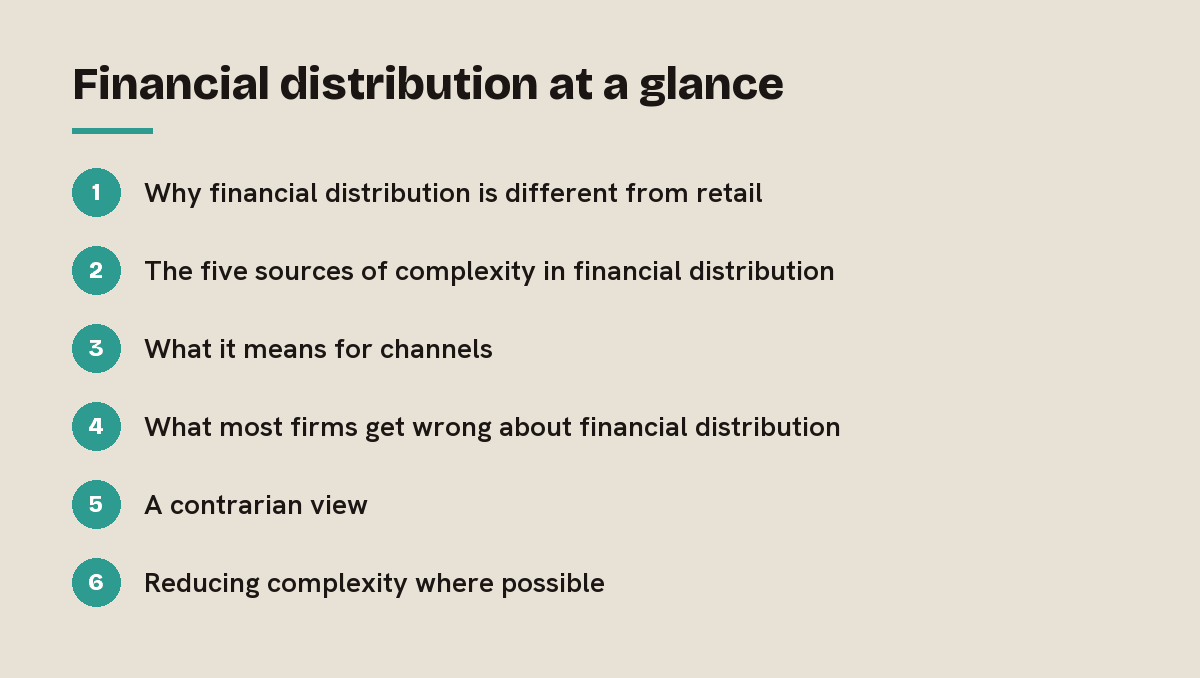
1. Why financial distribution is different from retail
| Feature | Consumer goods | Financial services |
|---|---|---|
| Regulation | Light, product safety | Heavy: licensing, conduct, disclosure |
| Value delivery | At purchase | Over years or decades |
| Risk | Limited | Credit, insurance or investment risk transferred |
| Customer checks | Rarely needed | Identity, affordability, suitability |
| Channels | Mostly direct or retail | Direct, branch, adviser, broker, partner, embedded |
2. The five sources of complexity in financial distribution
- Regulation: each product and channel carries specific obligations, from demands and needs in insurance to suitability in investments.
- Deferred value: customers judge products when they claim, retire or repay, not when they buy.
- Risk transfer: providers must assess the customer before accepting risk.
- Multi-step transactions: applications, approvals, documents and signatures.
- Multiple channels: each with its own economics and controls.
The rules are specific. The Insurance Distribution Directive requires distributors to specify customers’ demands and needs; ESMA’s MiFID II suitability guidelines set out what must be assessed before investment advice; and the revised Consumer Credit Directive requires creditworthiness assessments in the consumer’s interest, applying from 20 November 2026.
3. What it means for channels
| Channel | Main complexity |
|---|---|
| Direct digital | Building checks and disclosures into self-service |
| Branch | Cost and consistency of advice |
| Adviser and broker | Oversight of intermediaries, suitability records |
| Partner and embedded | Shared responsibility across firms |
4. What most firms get wrong about financial distribution
- Copying retail playbooks: speed and simplicity matter, but not at the expense of suitability and disclosure.
- Ignoring the after-sale: claims, servicing and complaints are part of financial distribution.
- Underestimating partners’ obligations: embedded distribution still needs regulated processes behind it.
- Treating complexity as fixed: simpler products and better design can remove much of it.
Example: an insurer simplified its home insurance into three clear tiers and built the demands-and-needs questions into a short digital journey. Distribution through partners and its own app grew quickly, because the product could finally be explained and bought in a few screens.
5. A contrarian view
Complexity is often accepted as unavoidable. Much of it is self-inflicted: too many product variants, documents written for lawyers and processes designed around old systems. The regulated core of financial distribution is real, but institutions that simplify everything around it find it far less complex than they expected.
6. Reducing complexity where possible
- Simplify products for digital and partner channels.
- Build regulatory steps into journeys, not around them.
- Give each channel a clear role.
- Design the after-sale experience as part of distribution.
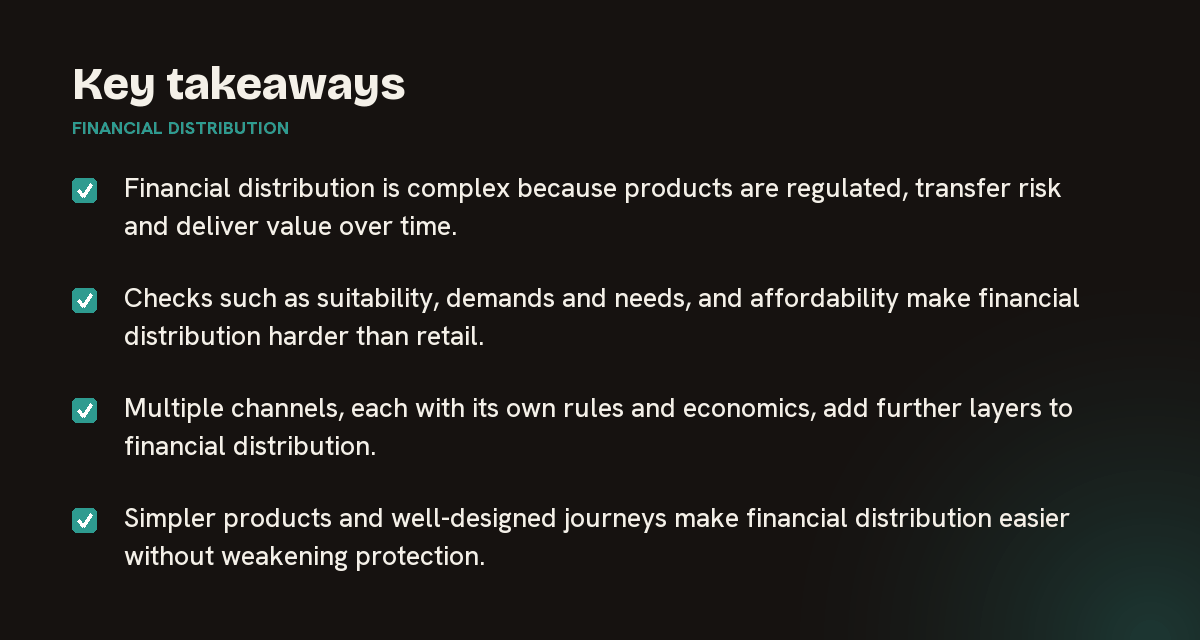
Key takeaways on financial distribution
- Financial distribution is complex because products are regulated, transfer risk and deliver value over time.
- Checks such as suitability, demands and needs, and affordability make financial distribution harder than retail.
- Multiple channels, each with its own rules and economics, add further layers to financial distribution.
- Simpler products and well-designed journeys make financial distribution easier without weakening protection.
For leadership teams, recognising why financial distribution is complex is the starting point for designing it well. The aim is not to copy other industries, but to remove unnecessary complexity while respecting the obligations that protect customers.
Optimizium helps banks, insurers and wealth managers simplify products and financial distribution without compromising control. We respect the regulatory and product expertise institutions hold, because it explains why complexity exists. And we bring compliance, risk and distribution into the design as co-authors, so simpler distribution remains sound.
Explore how we approach this across Banking, Insurance, Wealth Management and Beyond Banking, browse the FAQ Hub, or read the related question: What differentiates SME and corporate distribution from consumer channels?
On this page
Partner with the experts.
Let's discuss how Optimizium can accelerate your roadmap and navigate complex digital transformation.
Schedule a consultation →