Home › FAQ Hub › Why is funnel optimization more prevalent in fintech than in incumbents?
Tech & Core ModernisationWhy is funnel optimization more prevalent in fintech than in incumbents?
Funnel optimization is the continuous measurement and improvement of each step in the customer journey, from first visit to application, approval and active use, and it is more prevalent in fintech because fintechs run high-intensity digital funnels with measurable customer acquisition costs, constant growth experiments and rapid cohort analysis.
A fintech growth team can tell you, to the decimal point, how many people who started an application yesterday finished it, where the rest dropped off, and what a test running this week has changed. Many incumbents would need weeks to assemble the same picture, and it would cover only part of the journey.
Funnel optimization is the continuous measurement and improvement of each step in the customer journey, from first visit to application, approval and active use, and it is more prevalent in fintech because fintechs run high-intensity digital funnels with measurable customer acquisition costs, constant growth experiments and rapid cohort analysis. Incumbents distribute through branches, advisers and brokers, where much of the journey happens offline, data arrives slowly and no single team owns the end-to-end result. Effective funnel optimization needs product, growth, analytics and technology to work as one unit with shared goals, which is how fintechs are organised from the start and how most incumbents are not.
The core tension, in one line:
Incumbents have more customers and more data, but less ability to learn from either quickly.
a fintech notices that applicants on older phones drop off at the document photo step. Within a week it tests an alternative upload option, measures the result by cohort and rolls it out. An incumbent bank with the same issue learns about it from complaints a quarter later.
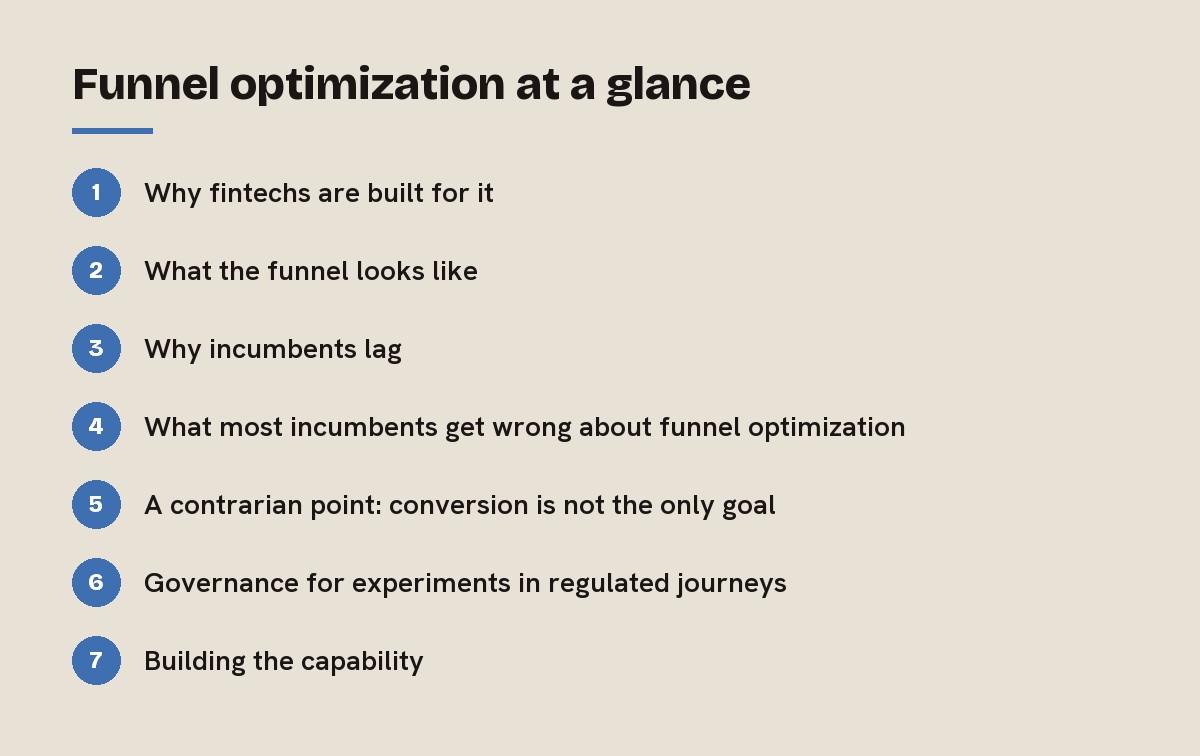
1. Why fintechs are built for it
| Factor | Fintech | Incumbent |
|---|---|---|
| Channel mix | Almost entirely digital | Branch, adviser, broker and digital |
| Data feedback | Real-time, event-level | Delayed, aggregated, sometimes manual |
| Acquisition cost | Measured per channel and cohort | Often spread across budgets and channels |
| Team structure | Product, growth, analytics and engineering in one squad | Separate marketing, IT, operations and channel teams |
| Release cadence | Daily or weekly | Monthly or quarterly |
| Experiment culture | Tests are routine | Tests need approval and budget |
2. What the funnel looks like
A typical financial funnel has more steps than a retail checkout, and more of them carry regulatory weight.
- Awareness and visit: marketing channels bring prospects to the product.
- Start: the customer begins an application or quote.
- Identity and checks: KYC, fraud and eligibility checks run.
- Decision: credit, underwriting or suitability outcome.
- Completion: contract signed, account opened, policy bound.
- Activation: first use, first deposit, first claim handled well.
Each step loses customers. Signicat’s survey of 7,600 European consumers found that 68 per cent had abandoned a financial services application, up from 63 per cent two years earlier. In a market with acquisition costs that high, funnel optimization is one of the cheapest growth levers available.
3. Why incumbents lag
- Offline friction: steps that happen in branches or with brokers are rarely tracked at the same level of detail.
- Fragmented ownership: marketing owns traffic, IT owns the site, operations owns checks, and nobody owns completion.
- Slow data: events are stored in different systems and joined weeks later.
- Risk aversion around experiments: testing variations of regulated journeys can seem risky without a clear governance model.
The competitive gap is narrower than it seems in market share terms. The ECB notes that purely digital banks held a market share below 4 per cent in the euro area in 2024. Incumbents still hold most customers; what they lack is the learning speed that funnel optimization creates.
4. What most incumbents get wrong about funnel optimization
- Buying analytics tools without changing teams: dashboards do not improve funnels; empowered teams do.
- Optimising one step in isolation: improving starts while ignoring decision and activation simply moves the drop-off.
- Testing without guardrails: experiments on regulated journeys need pre-agreed limits on wording, pricing and disclosure, set with compliance.
- Ignoring assisted channels: branch, adviser and broker steps belong in the same funnel view.
Example: a bank formed a single team responsible for current account opening, with product, design, analytics, engineering and a compliance partner. In the first six months it ran a series of small tests, simplifying identity steps, clarifying error messages and adding a save-and-return option. Completion rose substantially, and the bank used the same model for its savings and loan journeys.
5. A contrarian point: conversion is not the only goal
Fintechs sometimes optimise funnels for sign-ups that never become active or profitable customers. Incumbents can learn the discipline without copying that mistake. The best funnel optimization measures the whole path to an active, well-served customer, including affordability and suitability, and rewards teams for value and outcomes rather than raw volume.
6. Governance for experiments in regulated journeys
Incumbents often hesitate to test because they fear regulatory consequences. A short experimentation policy removes most of that fear. It defines which elements can be tested freely, such as layout, order of steps and help text; which need light review, such as wording near disclosures; and which are excluded, such as pricing and eligibility rules unless formally approved. With that in place, teams can move quickly inside agreed limits.
7. Building the capability
- Instrument the full journey, including assisted steps.
- Form a cross-functional team that owns completion end to end.
- Agree an experimentation policy with risk and compliance.
- Measure by cohort, through to activation and early value.
- Share results widely, so learning spreads across products.
Key takeaways on funnel optimization
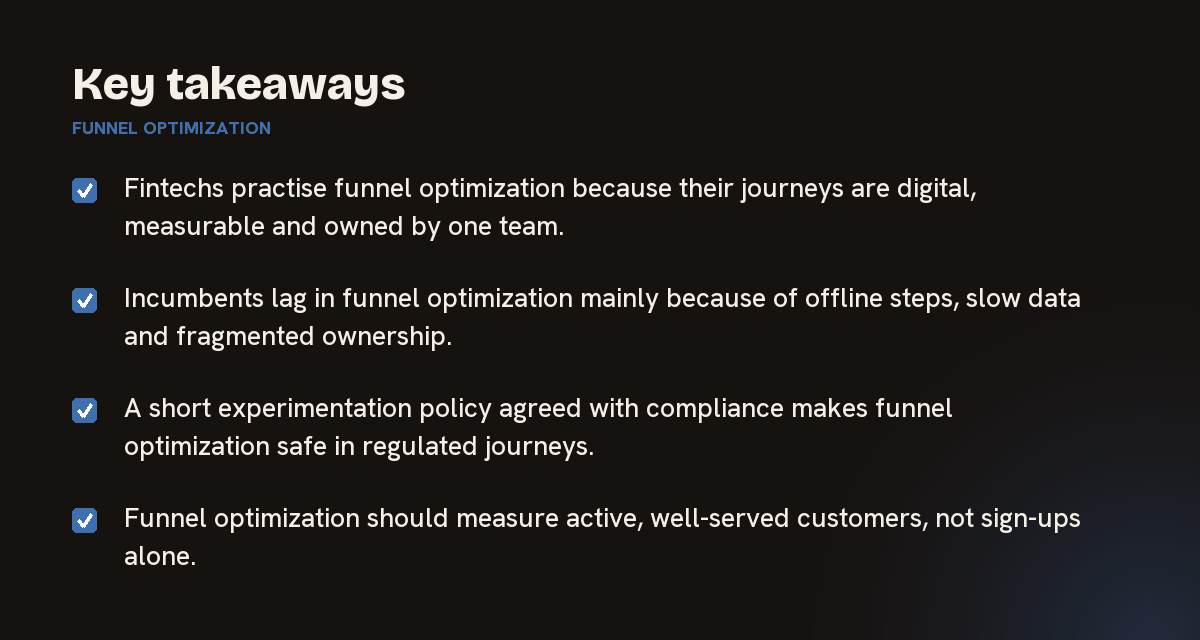
- Fintechs practise funnel optimization because their journeys are digital, measurable and owned by one team.
- Incumbents lag in funnel optimization mainly because of offline steps, slow data and fragmented ownership.
- A short experimentation policy agreed with compliance makes funnel optimization safe in regulated journeys.
- Funnel optimization should measure active, well-served customers, not sign-ups alone.
For incumbents, the opportunity is significant. They already have the brand, the customer base and the data; adopting the discipline of funnel optimization lets them turn those advantages into faster learning and lower acquisition costs, while keeping the controls that customers and regulators expect.
Optimizium helps banks, insurers and wealth managers build the teams, data and governance that make funnel optimization work. We respect the risk and conduct standards that incumbents have built, because they are a strength in a market where trust matters. And we bring compliance colleagues into experimentation as co-authors, so tests are fast, safe and well evidenced.
Explore how we approach this across Banking, Insurance, Wealth Management and Beyond Banking, browse the FAQ Hub, or read the related question: How do fintechs measure digital performance differently?
Related questions
On this page
Partner with the experts.
Let's discuss how Optimizium can accelerate your roadmap and navigate complex digital transformation.
Schedule a consultation →