Home › FAQ Hub › Why is omnichannel harder in insurance and wealth?
Strategy & PositioningWhy is omnichannel harder in insurance and wealth?
Omnichannel is harder in insurance and wealth because the customer relationship is shared with intermediaries and shaped by processes that banking rarely faces at the same intensity.
In retail banking, a customer can start a payment on the phone, check it on the web and ask about it in a branch, and the bank sees one customer throughout. Insurers and wealth managers want the same seamless picture, but the path between them and their customers runs through more hands.
Omnichannel is harder in insurance and wealth because the customer relationship is shared with intermediaries and shaped by processes that banking rarely faces at the same intensity. Insurance involves underwriting, broker and agent distribution, claims handling and regulatory disclosure; wealth combines advice, suitability assessments, execution and reporting. Each step often lives in a different system, sometimes owned by a different firm.
Aligning broker and adviser systems with the insurer’s or wealth manager’s own channels creates complexity that a direct bank does not have. The result is that customer data, case status and context rarely follow the customer from one channel to the next, which is the heart of what omnichannel is meant to deliver.
The core tension, in one line:
Customers expect one relationship; in insurance and wealth, that relationship is legally and commercially shared between several parties.
a customer gets a home insurance quote online, then calls a broker to ask about cover for a home office. The broker cannot see the online quote and starts again. After the insurer gives brokers access to the same case through a portal, the broker continues where the customer left off and converts the quote in one call.
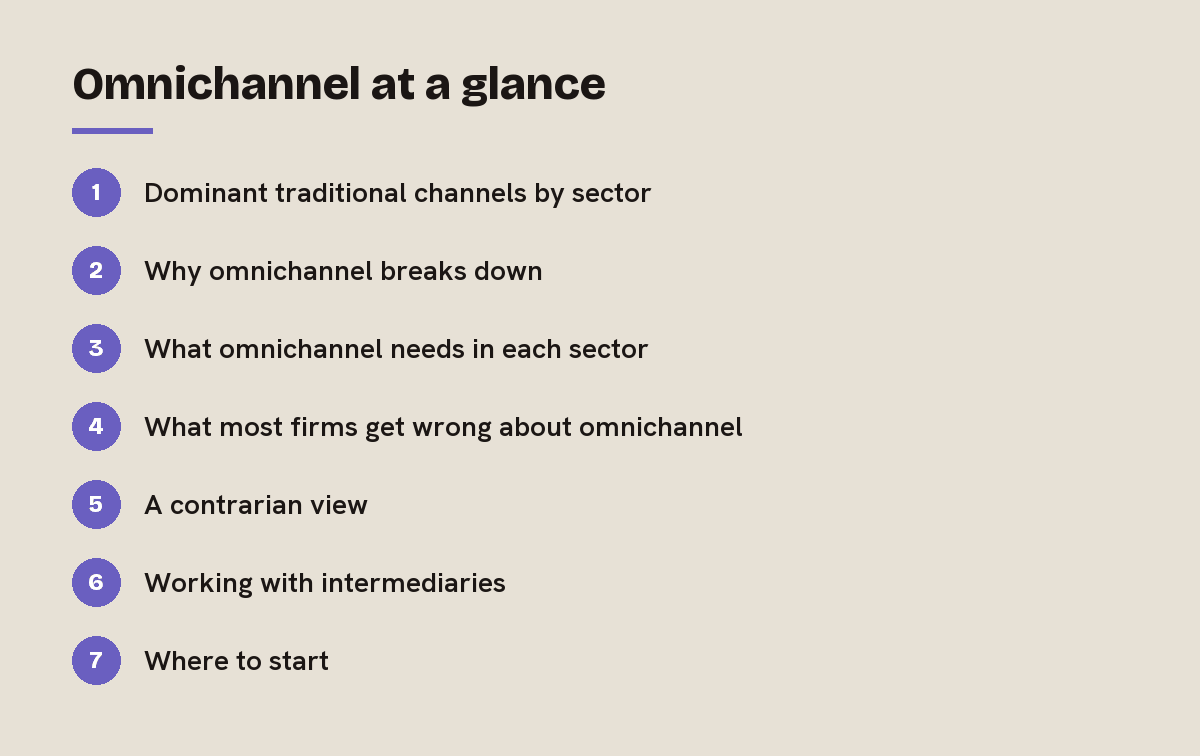
1. Dominant traditional channels by sector
| Sector | Dominant traditional channel | What sits between firm and customer |
|---|---|---|
| Insurance | Broker or agent | Intermediary systems, underwriting referrals, claims partners |
| Wealth | Adviser | Advice processes, suitability records, platforms and custodians |
| Banking | Branch and contact centre | Mostly the bank’s own systems |
| Fintech | Direct digital | Partners, where products are embedded |
2. Why omnichannel breaks down
- Shared ownership of the customer: brokers and independent advisers often hold the relationship and the data.
- Regulated steps: demands-and-needs assessments in insurance and suitability in wealth must be completed and recorded, whatever the channel.
- Long product lives: policies and portfolios last years or decades, across several generations of systems.
- Low interaction frequency: customers contact insurers and wealth managers rarely, so each contact must work first time.
The data on channels confirms the gap. EIOPA found that digital-only distribution channels still lag well behind physical or hybrid ones, especially for life insurance, where consumers prefer in-person meetings. In banking, by contrast, Eurostat reports that 67 per cent of people aged 16 to 74 in the EU used internet banking in 2024.
3. What omnichannel needs in each sector
| Need | Insurance | Wealth |
|---|---|---|
| Shared case | Quote, policy and claim visible to customer, broker and insurer | Client file visible to client and adviser |
| Regulatory record | Demands and needs captured once, reused | Suitability captured once, reused |
| Hand-over | Online to broker and back without restarting | App to adviser and back without restarting |
| Partner integration | Broker portals and APIs | Platforms, custodians and planning tools |
The rules travel with the customer across channels. In insurance, the Insurance Distribution Directive requires distributors to specify the customer’s demands and needs. In wealth, ESMA’s guidelines on the MiFID II suitability requirements set out what must be gathered and recorded. An omnichannel design that captures this information once and reuses it removes much of the friction.
4. What most firms get wrong about omnichannel
- Copying banking playbooks: an app-first strategy ignores the intermediaries who write much of the business.
- Building channels instead of cases: a new portal or app without a shared case simply adds another silo.
- Treating intermediaries as competitors: brokers and advisers are part of the customer journey and need the same tools.
- Ignoring the regulatory record: if each channel collects suitability or demands and needs separately, customers repeat themselves and evidence fragments.
Example: a wealth manager let clients top up investments in its app, but advisers could not see app activity and kept calling clients about transactions they had already made. Connecting the app and the adviser workstation to the same client record, with suitability captured once, turned the app into a support for advice rather than a parallel channel.
5. A contrarian view
Omnichannel is often framed as “be available everywhere”. In insurance and wealth, the better goal is continuity: whichever channel a customer uses, the next person or screen knows what happened before. A firm with three well-connected channels delivers more than one with six disconnected ones.
6. Working with intermediaries
Brokers and independent advisers will not adopt a portal that only serves the insurer or wealth manager. The tools that succeed save them time: pre-filled forms, instant quotes, live case status and fewer calls from clients asking for updates. Involving a small group of intermediaries in the design, and measuring their usage and satisfaction, turns them into advocates rather than reluctant users.
7. Where to start
- Pick the journey with the most hand-overs, often quotes or claims in insurance and onboarding in wealth.
- Create one shared case visible across channels and intermediaries.
- Capture regulatory information once and reuse it everywhere.
- Give brokers and advisers the same digital tools as direct customers.
- Measure continuity: how often customers have to repeat information.
Key takeaways on omnichannel
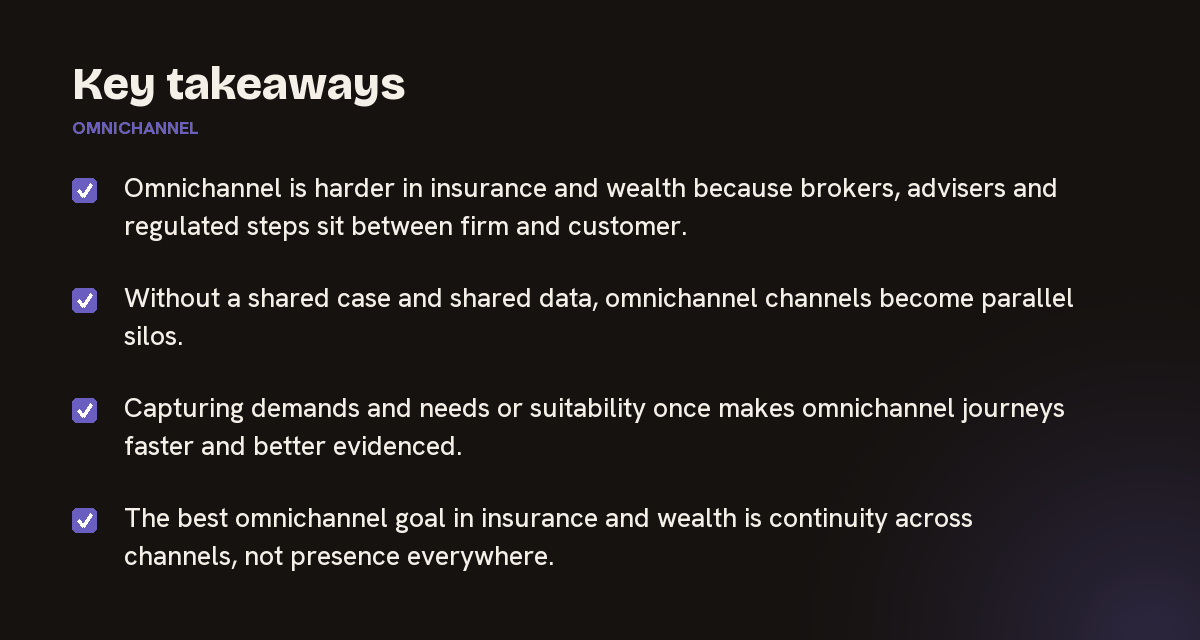
- Omnichannel is harder in insurance and wealth because brokers, advisers and regulated steps sit between firm and customer.
- Without a shared case and shared data, omnichannel channels become parallel silos.
- Capturing demands and needs or suitability once makes omnichannel journeys faster and better evidenced.
- The best omnichannel goal in insurance and wealth is continuity across channels, not presence everywhere.
For leadership teams in insurance and wealth, omnichannel is less a channel question than a data and partnership question. The firms that progress are those that share cases and records with intermediaries and design every hand-over deliberately.
Optimizium helps insurers and wealth managers design connected journeys across direct, broker and adviser channels. We respect the relationships intermediaries hold, because they remain central to how customers buy and stay. And we bring distribution, risk and compliance teams into the design as co-authors, so continuity improves without weakening the regulatory record.
Explore how we approach this across Insurance, Wealth Management and Banking, browse the FAQ Hub, or read the related question: Why is omnichannel distribution critical for modern insurance providers?
Partner with the experts.
Let's discuss how Optimizium can accelerate your roadmap and navigate complex digital transformation.
Schedule a consultation →