Home › FAQ Hub › How are payments transforming through digital channels?
Tech & Core ModernisationHow are payments transforming through digital channels?
Digital payments are changing how money moves in four main ways: real-time rails that settle transfers in seconds, digital wallets and peer-to-peer services that change how customers pay, open banking that lets third parties initiate payments directly from accounts, and tokenisation that may change how money and assets move.
Payments used to be the quiet plumbing of banking: reliable, profitable and largely invisible to customers. The rise of digital payments has turned them into one of the most competitive and fastest-changing parts of financial services.
Digital payments are changing how money moves in four main ways: real-time rails that settle transfers in seconds, digital wallets and peer-to-peer services that change how customers pay, open banking that lets third parties initiate payments directly from accounts, and tokenisation that may change how money and assets move. Together, these forces accelerate settlement, widen cross-border options and enable new uses. For incumbent banks, the shift brings margin pressure and a need to modernise infrastructure; fintech wallets drive much of the innovation in user experience; wealth managers use payments mainly for funding, withdrawals and securities settlement, where speed and reliability still matter greatly.
The core tension, in one line:
Payments are becoming faster and cheaper for customers, which makes them harder to profit from for providers.
a customer pays a tradesperson by instant transfer from a banking app on a Sunday evening. The money arrives in seconds, the app confirms the payee’s name before sending, and the tradesperson’s accounting software reconciles the payment automatically. Five years ago, the same payment would have waited until Monday.
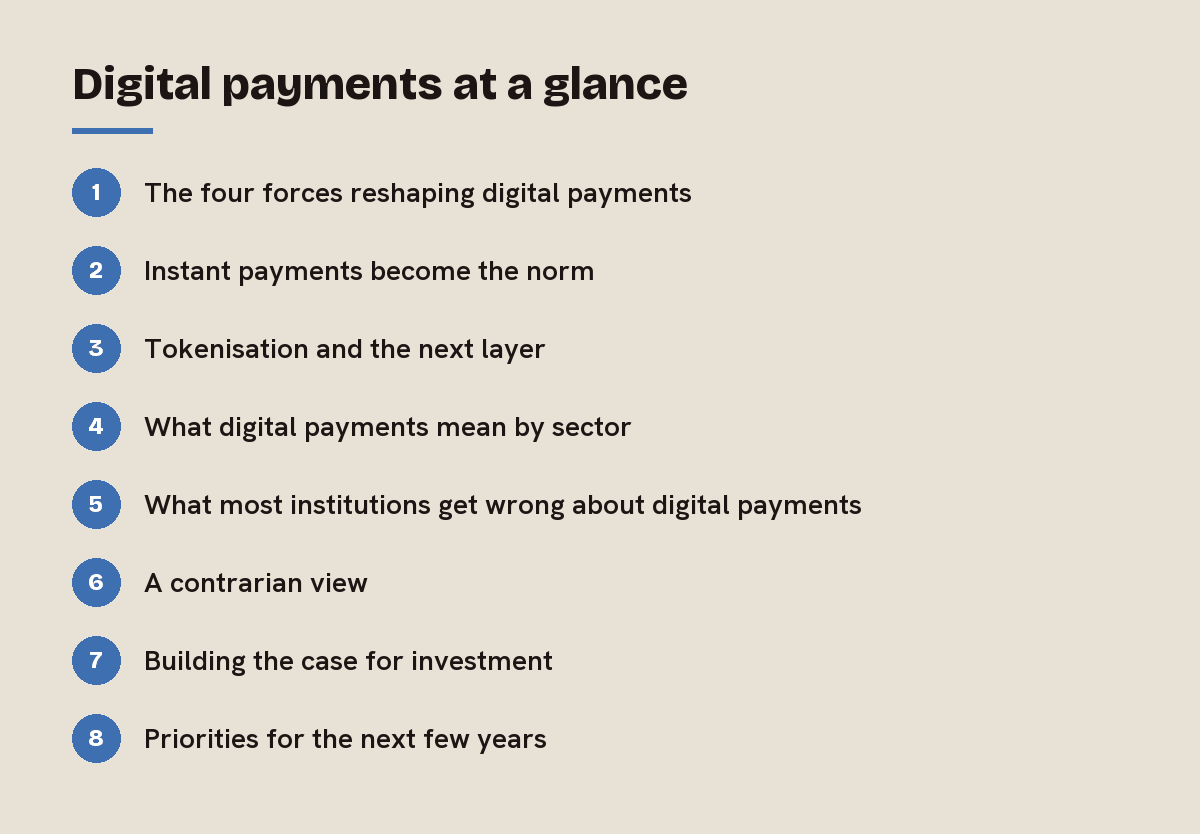
1. The four forces reshaping digital payments
| Impact | What it looks like on the ground | Who benefits most |
|---|---|---|
| Real-time rails | Transfers settle in seconds, around the clock | Consumers, small businesses, platforms |
| Tokenisation | Card details replaced by tokens; experiments with tokenised deposits and assets | Wallet providers, banks, market infrastructure |
| Open banking payments | Third parties initiate payments directly from accounts | Merchants seeking alternatives to cards |
| Wallet ecosystems | Phone and platform wallets as the main payment interface | Large technology platforms and fintechs |
2. Instant payments become the norm
The EU’s Instant Payments Regulation requires payment providers that offer euro credit transfers to offer instant transfers as well, available at any time of day, at charges no higher than standard transfers, and to provide a service that checks the payee’s name against the account before a payment is authorised. Instant transfers are moving from a premium feature to a baseline expectation for digital payments.
Customer behaviour already supports this. Eurostat reports that 67 per cent of people aged 16 to 74 in the EU used internet banking in 2024, and digital payments are now where most customers start.
3. Tokenisation and the next layer
Tokenisation is moving beyond card security. The ECB notes that around 30 per cent of banks it supervises plan to tokenise deposits. If that materialises at scale, programmable money and faster settlement of securities and other assets could reshape parts of payments and capital markets infrastructure.
4. What digital payments mean by sector
- Banking: incumbents face margin compression on traditional payment fees and must modernise infrastructure for 24/7 instant processing and fraud controls.
- Fintech: wallets and payment apps lead on experience, often building on banks’ rails and licences.
- Wealth: payments mainly serve funding, withdrawals and securities settlement. Faster, more reliable money movement improves client experience at key moments, such as funding a new portfolio.
- Insurance: faster claims payouts and easier premium collection, including through instant payments, improve customer experience.
| Sector | Main payments priority |
|---|---|
| Banking | Instant infrastructure, fraud prevention, new revenue models |
| Fintech | Experience, wallet integration, partner rails |
| Wealth | Reliable funding and withdrawals, settlement efficiency |
| Insurance | Fast payouts, easy premium collection |
5. What most institutions get wrong about digital payments
- Treating digital payments as a utility only: their data and the moment of payment are valuable opportunities for engagement and new services.
- Underestimating fraud: instant, irrevocable payments demand real-time fraud detection and clear payee confirmation.
- Modernising in silos: separate projects for instant payments, open banking and wallets duplicate effort.
- Ignoring business customers: small businesses benefit hugely from instant settlement and automated reconciliation.
Example: a regional bank used its move to instant payments as a chance to rebuild its payments hub. Rather than adding instant capability to its legacy system, it introduced a modern platform that handled instant, standard and open banking payments with one fraud engine. Payments-related complaints fell, and the bank launched a request-to-pay service for small business customers within the year.
6. A contrarian view
Many see digital payments as a race to zero margin. That is true for basic transfers. But payments also create rich data, frequent customer contact and natural moments for services such as instant credit, invoicing and cash management. Institutions that treat payments as a platform for these services, rather than a cost centre, can still build attractive economics.
7. Building the case for investment
Payments modernisation is expensive, and the direct revenue it produces is often modest. The business case therefore rests on several sources of value at once: lower processing and exception costs, reduced fraud losses, retention of primary banking relationships, new fee-based services for business customers, and readiness for regulatory change. Presenting these together, with clear measures for each, helps boards see digital payments as strategic infrastructure rather than a compliance project.
8. Priorities for the next few years
- Modernise infrastructure for 24/7 instant processing.
- Invest in real-time fraud prevention and payee verification.
- Use open banking to offer account-to-account payments where they suit merchants.
- Watch tokenisation pilots and prepare data and settlement capabilities.
- Build services around payments, especially for small businesses.
Key takeaways on digital payments
- Digital payments now settle in seconds, so instant processing is a baseline expectation rather than a premium feature.
- Fraud controls and payee checks must run in real time, because digital payments are fast and hard to reverse.
- Margins on simple transfers keep falling, but digital payments create data and moments for valuable new services.
- Institutions that modernise one platform for instant, open banking and card flows get more from digital payments than those running separate projects.
For leadership teams, the rise of digital payments is both a threat and an opportunity. Margins on simple transfers will keep falling, but institutions that build modern, secure platforms and services around payments can strengthen their customer relationships.
Optimizium helps banks, insurers and wealth managers plan and deliver payments modernisation. We respect the reliability and control disciplines that payments operations have built, because customers depend on them every day. And we bring fraud, risk and compliance colleagues into the design as co-authors, so faster payments are also safer payments.
Explore how we approach this across Banking, Wealth Management, Insurance and Beyond Banking, browse the FAQ Hub, or read the related question: How does wealth management differ from retail banking in digital strategy?
On this page
Partner with the experts.
Let's discuss how Optimizium can accelerate your roadmap and navigate complex digital transformation.
Schedule a consultation →