Home › FAQ Hub › How does explainability differ across financial sectors?
AI, Data & AnalyticsHow does explainability differ across financial sectors?
Explainability, the ability to describe in understandable terms why a model or automated system reached a particular outcome, is expected to different degrees across financial sectors because regulatory intensity and consumer protection exposure differ.
As financial institutions use more models and AI to make decisions, a simple question becomes harder to answer: why did the system decide that? How much that question matters, and how precise the answer must be, depends heavily on the sector and the decision.
Explainability, the ability to describe in understandable terms why a model or automated system reached a particular outcome, is expected to different degrees across financial sectors because regulatory intensity and consumer protection exposure differ. Sectors with fiduciary or suitability obligations, such as wealth management, require the strongest transparency, because recommendations must be justified to each client. Insurance faces high expectations, especially in pricing and claims decisions. Banking faces moderate to high expectations, highest in credit decisions. Fintechs vary, depending on their products and licences. The general rule is simple: the higher the consumer risk of a decision, the stronger the justification required, and the more carefully models must be chosen and documented.
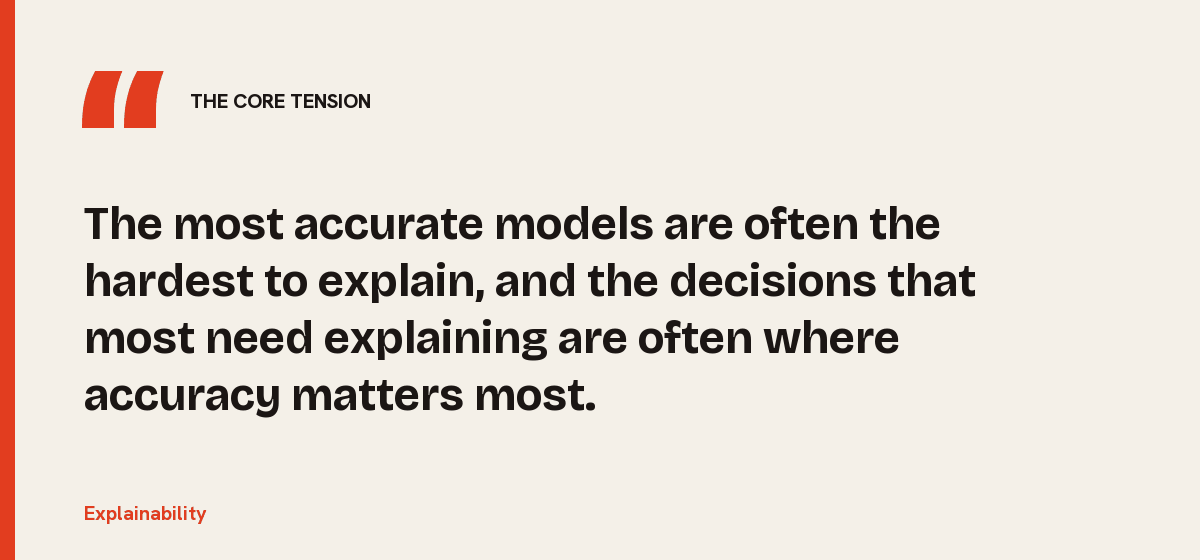
The core tension, in one line:
The most accurate models are often the hardest to explain, and the decisions that most need explaining are often where accuracy matters most.
a bank’s new credit model approves more applicants with the same loss rate. Before deployment, the risk team checks that each decision can be explained in terms customers understand, such as income stability and existing commitments, and that no protected characteristics drive outcomes. Only then is the model approved.
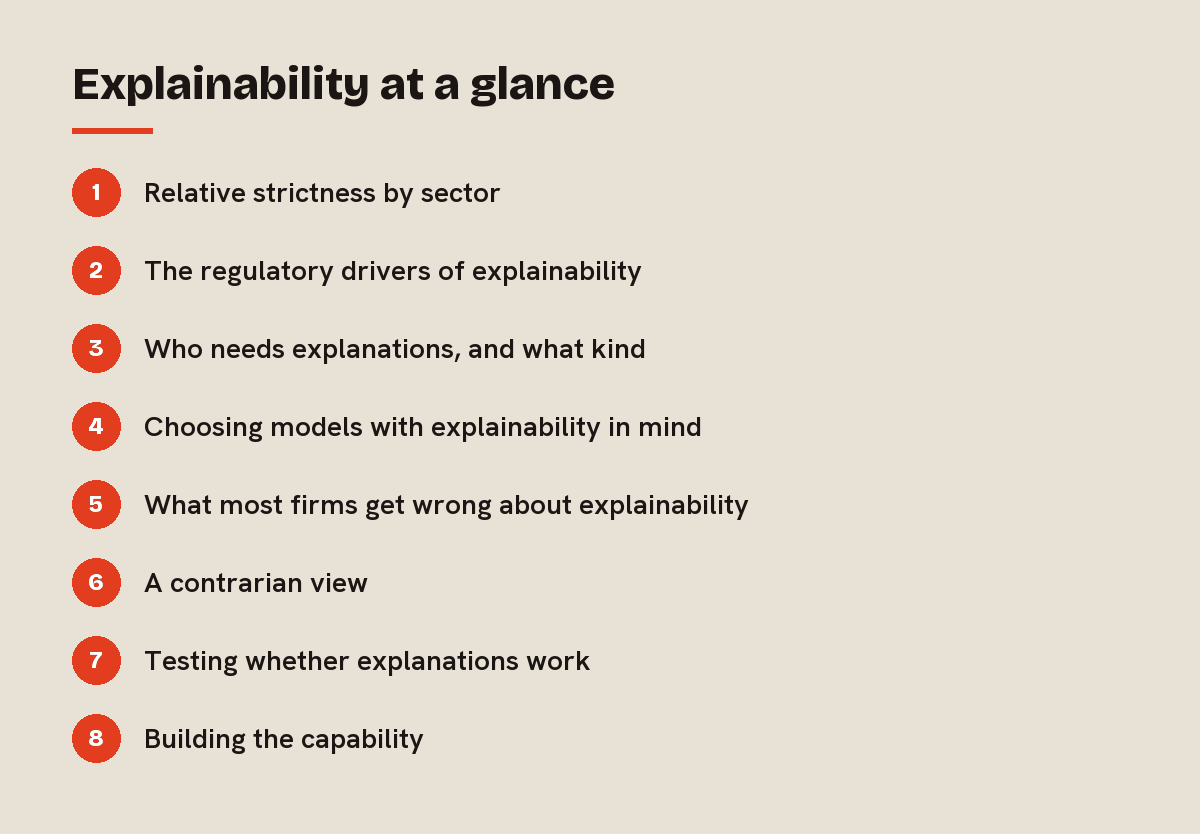
1. Relative strictness by sector
| Sector | Explainability expectation | Why |
|---|---|---|
| Wealth | Very high | Suitability and fiduciary duties require justified recommendations |
| Insurance | High | Pricing fairness, claims decisions, life and health risk assessment |
| Banking | Moderate to high | Highest for credit decisions; lower for internal analytics |
| Fintech | Variable | Depends on products, licences and partners |
2. The regulatory drivers of explainability
- EU Artificial Intelligence Act: the AI Act classifies AI systems used to assess creditworthiness, and for risk assessment and pricing in life and health insurance, as high-risk, with requirements for documentation, transparency and human oversight.
- Automated decisions under the GDPR: in its SCHUFA judgment of December 2023, the Court of Justice found that a credit score can count as an automated decision when it plays a decisive role in a lender’s decision, which brings rights for individuals to meaningful information about the logic involved.
- Suitability rules: in investment advice, ESMA’s MiFID II suitability guidelines require firms to assess and record why a recommendation is suitable, which extends to automated or algorithm-supported advice.
3. Who needs explanations, and what kind
| Audience | What they need | Typical form |
|---|---|---|
| Customers | Why a decision affected them and what they can do | Plain-language reasons, key factors |
| Advisers and staff | Enough understanding to stand behind the decision | Factor summaries, confidence indicators |
| Model risk and audit | How the model works and where it may fail | Documentation, validation results |
| Supervisors | Evidence of control and fairness | Governance records, testing, monitoring |
4. Choosing models with explainability in mind
Institutions do not always need the most complex model, and explainability should be one of the criteria from the start. In credit and fraud, the ECB found that decision tree-based models are mainly used for both credit scoring and fraud detection among the banks it examined, with neural networks mainly used for fraud. That pattern reflects a practical trade-off: where decisions directly affect customers’ access to credit, interpretable models are easier to justify.
5. What most firms get wrong about explainability
- Treating explainability as an afterthought: adding explanation tools after a model is built rarely satisfies regulators or customers.
- One standard for everything: internal analytics and customer-facing decisions need different levels of transparency.
- Explaining the model, not the decision: customers care about why their application was declined, not how the algorithm works in general.
- Ignoring advisers: in wealth and insurance, people must be able to stand behind automated recommendations.
Example: a wealth manager introduced an algorithm to propose portfolio changes. Advisers initially ignored the proposals because they could not see the reasoning. After the firm added a short explanation for each proposal, showing the main drivers and how it fitted the client’s profile, adoption rose and suitability records improved.
6. A contrarian view
It is often assumed that greater transparency always means lower performance. In many financial applications the gap between interpretable and complex models is small, and the benefits of transparency, easier validation, faster approval, greater trust from advisers and customers, outweigh small gains in accuracy. The right choice depends on the decision, not on a general preference for sophistication.
7. Testing whether explanations work
An explanation that is technically correct but incomprehensible does not meet its purpose. Leading institutions test explanations with real customers and staff, checking whether people can say in their own words why a decision was made and what they could do differently. This kind of testing turns explainability from a documentation exercise into a customer outcome that can be measured and improved.
8. Building the capability
- Classify use cases by consumer impact and set transparency standards for each.
- Choose model types that meet those standards.
- Design explanations for each audience, tested with real users.
- Document and monitor models throughout their life.
- Involve risk, legal and compliance from the start.
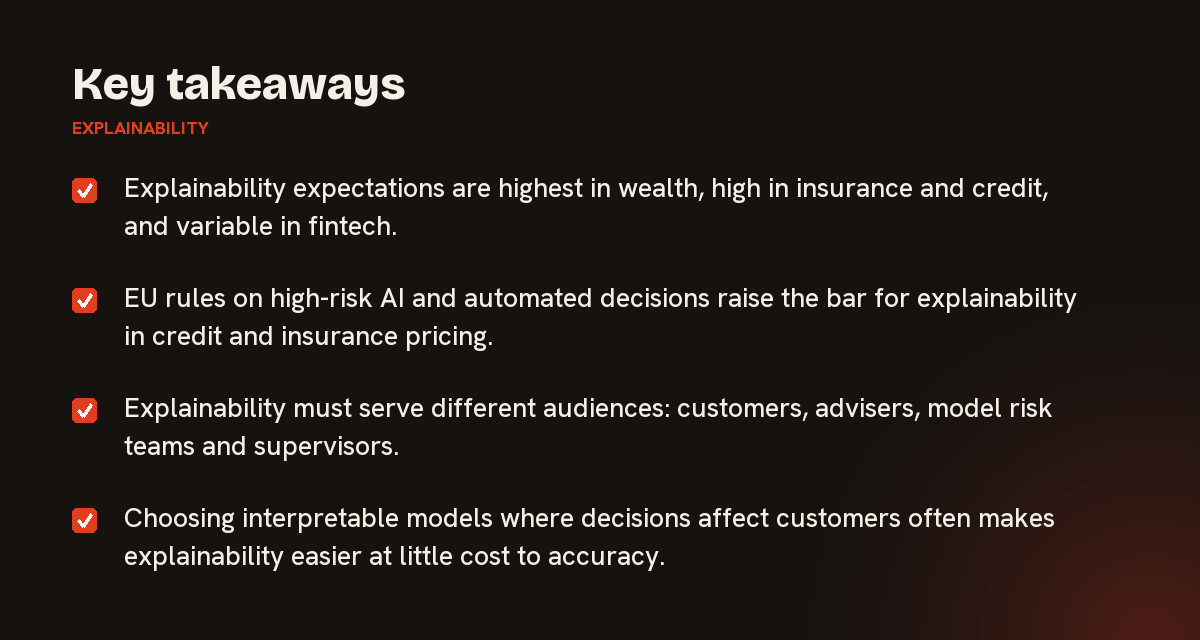
Key takeaways on explainability
- Explainability expectations are highest in wealth, high in insurance and credit, and variable in fintech.
- EU rules on high-risk AI and automated decisions raise the bar for explainability in credit and insurance pricing.
- Explainability must serve different audiences: customers, advisers, model risk teams and supervisors.
- Choosing interpretable models where decisions affect customers often makes explainability easier at little cost to accuracy.
For leadership teams, explainability is becoming a condition for using AI in the decisions that matter most. Setting clear standards by sector and use case lets institutions move faster where risk is low and act with care where customers are most affected.
Optimizium helps banks, insurers and wealth managers design AI and decision systems that can be explained and defended. We respect the model risk and actuarial expertise institutions already hold, because it is the foundation of good governance. And we bring compliance, legal and data protection colleagues into the design as co-authors, so transparency is built in from the first model.
Explore how we approach this across Banking, Insurance, Wealth Management and Beyond Banking, browse the FAQ Hub, or read the related question: How do digital channels create new data assets?
Related questions
On this page
Partner with the experts.
Let's discuss how Optimizium can accelerate your roadmap and navigate complex digital transformation.
Schedule a consultation →