Home › FAQ Hub › Why do advisory channels persist despite digitalisation?
Leadership, Change & Operating ModelsWhy do advisory channels persist despite digitalisation?
Advisory channels persist where financial products are complex, long-term or require personalised advice. Wealth management and insurance are the clearest examples: decisions carry a high cognitive load, involve long horizons and depend heavily on trust, which limits complete digital substitution.
For more than a decade, observers predicted that robo-advice and apps would replace financial advisers. Advisers are still here, and in many markets they remain the main route for important financial decisions. That persistence is not nostalgia.
Advisory channels persist where financial products are complex, long-term or require personalised advice. Wealth management and insurance are the clearest examples: decisions carry a high cognitive load, involve long horizons and depend heavily on trust, which limits complete digital substitution. Advisers provide guidance on suitability, risk tolerance and portfolio construction, and they help clients act sensibly at difficult moments, such as market falls or illness.
Digital tools have not removed the need for advisers; they have changed what advisers do. Technology increasingly augments advisers, improving efficiency and compliance, while clients handle simple tasks themselves. The result in most markets is a hybrid model rather than a contest between humans and machines.
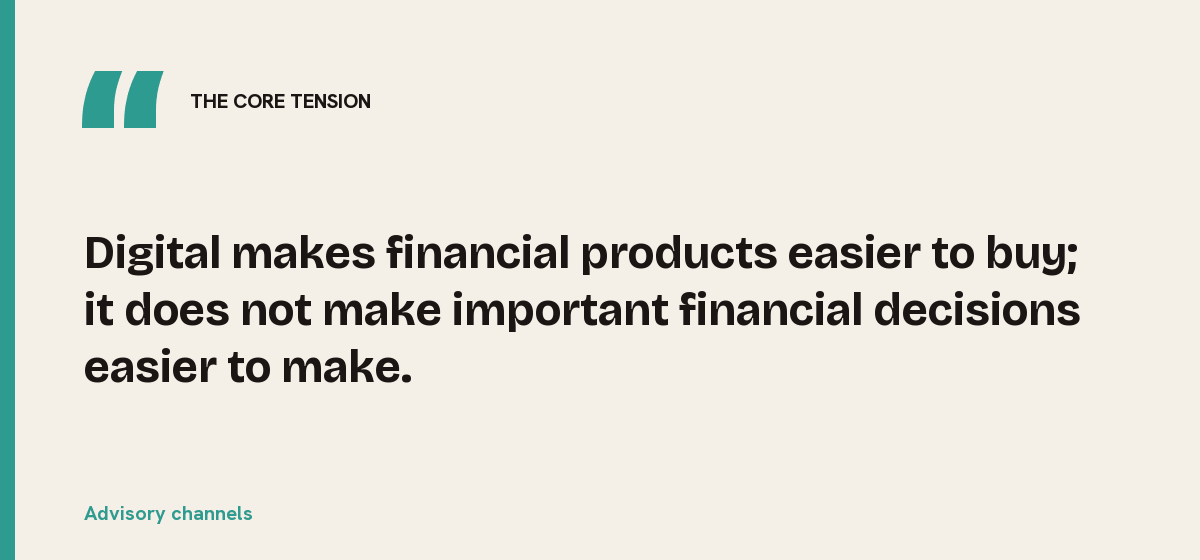
The core tension, in one line:
Digital makes financial products easier to buy; it does not make important financial decisions easier to make.
a client nearing retirement can see her pension and investments in an app, but deciding how to draw an income involves tax, longevity, risk and family considerations. She books a session with an adviser, who uses planning tools to model options and records the recommendation. The app handles everything else.
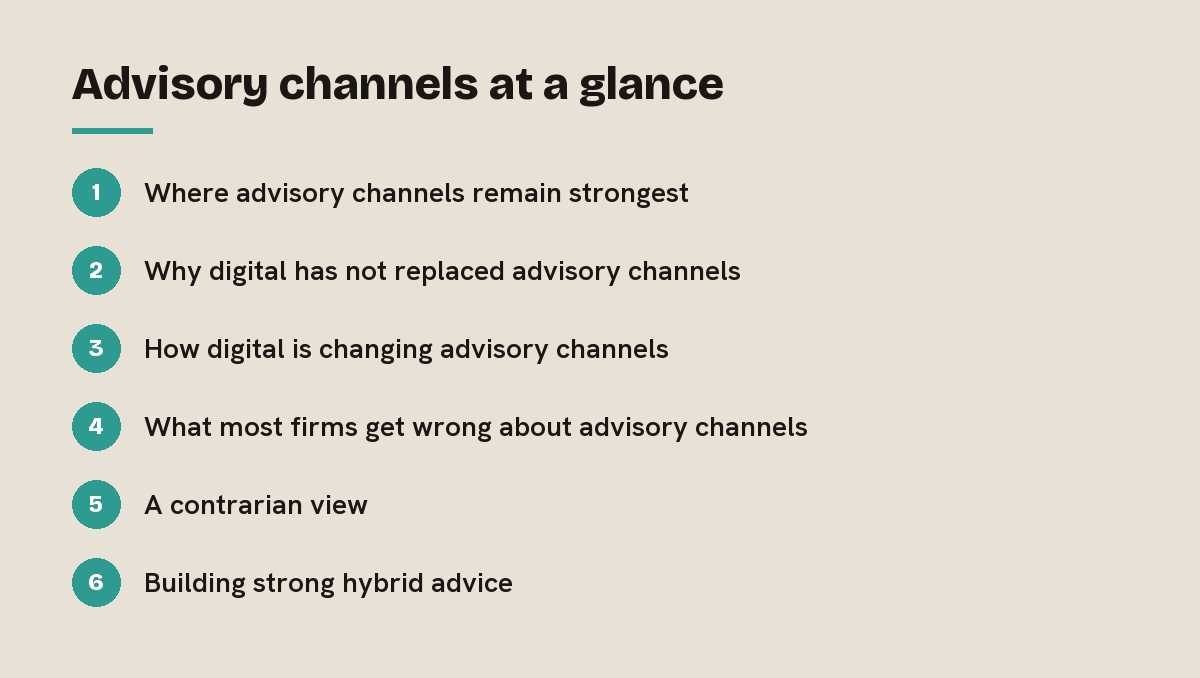
1. Where advisory channels remain strongest
| Situation | Why advice matters | Digital role |
|---|---|---|
| Retirement income | Long horizons, tax, irreversible choices | Modelling and reporting |
| Protection insurance | Health underwriting, complex needs | Quotes and applications |
| Complex investments | Risk understanding, suitability | Execution and monitoring |
| Life events | Emotional and financial complexity | Information and booking |
| Market stress | Behavioural support | Updates and explanation |
2. Why digital has not replaced advisory channels
- Cognitive load: many decisions involve trade-offs customers find hard to judge alone.
- Trust: customers want someone accountable when much is at stake.
- Regulation: suitability rules require careful assessment and records, which advisers provide.
- Behaviour: advisers help clients avoid costly mistakes, such as selling in a panic.
Customer preference supports this. EIOPA found that digital-only distribution channels still lag well behind physical or hybrid ones, especially for life insurance, where consumers prefer in-person meetings. In investment advice, ESMA’s guidelines on the MiFID II suitability requirements set out what must be gathered and assessed, a process that benefits from human judgement for complex cases.
3. How digital is changing advisory channels
| Before | Now |
|---|---|
| Advisers gather data by hand | Data captured digitally and pre-filled |
| Reports prepared manually | Reports generated automatically |
| Meetings for every request | Simple tasks handled in apps |
| Advice limited by adviser time | Advisers serve more clients with better tools |
4. What most firms get wrong about advisory channels
- Trying to replace advisers outright: pure digital advice works for simple needs, not for most complex ones.
- Building digital alongside, not with, advisers: disconnected apps create parallel channels and frustration.
- Ignoring adviser productivity: the biggest gains often come from removing administration.
- Neglecting younger clients: hybrid models can make advice accessible to those with smaller balances.
Example: a wealth manager launched a robo-advice service expecting it to replace advice for smaller clients. Many clients used it but still asked to speak to someone at key moments. The firm turned it into a hybrid service with optional adviser sessions, and both satisfaction and assets grew faster than in the purely digital model.
5. A contrarian view
The question is often framed as “will advisers survive digital?”. A better question is which parts of advice create value that technology cannot, and how to let advisers spend all their time there. Firms that answer it well make advisory channels more productive, not smaller.
6. Building strong hybrid advice
- Let clients self-serve for simple needs.
- Give advisers a complete digital view of each client.
- Automate suitability records and reporting.
- Design hand-overs between app and adviser carefully.
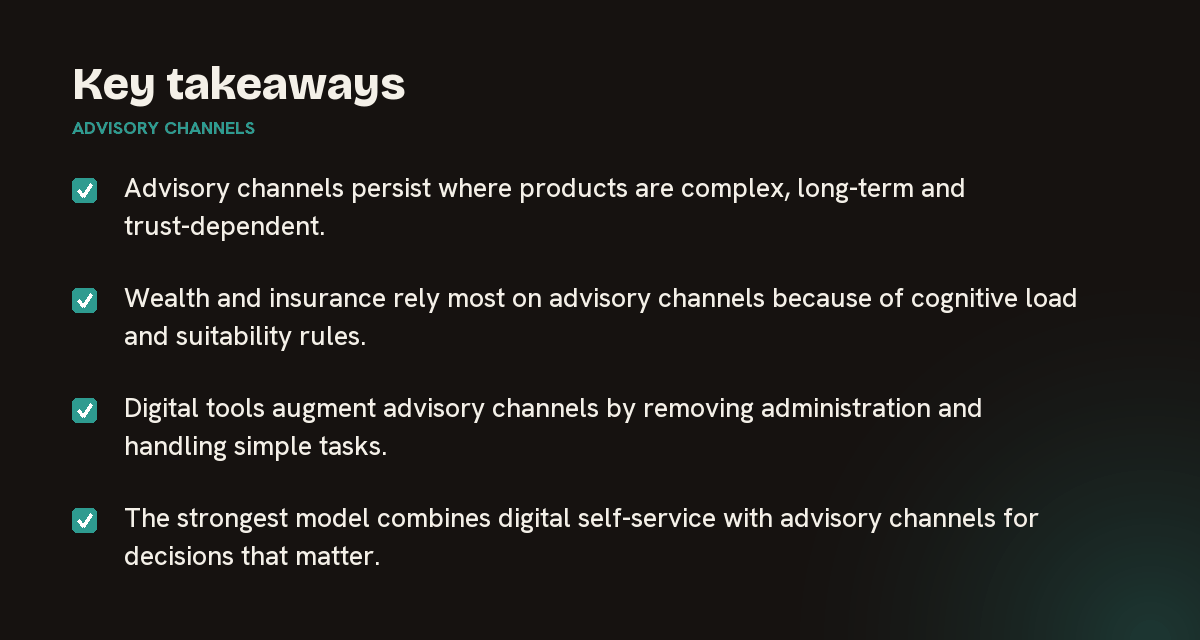
Key takeaways on advisory channels
- Advisory channels persist where products are complex, long-term and trust-dependent.
- Wealth and insurance rely most on advisory channels because of cognitive load and suitability rules.
- Digital tools augment advisory channels by removing administration and handling simple tasks.
- The strongest model combines digital self-service with advisory channels for decisions that matter.
For leadership teams in wealth and insurance, the future of advisory channels is hybrid. The firms that win will give clients digital convenience for simple needs and make their advisers more productive and better informed for the decisions that matter most.
Optimizium helps wealth managers, insurers and banks design hybrid advice models. We respect the judgement and relationships advisers bring, because they are central to client trust. And we bring compliance and risk colleagues into the design as co-authors, so hybrid advice is efficient and well evidenced.
Explore how we approach this across Wealth Management, Insurance and Banking, browse the FAQ Hub, or read the related question: Why do frontline and middle management often resist digital?
Related questions
On this page
Partner with the experts.
Let's discuss how Optimizium can accelerate your roadmap and navigate complex digital transformation.
Schedule a consultation →