Home › FAQ Hub › Why do most change strategies ignore channel economics?
Leadership, Change & Operating ModelsWhy do most change strategies ignore channel economics?
Most change strategies ignore channel economics because transformation is framed as a technology upgrade rather than as a rebalancing of profit and loss across branches, brokers, advisers, partners and direct digital channels. Programmes measure systems delivered and features launched, while the economics of each channel, acquisition cost, margin, cost to serve and retention, sit with finance teams that are rarely at the centre of design.
Transformation plans in financial services are full of technology roadmaps, operating model charts and customer journey maps. What they often lack is a clear view of how money is made and spent in each channel, and how that will change.
Most change strategies ignore channel economics because transformation is framed as a technology upgrade rather than as a rebalancing of profit and loss across branches, brokers, advisers, partners and direct digital channels. Programmes measure systems delivered and features launched, while the economics of each channel, acquisition cost, margin, cost to serve and retention, sit with finance teams that are rarely at the centre of design.
When channel economics are ignored, institutions can build digital journeys that cannibalise profitable channels without lowering total cost, or cut costly channels that quietly hold the most valuable customers. Good change strategies combine rigour with data and profit and loss by channel with the commercial judgement to know where serving customers in a more expensive way still pays.
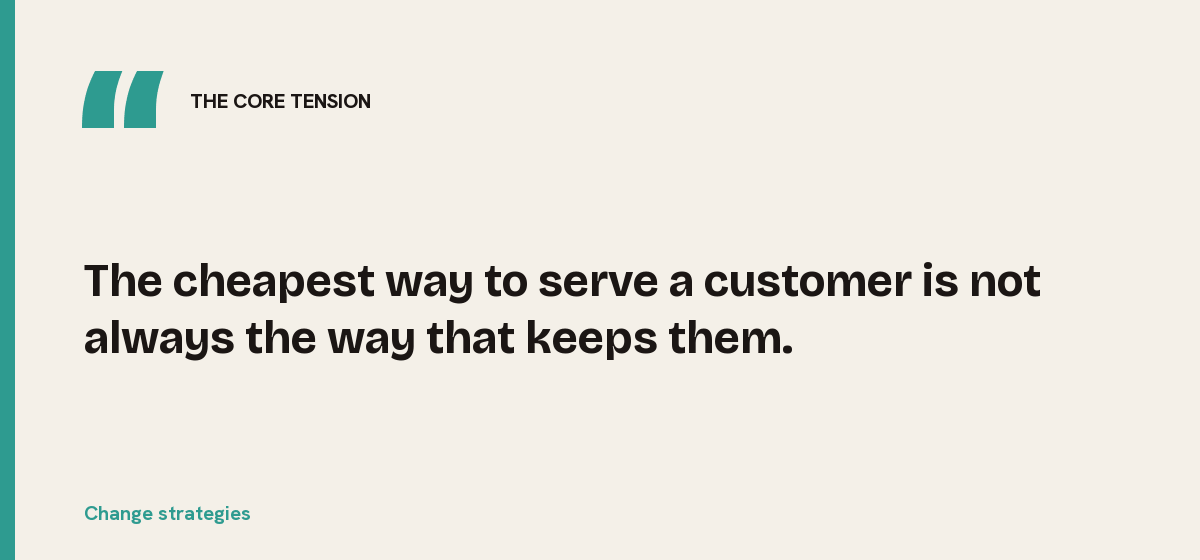
The core tension, in one line:
The cheapest way to serve a customer is not always the way that keeps them.
a bank plans to close branches to cut costs. Channel economics show that a small group of branch customers generate a large share of lending profit and rely on in-person advice. The bank keeps advisory hubs for that segment and moves routine transactions to digital, reducing costs without losing its most profitable relationships.
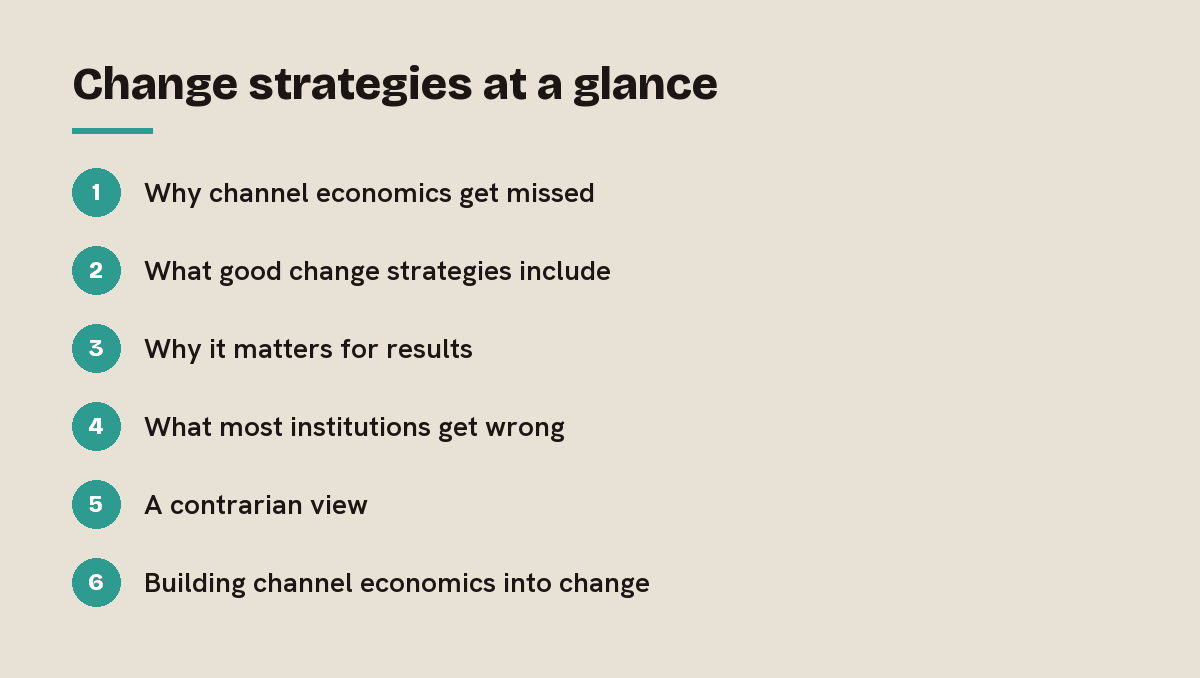
1. Why channel economics get missed
| Cause | What it looks like on the ground | Consequence |
|---|---|---|
| Technology framing | Programmes defined by systems and features | Benefits measured in outputs, not profit |
| Finance at the edge | P&L by channel not part of design | Decisions miss cost and margin effects |
| Siloed incentives | Channel teams measured separately | Nobody owns total relationship value |
| Short horizons | Savings targets for the next budget year | Long-term customer value ignored |
2. What good change strategies include
- P&L by channel and segment: acquisition cost, margin, cost to serve and retention for each channel.
- Customer migration scenarios: what happens to value when customers move between channels.
- Cannibalisation analysis: where digital will replace profitable channels and whether total cost falls.
- Commercial judgement: recognising where a more expensive channel still earns its place.
3. Why it matters for results
Large programmes have a poor track record. McKinsey’s research found that only 16 per cent of respondents said their digital transformations had improved performance and been sustained. Measurement is part of the problem: when the ECB surveyed 105 large banks, it found that almost all had a digital strategy, yet many lacked adequate indicators to steer it. Change strategies without channel economics lack the indicators that matter most.
| Channel | Main economic question |
|---|---|
| Branch | Which customers and products justify the cost? |
| Broker and adviser | Which business needs advice, and at what commission? |
| Direct digital | Does lower cost survive higher price comparison? |
| Partner and embedded | Is revenue sharing worth the reach? |
Channel mix also varies by sector. EIOPA found that digital-only distribution still lags well behind physical or hybrid channels in insurance, so channel economics there look very different from retail banking.
4. What most institutions get wrong
- Cutting costly channels without checking who uses them: valuable customers may leave with the channel.
- Building digital without a cost plan: new channels added on top of old ones raise total cost.
- Measuring digital success by adoption only: adoption without cost or revenue effects is incomplete.
- Leaving finance out of design: channel economics need finance and commercial teams in the room.
Example: an insurer’s change programme moved renewals online and celebrated high adoption. A later review showed brokers had lost renewal commissions on business they had originated, and several began moving clients elsewhere. Revisiting the economics, the insurer credited brokers for digital renewals of their clients, protecting the relationship and the book.
5. A contrarian view
Channel economics are often treated as a cost-cutting tool. Their bigger value is in protecting revenue: knowing which customers and channels create most of the profit lets institutions transform without losing what matters. Purely cost-led change strategies can win the budget year and lose the decade.
6. Building channel economics into change
- Put finance and commercial leaders in the design team from the start.
- Model customer migration and its effect on revenue and cost.
- Agree measures for each channel and for total relationship value.
- Revisit the economics as adoption and behaviour change.
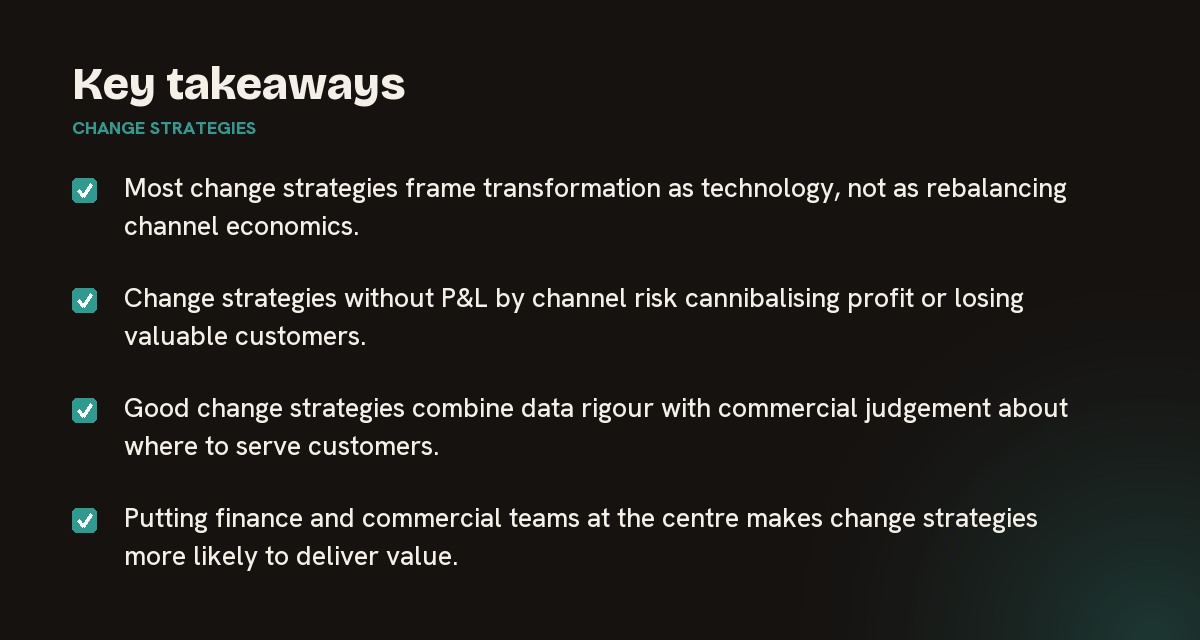
Key takeaways on change strategies
- Most change strategies frame transformation as technology, not as rebalancing channel economics.
- Change strategies without P&L by channel risk cannibalising profit or losing valuable customers.
- Good change strategies combine data rigour with commercial judgement about where to serve customers.
- Putting finance and commercial teams at the centre makes change strategies more likely to deliver value.
For leadership teams, adding channel economics to change strategies is one of the most valuable corrections available. It turns transformation from a technology programme into a deliberate reshaping of how the institution earns and serves.
Optimizium helps banks, insurers and wealth managers build change strategies grounded in channel economics. We respect the commercial knowledge of distribution and finance teams, because they understand where value really sits. And we bring risk and compliance into the design as co-authors, so economic choices remain fair to customers.
Explore how we approach this across Banking, Insurance, Wealth Management and Beyond Banking, browse the FAQ Hub, or read the related question: How does leadership maturity influence transformation outcomes?
Related questions
Partner with the experts.
Let's discuss how Optimizium can accelerate your roadmap and navigate complex digital transformation.
Schedule a consultation →