Home › FAQ Hub › Why is identity and access management (IAM) strategic?
Tech & Core ModernisationWhy is identity and access management (IAM) strategic?
Identity and access management is strategic because it underpins onboarding, authentication, authorisation, step-up security for risky actions and the management of consent.
Almost everything in financial services starts with two questions: who is this person, and what are they allowed to do? For years the answers were treated as a technical concern. Today they decide how fast customers can be onboarded, how safe each payment is and whether one customer can easily hold several products.
Identity and access management is strategic because it underpins onboarding, authentication, authorisation, step-up security for risky actions and the management of consent. A well-managed financial identity lets an institution recognise the same customer across every product and channel, which enables cross-sell, sharpens risk assessment and simplifies regulatory compliance.
When identity is fragmented, each product asks for the same details again, controls are duplicated and fraudsters find gaps between systems. That is why IAM has moved from a security layer to business infrastructure, and why new EU rules on digital identity and anti-money laundering raise its importance further.
The core tension, in one line:
The easier it is for a genuine customer to get in, the harder it must be for a fraudster, and the same identity layer has to achieve both.
a bank with accounts, cards, insurance and investments ran four separate identity systems. A customer adding insurance in the app had to verify themselves again. After unifying identity and consent, additional products could be taken out in minutes, and impersonation attempts were spotted earlier because signals were shared.
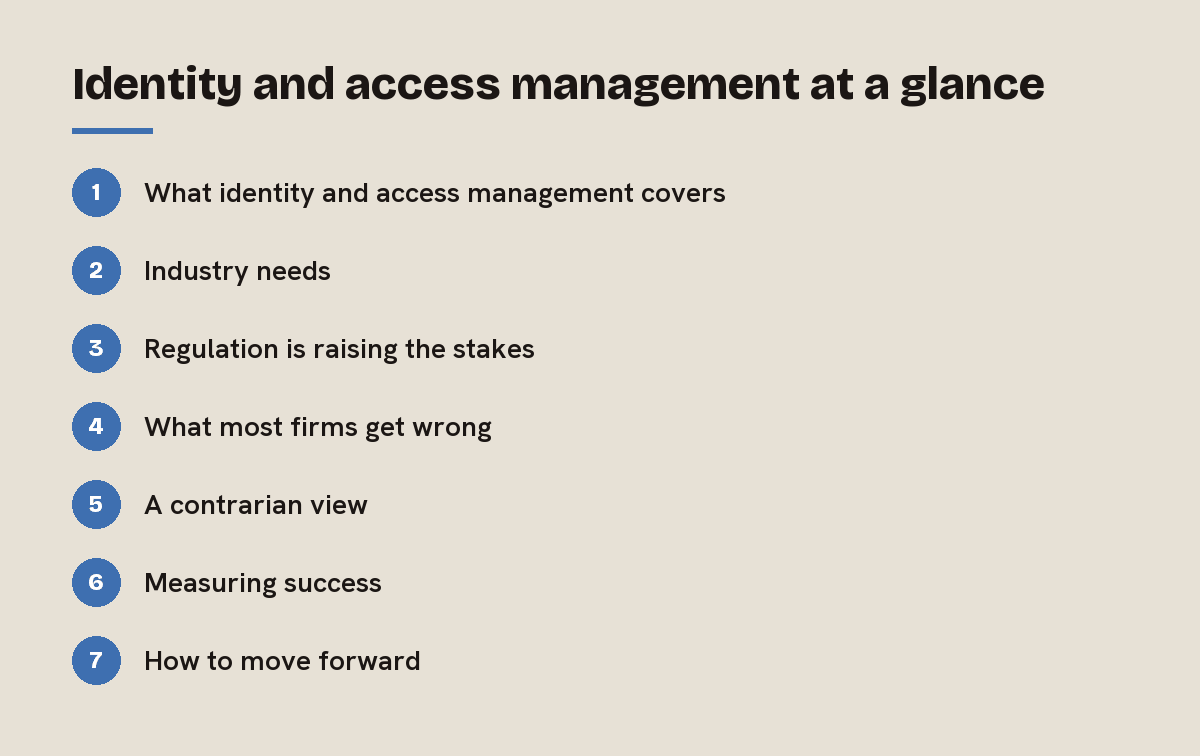
1. What identity and access management covers
| Function | What it looks like on the ground | Why it matters |
|---|---|---|
| Onboarding | Identity verification and due diligence | Speed of opening and compliance |
| Authentication | Secure login, biometrics, strong authentication | Protection against account takeover |
| Authorisation | What each customer, employee or partner may do | Control over transactions and data |
| Step-up security | Extra checks only when risk is high | Safety without needless friction |
| Consent | Permissions to use and share data | Trust and data protection compliance |
2. Industry needs
| Sector | Main identity need |
|---|---|
| Banking | Strong customer authentication for payments and access |
| Insurance | Reliable identity for underwriting and claims |
| Wealth | Investor classification and suitability |
| Fintech | Scalable onboarding and fraud prevention |
3. Regulation is raising the stakes
Two EU regulations make identity more strategic:
- European digital identity: the European Digital Identity Regulation requires private services that must use strong user authentication, explicitly including banking and financial services, to accept the European Digital Identity Wallet. Wallets are intended for legal persons as well as individuals.
- Anti-money laundering: the EU’s Anti-Money Laundering Regulation, applicable from 10 July 2027, creates a single rulebook for customer due diligence across Member States.
Institutions with modern identity and access management will absorb these changes quickly; those with identities scattered by product will have to adapt each one separately. Operational resilience matters too: identity platforms are critical systems under the Digital Operational Resilience Act, applicable since 17 January 2025.
4. What most firms get wrong
- One identity per product: each business line built its own, so the customer does not exist as a single person.
- Security that obstructs: repeating the same verification at every step frustrates customers without adding real protection.
- Forgetting employees and suppliers: internal and third-party access is a common route for attacks.
- Treating identity and access management as an IT project: without business owners, it is never used for cross-sell or customer experience.
Example: an insurer noticed that many fraudulent claims came from recently created accounts using partly real details. By linking its identity platform to fraud analytics and stepping up verification only for high-risk actions, it reduced claims fraud without adding steps for most customers.
5. A contrarian view
Identity is usually seen as a compliance cost. Designed well, it is a revenue enabler: it lets a customer add a second product in minutes, share data with permission for a better price and be recognised in any channel. Firms that manage identity as a commercial asset get far more from it than those that treat it only as an obligation.
6. Measuring success
Useful measures include the share of customers recognised as one identity across products, onboarding completion and time, authentication success at first attempt, account takeover and impersonation rates, and the time needed to add a product for an existing customer. Reported together, they show whether identity and access management is improving security and experience at the same time.
7. How to move forward
- Unify customer identity across products and channels.
- Use adaptive authentication, stepping up only when risk requires it.
- Make consent visible and revocable.
- Prepare to accept the EU Digital Identity Wallet.
- Bring internal and third-party access under the same governance model.
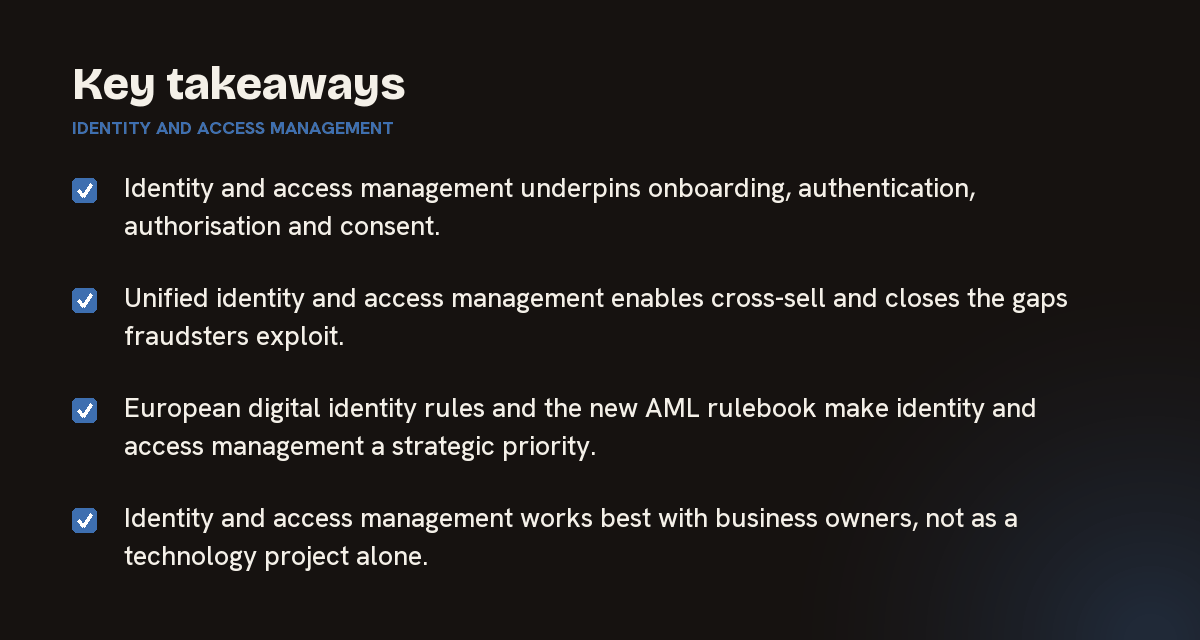
Key takeaways on identity and access management
- Identity and access management underpins onboarding, authentication, authorisation and consent.
- Unified identity and access management enables cross-sell and closes the gaps fraudsters exploit.
- European digital identity rules and the new AML rulebook make identity and access management a strategic priority.
- Identity and access management works best with business owners, not as a technology project alone.
For leadership teams, identity deserves the same attention as customer experience and cybersecurity, because it supports both. Decisions made now about how identity works across products will shape the speed of every digital initiative for years.
Optimizium helps banks, insurers and wealth managers turn identity into a strategic capability. We respect the expertise of fraud and financial crime teams, because they understand the real risks. And we bring security, risk and compliance colleagues into the design as co-authors, so identity becomes simpler for customers and safer at the same time.
Explore how we approach this across Banking, Insurance and Wealth Management, browse the FAQ Hub, or read the related question: How does wealth management differ from retail banking in digital strategy?
Partner with the experts.
Let's discuss how Optimizium can accelerate your roadmap and navigate complex digital transformation.
Schedule a consultation →